The asteroid that will pass closer than our satellites
Contents
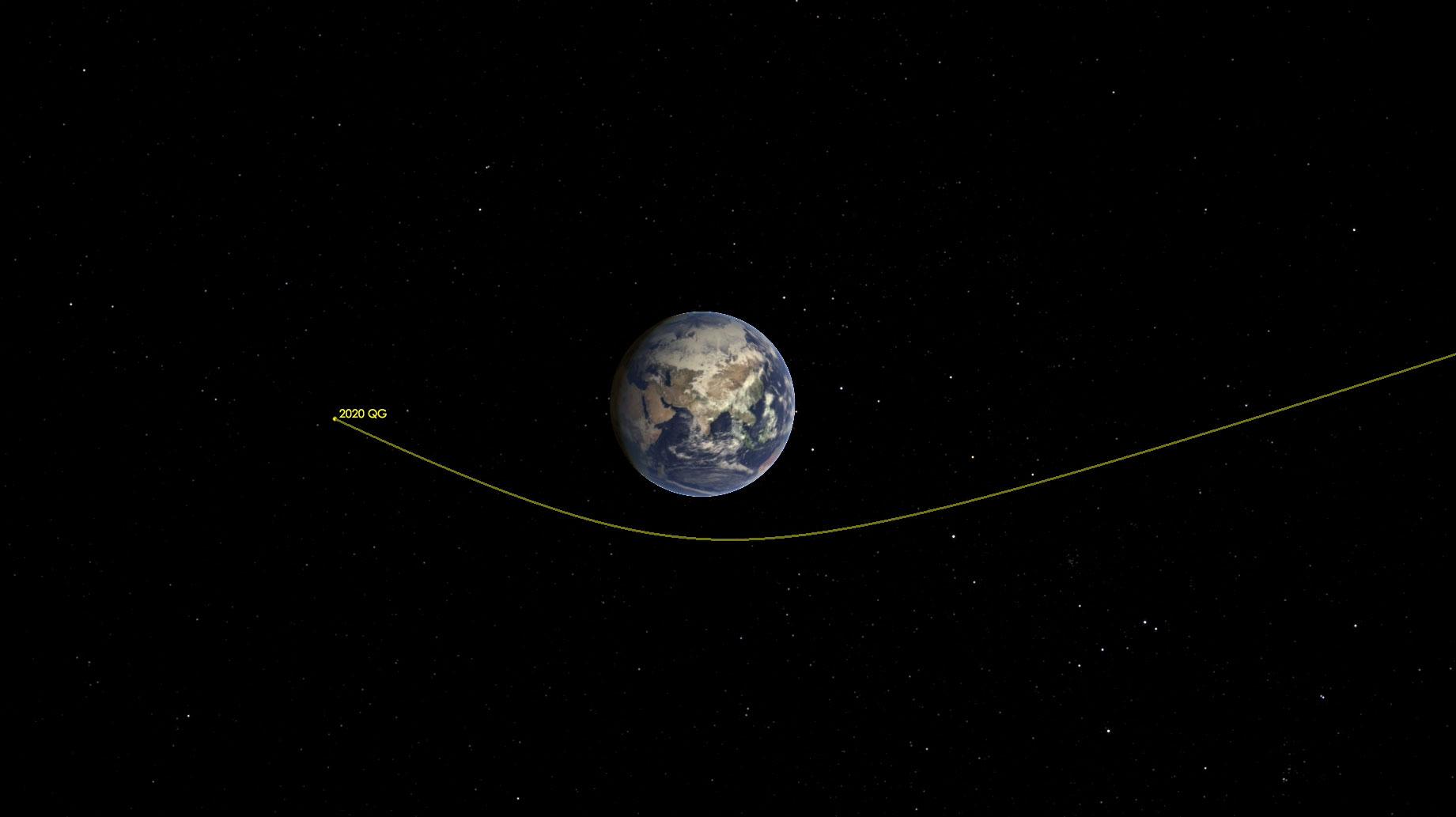
NASA/JPL-Caltech
Asteroid Characteristics
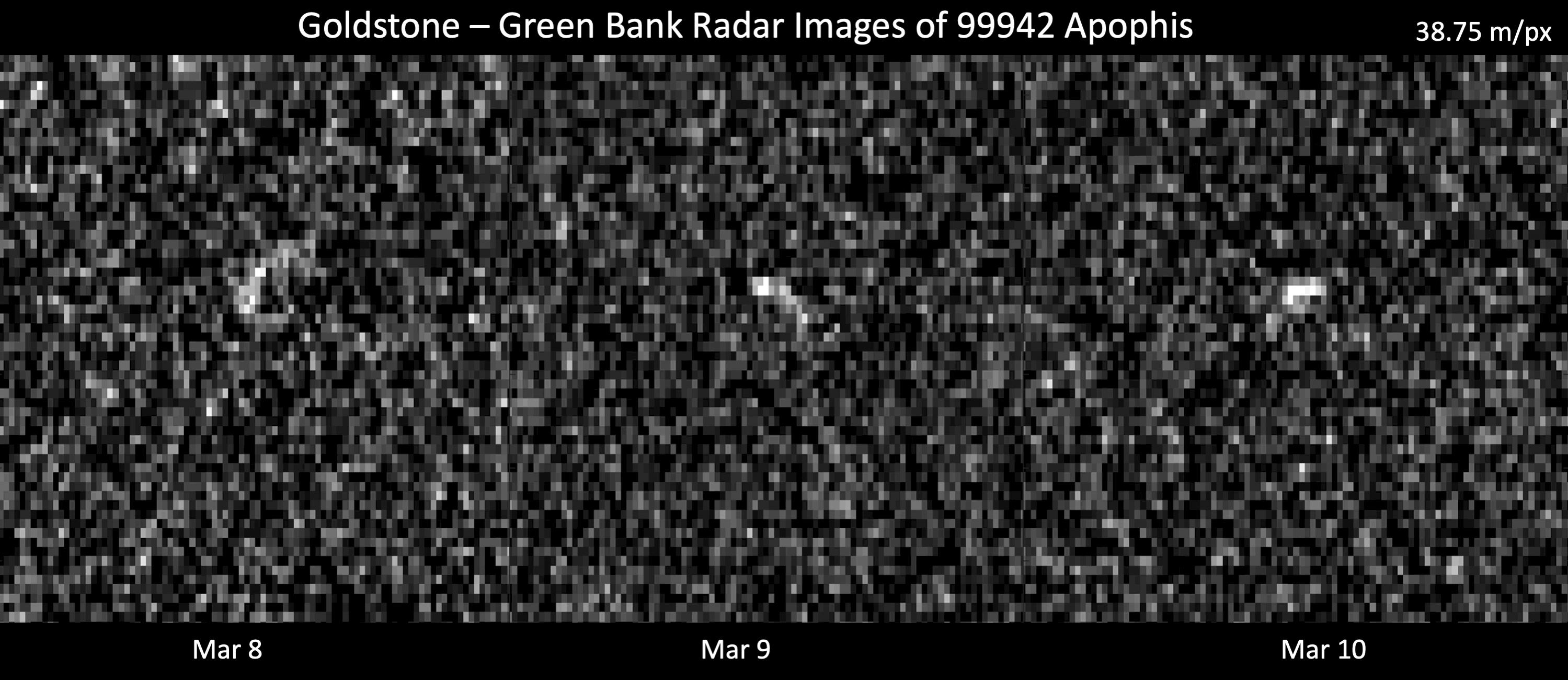
Goldstone radar images of Apophis, March 2021. NASA/JPL-Caltech
99942 Apophis is a near-Earth asteroid approximately 370 meters (1,210 feet) across — roughly the height of the Empire State Building. Classified as an Aten-group asteroid, it orbits the Sun every 323.6 days at a mean distance of 0.922 AU, spending most of its time inside Earth's orbit. Apophis was discovered on June 19, 2004, by astronomers Roy Tucker, David Tholen, and Fabrizio Bernardi at Kitt Peak National Observatory. It is named after Apep, the ancient Egyptian serpent deity of chaos and darkness — an adversary of the sun god Ra.
Near-Earth Asteroids
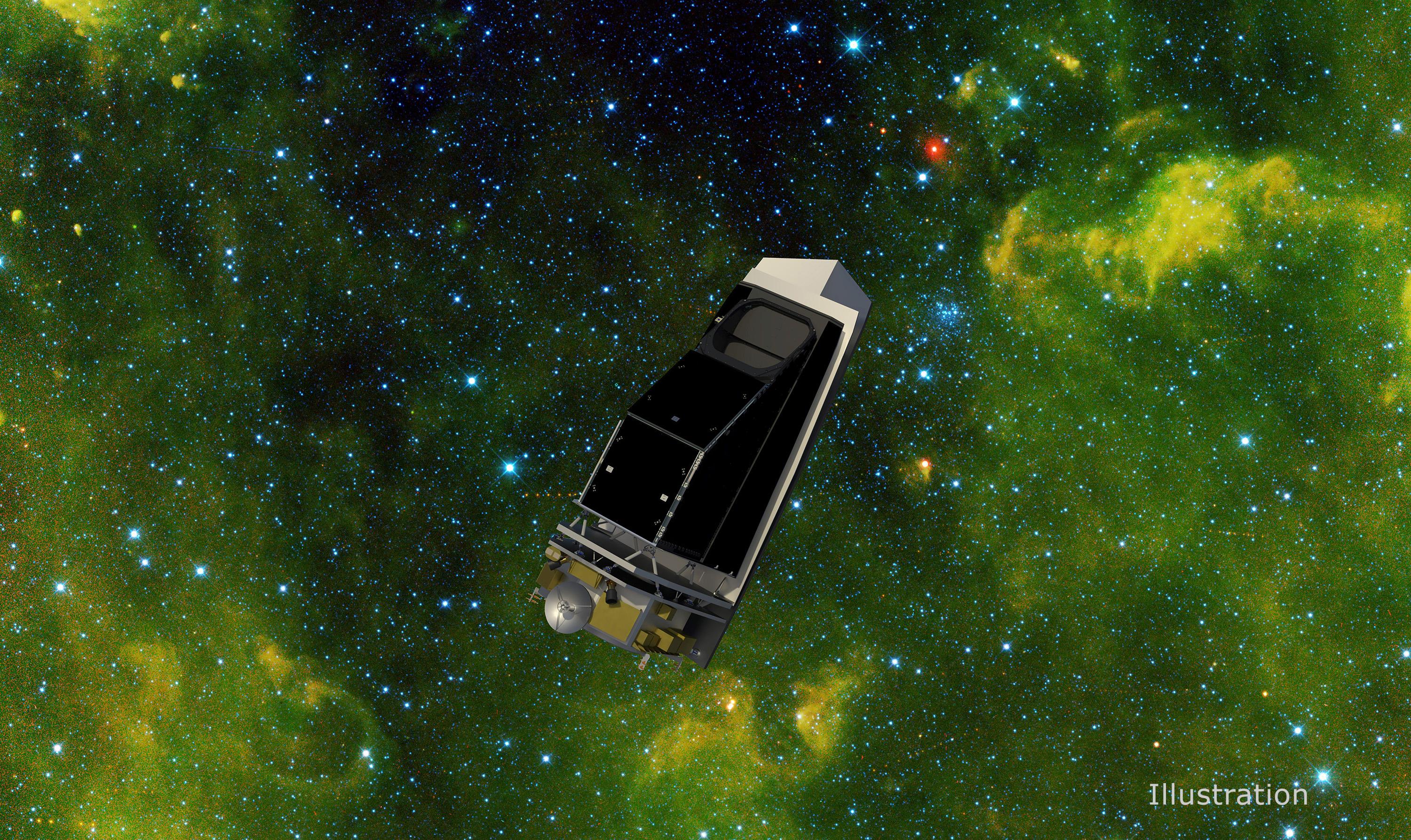
NASA's NEO Surveyor — the next generation of asteroid hunters. NASA/JPL-Caltech
Near-Earth asteroids (NEAs) are rocky remnants of the solar system's formation whose orbits bring them within 1.3 AU of the Sun. Over 35,000 NEAs have been cataloged to date, ranging from house-sized boulders to objects several kilometers across. Those larger than 140 meters that pass within 0.05 AU of Earth earn the designation Potentially Hazardous Asteroid (PHA) and are actively tracked by planetary defense programs worldwide. They are classified into three orbital families:
The 2029 Close Approach
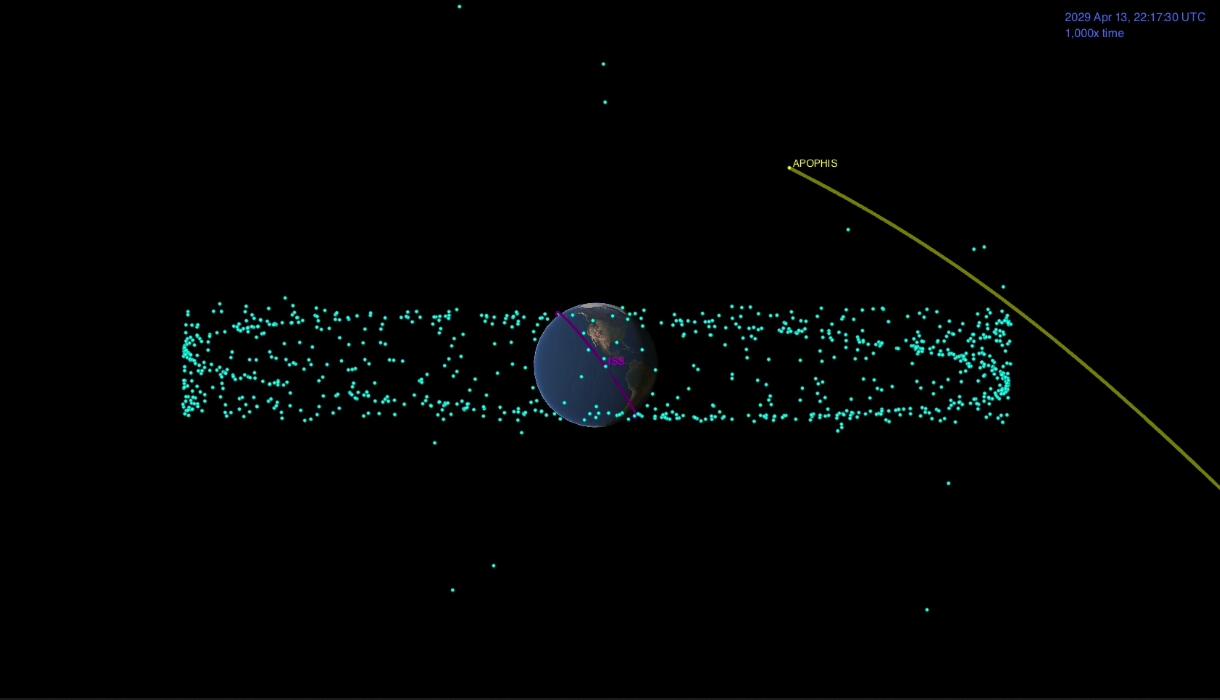
Apophis will pass inside the ring of geostationary satellites. NASA/JPL-Caltech
On Friday, April 13, 2029, Apophis will pass within approximately 31,600 km (19,600 miles) of Earth's surface — closer than the geostationary communication satellites orbiting at 35,786 km. For a brief window, the asteroid will be visible to the naked eye, reaching an apparent magnitude of about 3.1, comparable to the star Polaris. Observers in Europe, Africa, and western Asia will have the best views as it crosses the sky like a rapidly moving point of light.
Key Facts
The History of an Impact Scare
When Apophis was first tracked in 2004, initial orbit calculations gave it a 2.7% probability of striking Earth in 2029 — the highest impact probability ever recorded for an asteroid. For several tense weeks, the world faced the real possibility of a civilization-threatening impact. Additional observations steadily refined the orbit and eventually ruled out any collision — but the scare revealed both the power and the limits of our planetary surveillance.
What Scientists Will Learn
The 2029 flyby is an unprecedented opportunity for planetary science. No asteroid this large has ever been observed at such close range, and the encounter will yield data impossible to obtain any other way.
Kepler's Orbits and the Thinness of Safety
The Nightbase planetarium uses classical Keplerian two-body mechanics to propagate orbits — the elegant ellipses where each body responds only to the Sun's gravity. Under these simplified calculations, Apophis's predicted path results in a collision with Earth on nearly the same date that NASA's models predict the closest real-world encounter.
The difference between catastrophe and a safe flyby comes down to gravitational whispers from distant worlds — subtle nudges that only emerge when you account for every body pulling on every other.
The difference between impact and a safe flyby at 31,600 km comes down to gravitational perturbations from Jupiter, Venus, and the other planets — tiny tugs that accumulate over years and shift the trajectory by just enough. NASA's precise n-body simulations, which account for the pull of every significant mass in the solar system, resolve this hair-thin margin. It is a striking illustration of how delicate the conditions for life on Earth truly are. Our continued existence depends on the combined pull of the major bodies in the solar system. A slightly different Jupiter, a slightly shifted Venus — and the math tips from near-miss to extinction event.
Experience the Encounter
Watch the 2029 encounter unfold in real-time 3D. The planetarium jumps to March 2029 and follows Apophis as it sweeps past Earth — closer than our own communication satellites.
Launch Apophis TourSources & Credits
Orbital data: NASA/JPL Center for Near Earth Object Studies (CNEOS). Images: NASA/JPL-Caltech, public domain. Radar observations: Goldstone Deep Space Network, March 2021.
