Ceres

Properties
Position & Identifiers
Physical Properties
Orbital Properties
Observing Tips
Discovery
Current Ephemeris
Visibility
Set a location in User Settings to see visibility data.
About Ceres
Description
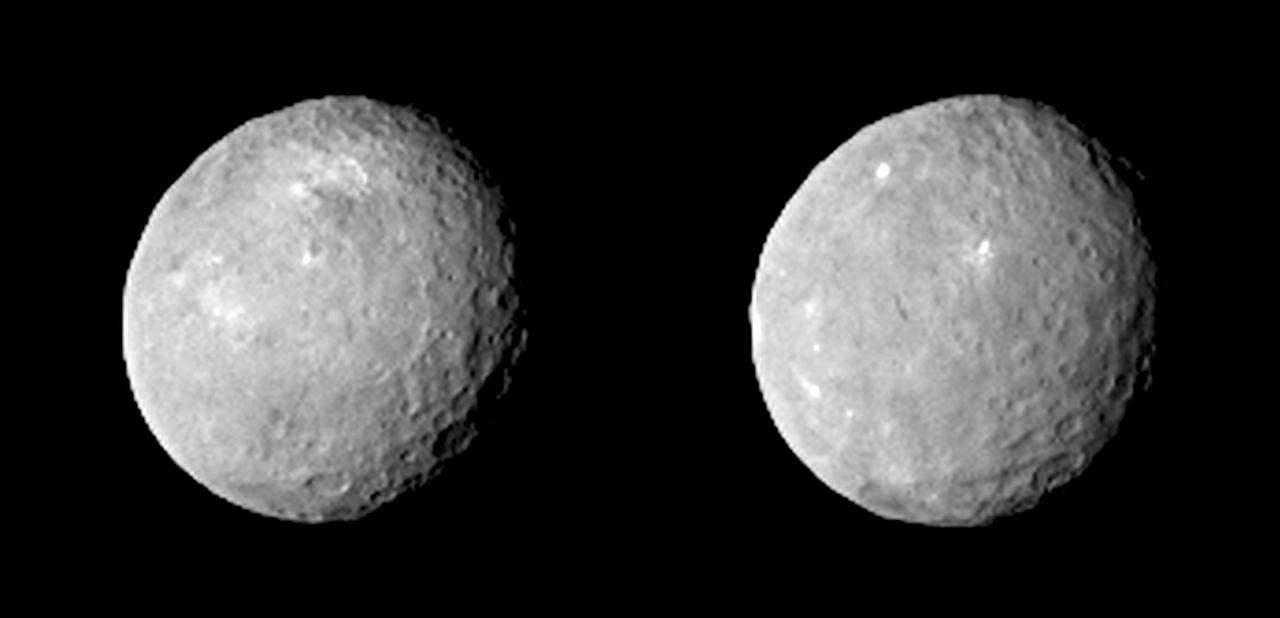
Ceres is the largest object in the asteroid belt and the only dwarf planet in the inner solar system, orbiting the Sun at 2.77 AU between Mars and Jupiter. With a diameter of 946 km, it contains roughly one-third of the total mass of the entire asteroid belt. Ceres is composed of a mixture of rock and water ice, with a thin outer crust, a possibly icy mantle, and a rocky core. Its surface is generally dark (albedo 0.09) but features over 300 bright spots — the most famous being the dazzling deposits in Occator Crater, which turned out to be sodium carbonate salts left by briny water that seeped up from a subsurface reservoir and evaporated.
Observing Tips
At opposition, Ceres reaches about magnitude 6.7 — just at the limit of naked-eye visibility under perfect conditions, but easily visible in binoculars. It appears as a star-like point; even in large amateur telescopes, its 0.84-arcsecond disk is too small to resolve. Like Pluto, the key to identifying Ceres is its motion — plot its position over several nights using a detailed chart and look for the 'star' that moves. Ceres travels through the zodiacal constellations and reaches opposition roughly every 15.5 months. Its brightness varies between magnitude 6.7 at the best oppositions and about magnitude 9.3 when farthest from Earth. A go-to mount with asteroid tracking makes finding it straightforward.
History
Ceres was the first asteroid ever discovered, found by Giuseppe Piazzi in Palermo, Sicily on January 1, 1801 — the very first night of the 19th century. Piazzi initially thought it was a comet, but its orbit revealed it as a new class of object orbiting between Mars and Jupiter, fulfilling the prediction of the Titius-Bode law. Ceres was considered a planet for about 50 years before being reclassified as an asteroid as more similar objects were found. In 2006, it was reclassified again as a dwarf planet. NASA's Dawn spacecraft orbited Ceres from 2015 to 2018, mapping its surface in detail and discovering the bright salt deposits in Occator Crater.
Fun Facts
Ceres may harbor a subsurface ocean of liquid water beneath its icy crust — the Dawn mission found evidence that briny water was still seeping to the surface in Occator Crater as recently as a few million years ago, and possibly even today. Ceres contains more fresh water than all of Earth's rivers and lakes combined. When it was first discovered, Ceres was called a planet — then an asteroid — then a dwarf planet, making it the only solar system body to have been reclassified twice.
Community Photos (1)
Credit: Justin Cowart. License: Public domain. (Wikimedia Commons)
Skybred Feb 28, 2026