Triton
Triton
Moon
Pisces
Visível
Nível 6
Professional/Research - Timing dependent

Propriedades
Magnitude
13.5
Tamanho Angular
0.1 arcmin
Type: Moon
Distance: 0.002 AU
Orbital Period: 5.9 days
Diameter: 2,707 km
Atmosphere: Thin nitrogen
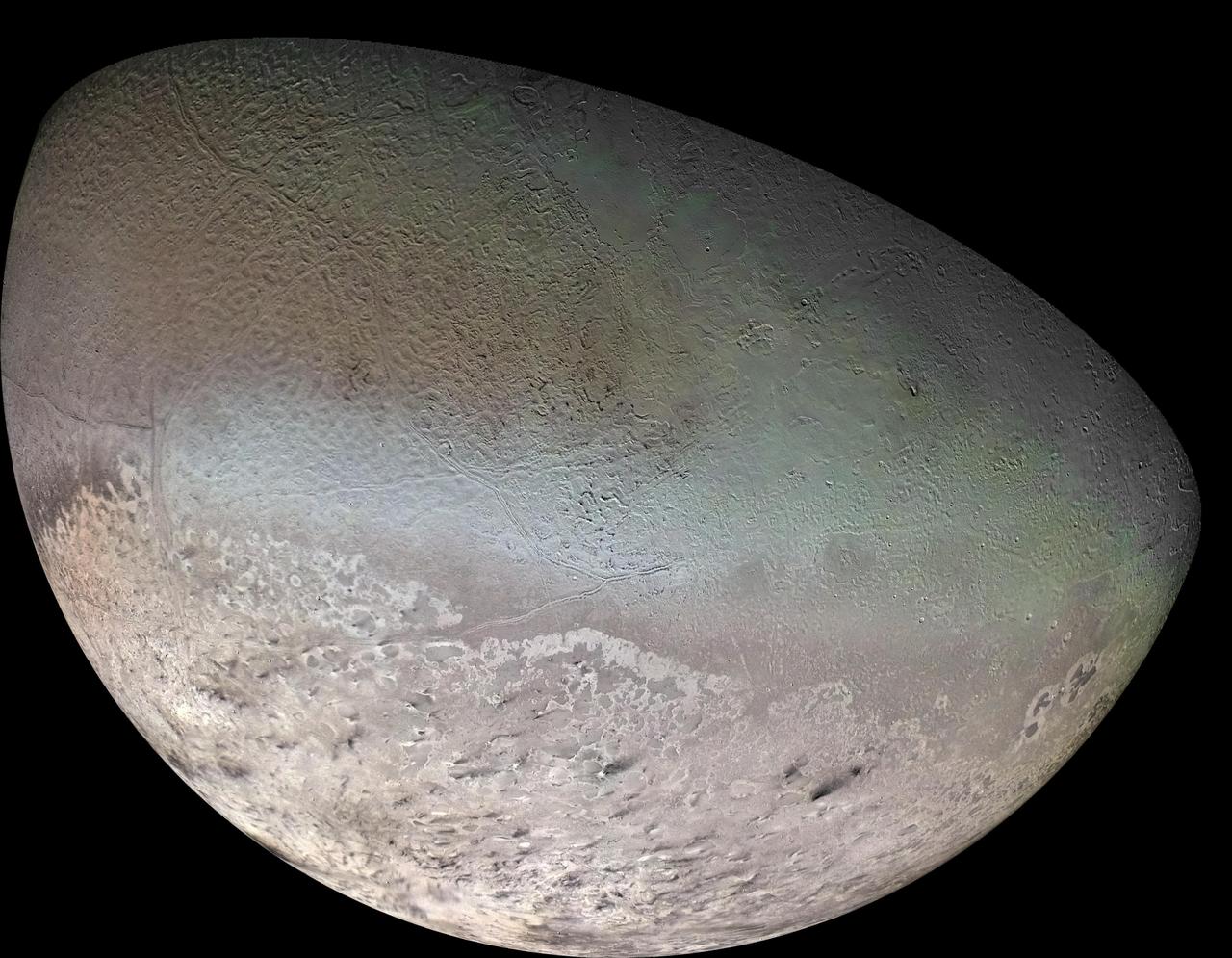
Features: Cantaloupe terrain, nitrogen geysers, polar caps
Largest moon of Neptune; retrograde orbit suggests it was captured from the Kuiper Belt. Nitrogen geysers observed by Voyager 2. Requires 10 inch telescope at high magnification.
Posição e Identificadores
RA
00h 08m 07.5s
Dec
-00° 32' 47.3"
Constelação
Pisces
Catálogo
Triton
Propriedades Físicas
Diâmetro
2,707 km
(0.21× Earth)
Massa
2.14e22 kg
Albedo
0.76
(76% reflected)
Temperatura
-240°C to -235°C
Rotação
5.9 days
Atmosfera
Thin nitrogen
Superfície
Cantaloupe terrain, nitrogen geysers, polar caps
Tamanho angular
0.1″ (current)
Propriedades orbitais
Semieixo maior
0.0024 AU
(354,697 km)
Excentricidade
0.0000
Inclinação
156.90°
Período orbital
5.9 days
Distância
30.875 AU
(4.28 light-hours)
Elongação
4.7°
Near Sun
Dicas de Observação
Melhores meses
August
, September
, October
Visibilidade
Telescope
Onde procurar
Near Neptune
Notas
Largest moon of Neptune; retrograde orbit suggests it was captured from the Kuiper Belt. Nitrogen geysers observed by Voyager 2. Requires 10 inch telescope at high magnification.
Corpo principal
Descoberta
Descoberto por
William Lassell
Data
1846-10-10
Efemérides atuais
30.875
AU from Earth
4.62B
km
0.1″
Tamanho angular
5°
Elongação
Visibilidade
Defina um local nas Configurações do Usuário para ver dados de visibilidade.
Fotos da Comunidade (1)
Credit: Michael T. Bland, U.S. Geological Survey (USGS). License: CC BY 4.0. (Wikimedia Commons)
Skybred Feb 28, 2026