Triton
Triton
Moon
Pisces
Visible
Niveau 6
Professional/Research - Timing dependent

Propriétés
Magnitude
13.5
Taille Angulaire
0.1 arcmin
Type: Moon
Distance: 0.002 AU
Orbital Period: 5.9 days
Diameter: 2,707 km
Atmosphere: Thin nitrogen
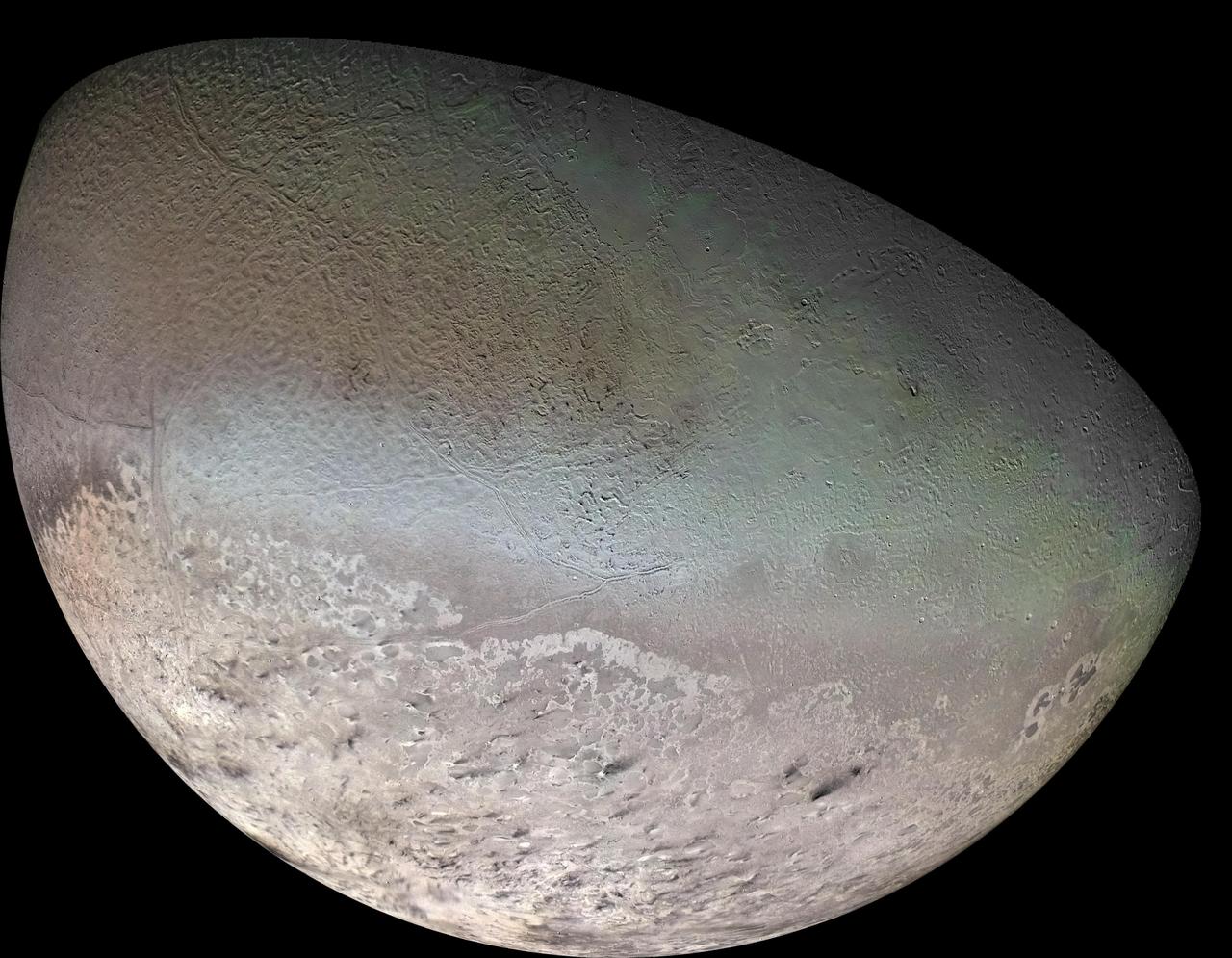
Features: Cantaloupe terrain, nitrogen geysers, polar caps
Largest moon of Neptune; retrograde orbit suggests it was captured from the Kuiper Belt. Nitrogen geysers observed by Voyager 2. Requires 10 inch telescope at high magnification.
Position et Identifiants
RA
00h 08m 08.7s
Dec
-00° 32' 41.1"
Constellation
Pisces
Catalogue
Triton
Propriétés Physiques
Diamètre
2,707 km
(0.21× Earth)
Masse
2.14e22 kg
Albédo
0.76
(76% reflected)
Température
-240°C to -235°C
Rotation
5.9 days
Atmosphère
Thin nitrogen
Surface
Cantaloupe terrain, nitrogen geysers, polar caps
Taille angulaire
0.1″ (current)
Propriétés orbitales
Demi-grand axe
0.0024 AU
(354,697 km)
Excentricité
0.0000
Inclinaison
156.90°
Période orbitale
5.9 days
Distance
30.875 AU
(4.28 light-hours)
Élongation
4.8°
Near Sun
Conseils d'Observation
Meilleurs mois
August
, September
, October
Visibilité
Telescope
Où chercher
Near Neptune
Notes
Largest moon of Neptune; retrograde orbit suggests it was captured from the Kuiper Belt. Nitrogen geysers observed by Voyager 2. Requires 10 inch telescope at high magnification.
Corps parent
Découverte
Découvert par
William Lassell
Date
1846-10-10
Éphémérides actuelles
30.875
AU from Earth
4.62B
km
0.1″
Taille angulaire
5°
Élongation
Visibilité
Définissez un site dans les Paramètres Utilisateur pour voir les données de visibilité.
Photos de la Communauté (1)
Credit: Michael T. Bland, U.S. Geological Survey (USGS). License: CC BY 4.0. (Wikimedia Commons)
Skybred Feb 28, 2026