Vesta

Properties
Position & Identifiers
Physical Properties
Orbital Properties
Observing Tips
Discovery
Current Ephemeris
Visibility
Set a location in User Settings to see visibility data.
About Vesta
Description
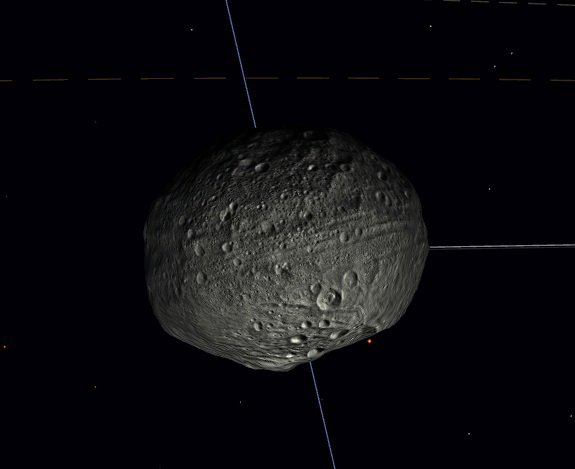
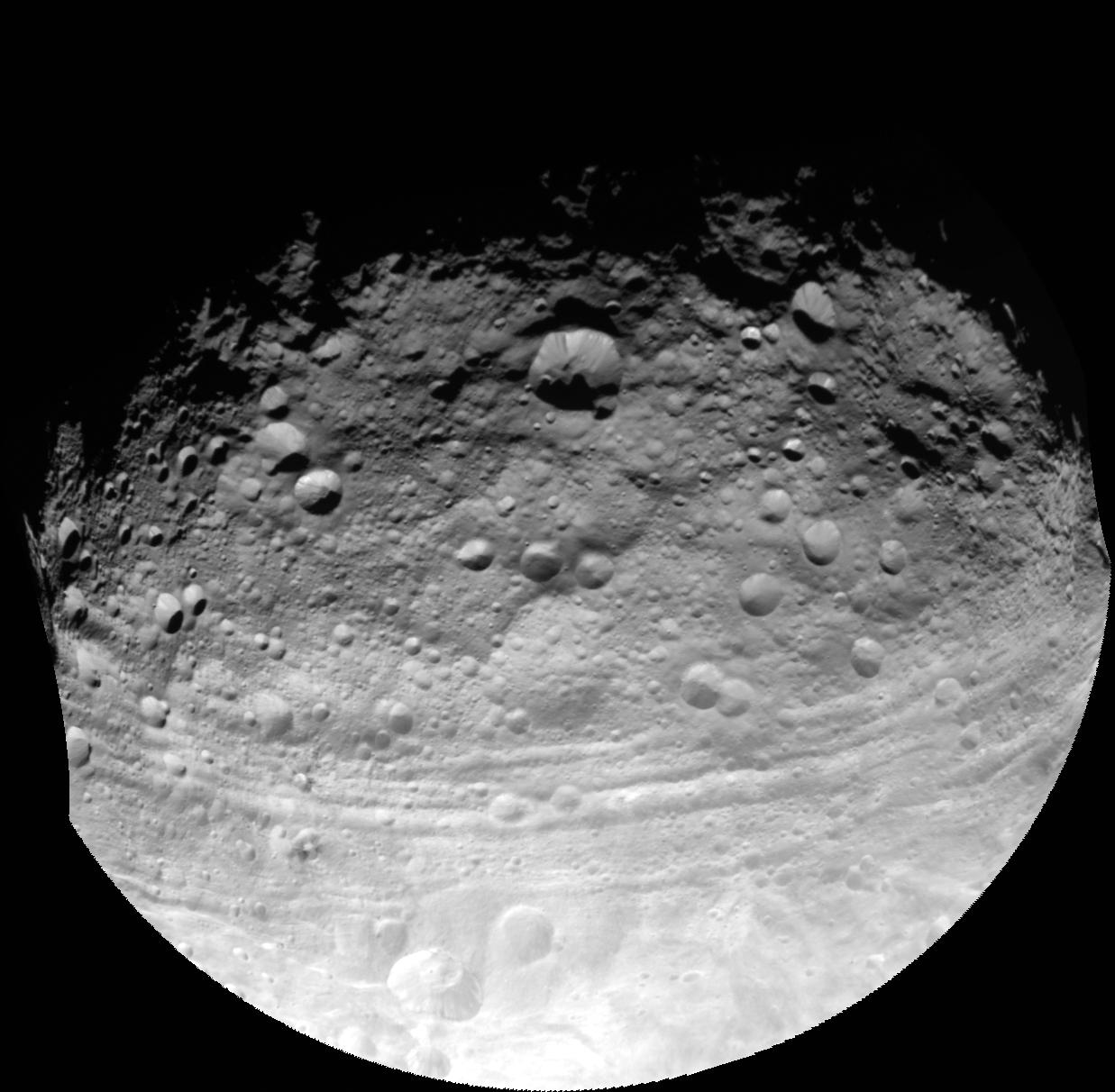
Vesta is the second-largest object in the asteroid belt and the brightest asteroid visible from Earth, orbiting the Sun at 2.36 AU between Mars and Jupiter. With a diameter of 525 km, it is a differentiated body with an iron-nickel core, a rocky mantle, and a basaltic crust — making it more like a small planet than a typical asteroid. Vesta's surface is dominated by the enormous Rheasilvia impact basin near its south pole, a 505 km wide crater with a central peak rising 22 km — one of the tallest mountains in the solar system. This catastrophic impact blasted roughly 1% of Vesta's volume into space, creating a family of smaller asteroids (Vestoids) and most of the HED meteorites found on Earth. Vesta's high albedo of 0.42 — brighter than any other large asteroid — is due to its basaltic surface composition.
Observing Tips
Vesta is the only asteroid that can be seen with the naked eye under ideal conditions, reaching magnitude 5.1 at favorable oppositions. Through binoculars it appears as a bright star-like point, easily found with a good finder chart. At typical oppositions it shines between magnitude 5.4 and 6.5 — always an easy binocular object. Like other asteroids, it reveals itself through its nightly motion against the background stars: plot its position over two or three consecutive nights and the moving 'star' is Vesta. Oppositions occur roughly every 15.5 months. A go-to telescope with asteroid tracking makes finding it straightforward, but even manual star-hopping works well given its brightness. No amateur telescope can resolve its disk, which spans only about 0.6 arcseconds.
History
Vesta was discovered on March 29, 1807 by German astronomer Heinrich Wilhelm Olbers, making it the fourth asteroid found after Ceres, Pallas, and Juno. It was named after the Roman goddess of the hearth and home. For nearly two centuries, Vesta was studied only from afar, but the Hubble Space Telescope revealed its shape and major surface features in the 1990s. NASA's Dawn spacecraft entered orbit around Vesta in July 2011 and spent 14 months mapping its surface in unprecedented detail, confirming its differentiated structure and the massive scale of the Rheasilvia impact before departing for Ceres in 2012.
Fun Facts
Vesta is the source of about 6% of all meteorites that fall on Earth — the HED (Howardite-Eucrite-Diogenite) meteorites blasted off by the Rheasilvia impact. It is the only asteroid with a confirmed differentiated interior, essentially making it a surviving protoplanet from the solar system's formation 4.5 billion years ago. At its brightest, Vesta outshines Uranus and can theoretically be spotted without optical aid.