Sky Digest
Export Sky Digest PDF
Include finder charts for selected objects:
Tonight at a Glance
Bright moon tonight — best deep-sky viewing after moonset (06:25)
Planet Highlights
Comets
For Beginners (naked eye)
Binocular Targets
Small Scopes (3–6 inch)
Big Scopes (8–12 inch)
The Week Ahead
| Wed | Thu | Fri | Sat | Sun | Mon | Tue |
| 🌔 90% | 🌔 96% | 🌕 99% | 🌕 100% | 🌕 97% | 🌖 92% | 🌖 85% |
| — | — | — | — | — | — | — |
NASA Astronomy Picture of the Day
HH-222: The Waterfall Nebula
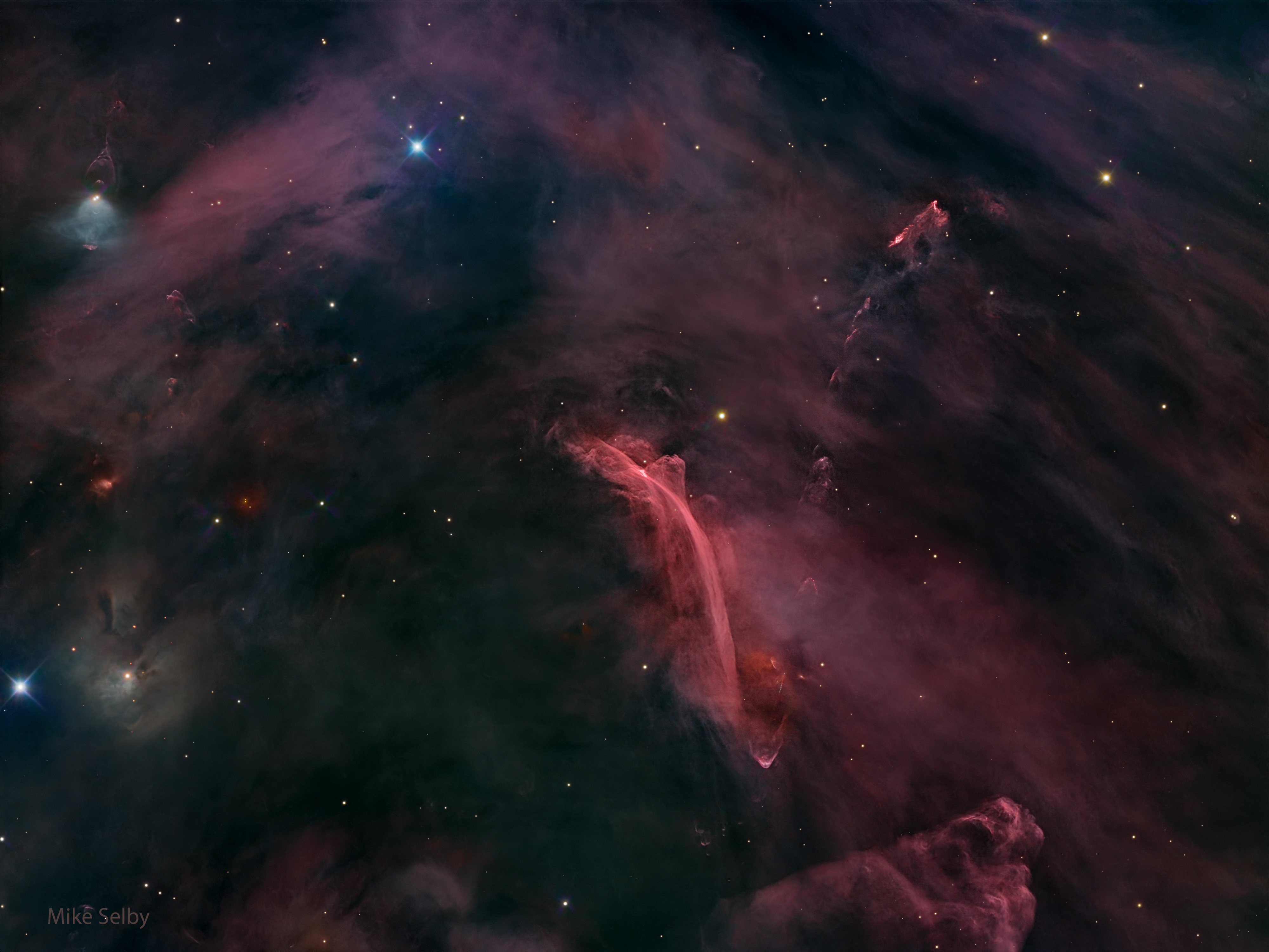
What created the Waterfall Nebula? The origin is still being researched. The structure, officially designated Herbig-Haro 222, appears in the region of NGC 1999 in the Great Orion Molecular Cloud complex. The elongated gaseous stream stretches about ten light years but appears similar to a long waterfall on Earth. Recent observations indicate that HH-222 is likely a gigantic gaseous bow shock, similar to a wave of water caused by a fast-moving ship. The origin of this shock wave is thought to be a jet outflow from the multiple star system V380 Orionis off the lower left of the frame. Therefore, gas does not flow along the waterfall, but rather the entire structure moves toward the upper right. The Waterfall Nebula lies about 1,500 light years away toward the constellation of Orion. The featured image was captured earlier this month from El Sauce Observatory in Chile. Jigsaw Nebula: Astronomy Puzzle of the Day
Image credit: Mike Selby — APOD is a service of NASA and Michigan Tech. U.
View on NASA APODSpace News
NASA introduces the Artemis II crew of four astronauts (Reid Wiseman, Victor Glover, Christina Koch, and Jeremy Hansen) who will fly around the Moon on humanity's first crewed lunar mission in over 50 years.
NASA — 30 Mar 2026
NASA awards Intuitive Machines $180.4 million to deliver science payloads to the lunar surface through the Commercial Lunar Payload Services initiative, supporting Artemis exploration objectives.
NASA — 27 Mar 2026
NASA releases the launch countdown for Artemis II, targeting no earlier than April 1, 2026, to send four astronauts on a 10-day mission around the Moon and back to Earth.
NASA — 26 Mar 2026
Europe's Service Module will provide critical propulsion, power, and life support systems for the Artemis II mission, highlighting international partnership in lunar exploration.
ESA — 27 Mar 2026
Plan your session before dark
Use Tonight to find targets, then add them to a Plan so you have a checklist ready when you're outside.
Open TonightSign in to get this digest by email and customize it for your location.