Sky Digest
Export Sky Digest PDF
Include finder charts for selected objects:
Tonight at a Glance
Bright moon tonight — best deep-sky viewing before moonrise (21:27)
Planet Highlights
Comets
For Beginners (naked eye)
Binocular Targets
Small Scopes (3–6 inch)
Big Scopes (8–12 inch)
The Week Ahead
| Wed | Thu | Fri | Sat | Sun | Mon | Tue |
| 🌖 77% | 🌖 68% | 🌖 58% | 🌗 48% | 🌗 39% | 🌗 30% | 🌘 22% |
| — | — | — | — | — | — | — |
NASA Astronomy Picture of the Day
Simeis 147: The Spaghetti Nebula Supernova Remnant

Its popular nickname is the Spaghetti Nebula. Officially cataloged as Simeis 147 and Sharpless 2-240, it is easy to get lost following the looping and twisting filaments of this intricate supernova remnant. Seen toward the boundary of the constellations of the Bull (Taurus) and the Charioteer (Auriga), the impressive gas structure covers nearly 3 degrees on the sky, equivalent to 6 full moons. That's about 150 light-years at the stellar debris cloud's estimated distance of 3,000 light-years. The supernova remnant has an estimated age of about 40,000 years, meaning light from this powerful stellar explosion first reached the Earth when woolly mammoths roamed free. Besides the expanding remnant, this cosmic catastrophe left behind a pulsar, a fast-spinning neutron star that is the remnant of the original star's core. The featured image was captured last month from Forca Canapine, Italy. Portal Universe: Random APOD Generator
Image credit: Saverio Ferretti — APOD is a service of NASA and Michigan Tech. U.
View on NASA APODSpace News
NASA awarded Intuitive Machines $180.4 million to deliver science payloads to the lunar surface as part of the CLPS initiative supporting the Artemis program, advancing human return to the Moon.
NASA — 27 Mar 2026
NASA selected 10 scientists to develop the science plan for Artemis astronauts on the lunar surface, including instrument deployment, observations, and Moon rock collection.
NASA — 27 Mar 2026
NASA released the launch countdown schedule for Artemis II, the first crewed mission to send four astronauts around the Moon, targeting no earlier than April 1.
NASA — 26 Mar 2026
Europe's Service Module, providing propulsion, power, and life support, is a critical component enabling the Artemis II mission to send astronauts around the Moon and return them safely.
ESA — 27 Mar 2026
Never Miss a Meteor Shower
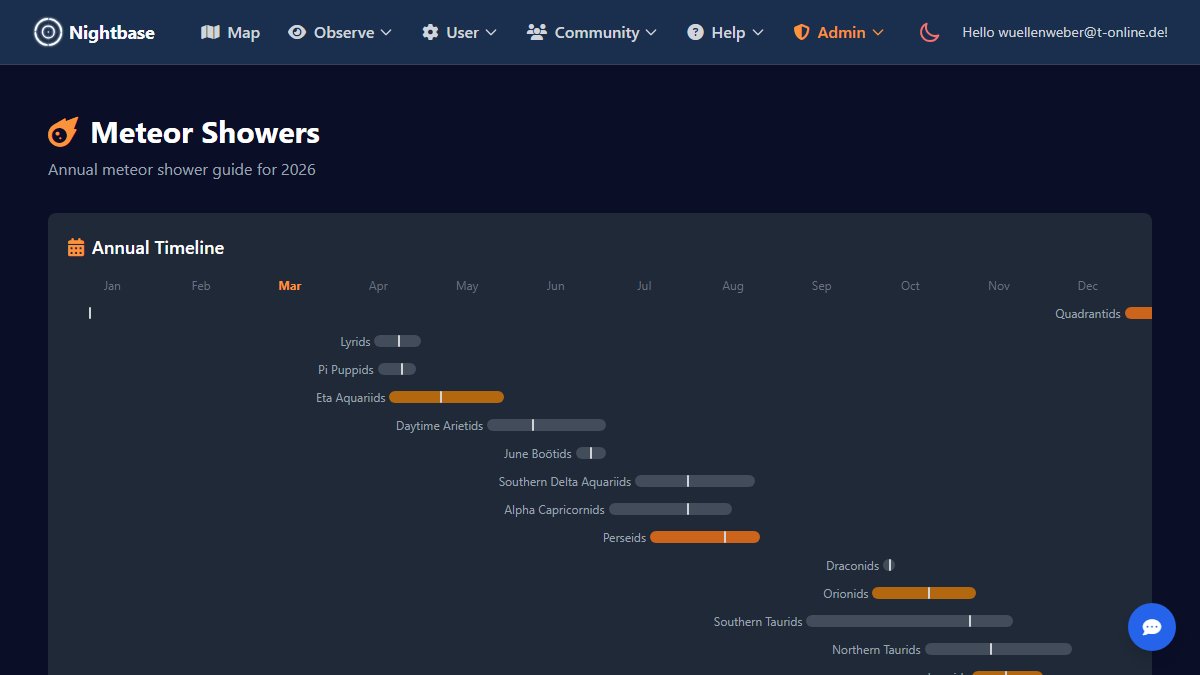
A complete calendar of annual meteor showers with peak dates, hourly rates, moon interference, and radiant positions. Plan ahead and know exactly when to look up.
 Open Meteor Showers
Sign in to get this digest by email and customize it for your location.