Sky Digest
Export Sky Digest PDF
Include finder charts for selected objects:
Tonight at a Glance
Bright moon tonight — best deep-sky viewing before moonrise (23:57)
Aurora Forecast — Very unlikely
Geomagnetic activity far below the Kp 7 needed at your latitude.
View full forecastPlanet Highlights
Comets
For Beginners (naked eye)
Binocular Targets
Small Scopes (3–6 inch)
Big Scopes (8–12 inch)
The Week Ahead
| Fri | Sat | Sun | Mon | Tue | Wed | Thu |
| 🌖 58% | 🌗 48% | 🌗 39% | 🌗 30% | 🌘 22% | 🌘 14% | 🌘 8% |
| — | — | — | — | — | — | — |
NASA Astronomy Picture of the Day
Ice Halos by Moonlight and Sunlight

Both Moon and Sun create beautiful ice halos in planet Earth's sky. In fact, the two brightest celestial beacons are each surrounded by a complex of ice halos in these photos of the sky above Chamonix-Mont-Blanc in France. The panels were recorded one night (left) and the following day at the end of December 2025. Similar ice halos appear in moonlight and sunlight because they are all formed through the geometry of flat, hexagonal ice crystals. The ice crystals reflect and refract light as they flutter in the cold atmosphere above the mountain resort. In the pictures both Moon and Sun are surrounded by a more commonly seen 22 degree circular halo. Bright and sometimes colorful patches at the intersections of the 22 degree circular halos with the indicated parselenic and parhelic arcs are also known as Moon dogs and Sun dogs. (Editor's note: Annotations updated by Marcella Pace)
Image credit: ice halos — APOD is a service of NASA and Michigan Tech. U.
View on NASA APODSpace News
NASA awards Intuitive Machines $180.4 million to deliver seven science payloads to the lunar surface as part of the Commercial Lunar Payload Services initiative supporting the Artemis program.
NASA — 27 Mar 2026
NASA selects 10 participating scientists to develop a science plan for Artemis astronauts to execute on the lunar surface, including instrument deployment and sample collection.
NASA — 27 Mar 2026
NASA releases the launch countdown for Artemis II, targeting no earlier than April 1, 2026, for the crewed mission that will take four astronauts around the Moon.
NASA — 26 Mar 2026
Europe's Service Module will provide critical propulsion, power, and life support systems for the Artemis II crewed lunar mission, highlighting international collaboration.
ESA — 27 Mar 2026
Never Miss a Meteor Shower
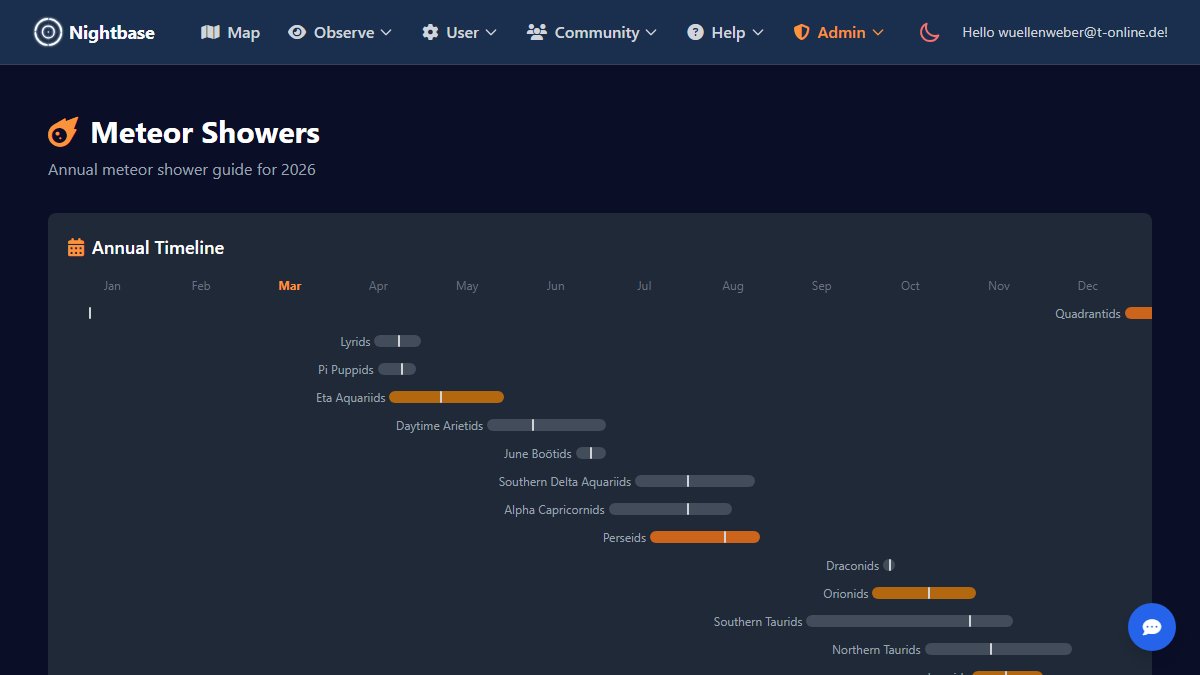
A complete calendar of annual meteor showers with peak dates, hourly rates, moon interference, and radiant positions. Plan ahead and know exactly when to look up.
 Open Meteor Showers
Sign in to get this digest by email and customize it for your location.