Sky Digest
Export Sky Digest PDF
Include finder charts for selected objects:
Tonight at a Glance
Aurora Forecast — Very unlikely
Geomagnetic activity far below the Kp 7 needed at your latitude.
View full forecastPlanet Highlights
Comets
For Beginners (naked eye)
Binocular Targets
Small Scopes (3–6 inch)
Big Scopes (8–12 inch)
The Week Ahead
| Tue | Wed | Thu | Fri | Sat | Sun | Mon |
| 🌘 22% | 🌘 14% | 🌘 8% | 🌘 4% | 🌑 1% | 🌑 0% | 🌑 1% |
| — | — | — | — | — | — | — |
NASA Astronomy Picture of the Day
A Solar Eruption from SDO
What just leapt from the Sun? A towering structure of solar plasma suddenly rose from the Sun's surface and unfurled into space -- a structure so large that many Earths would easily fit within it-- marking the onset of a dramatic Coronal Mass Ejection (CME). The event was captured in striking detail in late 2024 by NASA's Solar Dynamics Observatory (SDO), whose continuous monitoring improves space weather forecasts and helps humanity better understand how solar activity affects satellites, GPS, radio communications, and power grids on Earth. The featured video blends three extreme-ultraviolet views from SDO’s Atmospheric Imaging Assembly (AIA), revealing how plasma at different temperatures surged upward as the eruption unfolded. Here, red highlights cooler, denser material lifted from the Sun’s lower atmosphere, while yellow traces hotter, million-degree coronal loops stretching outward as magnetic fields open. After the main outburst, the Sun’s magnetic fields quickly reorganize.
APOD is a service of NASA and Michigan Tech. U.
View on NASA APODSpace News
NASA awarded Intuitive Machines $180.4 million to deliver science payloads to the lunar surface as part of the Artemis program, advancing capability to support crewed lunar missions.
NASA — 27 Mar 2026
NASA selected 10 scientists to shape the lunar surface science plan for Artemis astronauts, including instrument deployment and sample collection at the lunar south pole.
NASA — 27 Mar 2026
NASA released the launch countdown for Artemis II, targeting no earlier than April 1, 2026, for the first crewed mission around the Moon with four astronauts.
NASA — 26 Mar 2026
Europe's Service Module will provide propulsion, power, and life support for Artemis II astronauts on their 10-day journey around the Moon and back to Earth.
ESA — 27 Mar 2026
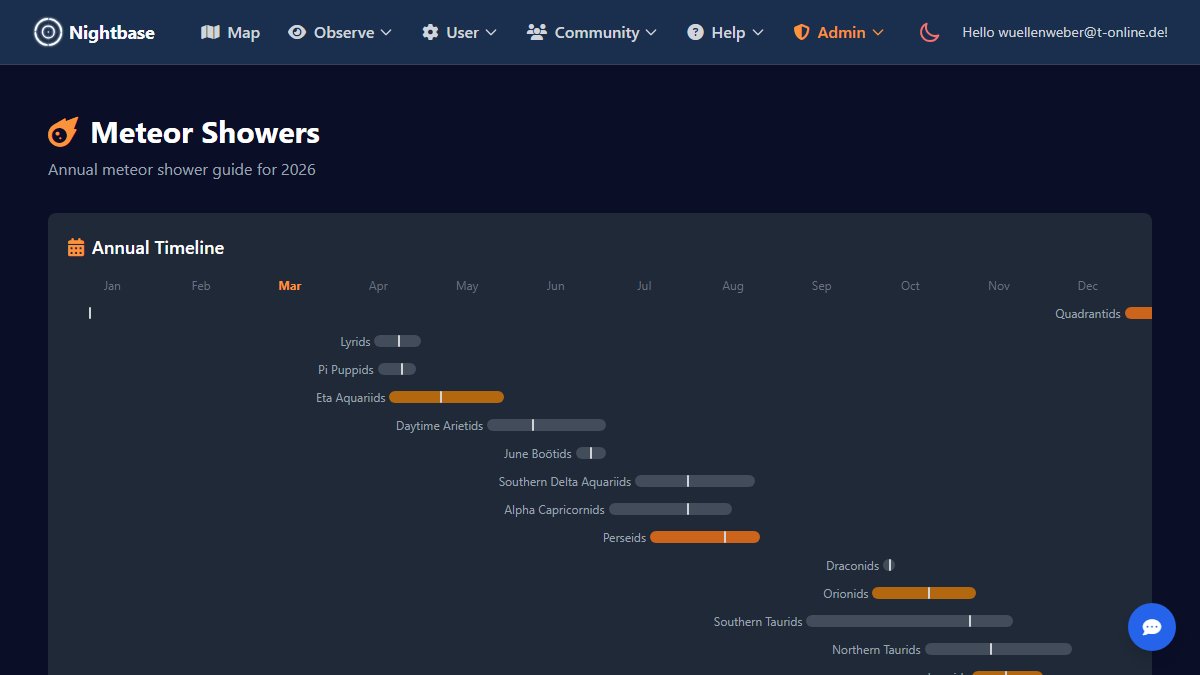
Never Miss a Meteor Shower
A complete calendar of annual meteor showers with peak dates, hourly rates, moon interference, and radiant positions. Plan ahead and know exactly when to look up.
 Open Meteor Showers
Sign in to get this digest by email and customize it for your location.