Sky Digest
Export Sky Digest PDF
Include finder charts for selected objects:
Tonight at a Glance
Planet Highlights
Comets
For Beginners (naked eye)
Binocular Targets
Small Scopes (3–6 inch)
Big Scopes (8–12 inch)
The Week Ahead
| Thu | Fri | Sat | Sun | Mon | Tue | Wed |
| 🌘 8% | 🌘 4% | 🌑 1% | 🌑 0% | 🌑 1% | 🌒 4% | 🌒 9% |
| — | — | — | — | — | — | — |
NASA Astronomy Picture of the Day
Plato and the Lunar Alps
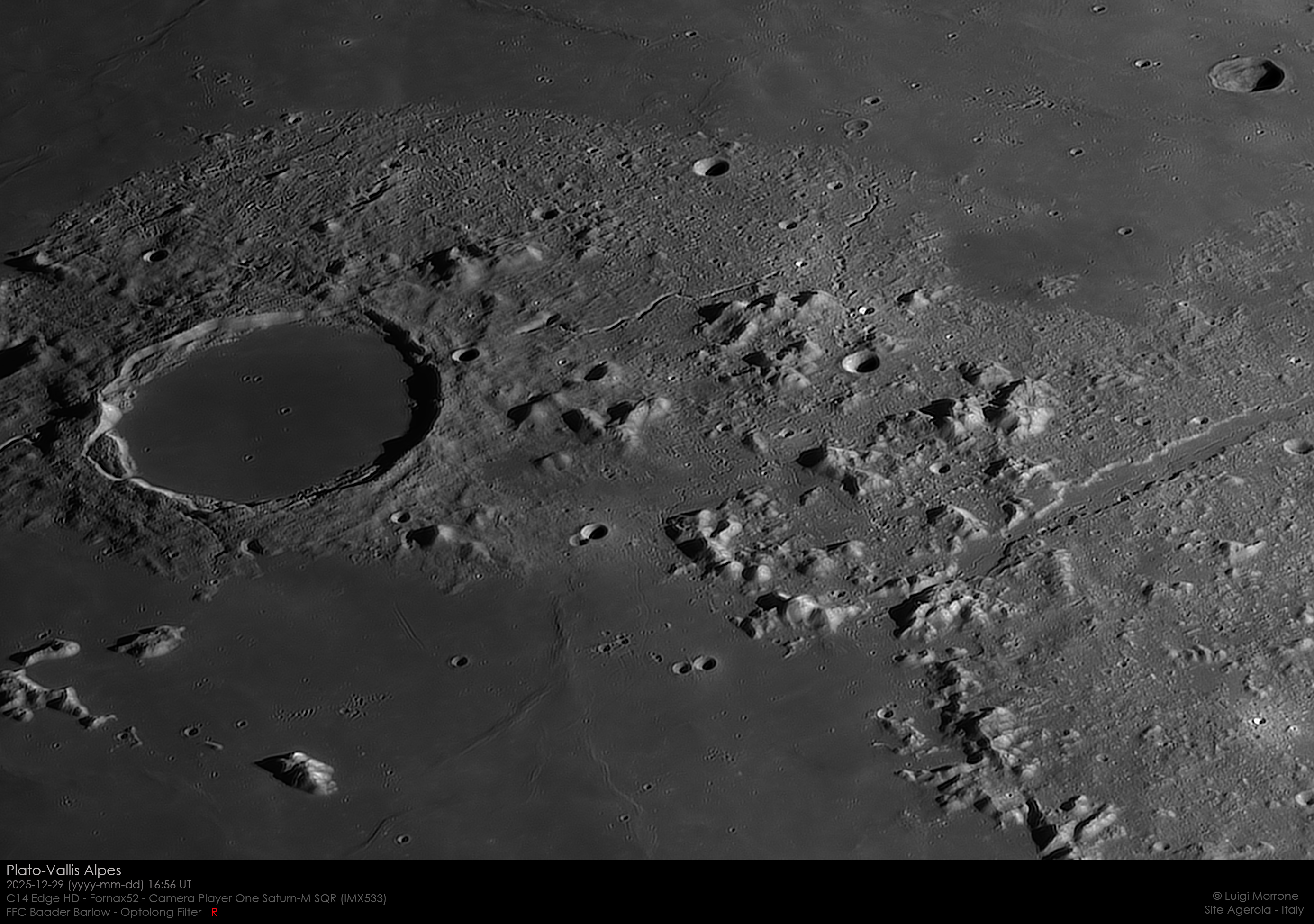
The dark-floored, 95 kilometer wide crater Plato and sunlit peaks of the lunar Alps (Montes Alpes) are highlighted in this this sharp telescopic snapshot of the Moon's surface. While the Alps of planet Earth were uplifted over millions of years as continental plates slowly collided, the lunar Alps were likely formed by a sudden collision that created the giant impact basin known as the Mare Imbrium or Sea of Rains. The mare's generally smooth, lava-flooded floor is seen below the bordering mountain range. The prominent straight feature cutting through the mountains is the lunar Alpine Valley (Vallis Alpes). Joining the Mare Imbrium and northern Mare Frigoris (Sea of Cold) the valley extends toward the upper right, about 160 kilometers long and up to 10 kilometers wide. Of course, the large, bright lunar alpine mountain below and right of Plato crater is named Mont Blanc. Lacking an atmosphere, not to mention snow, the lunar Alps are probably not an ideal location for a winter vacation. Still, a 150 pound skier would weigh a mere 25 pounds on the Moon.
Image credit: Luigi Morrone — APOD is a service of NASA and Michigan Tech. U.
View on NASA APODSpace News
NASA awarded Intuitive Machines $180.4 million to deliver seven science payloads to the lunar surface as part of the CLPS initiative supporting the Artemis program.
NASA — 27 Mar 2026
NASA selected 10 scientists to help develop a lunar surface science plan for Artemis astronauts, including instrument deployment and sample collection at the lunar south pole.
NASA — 27 Mar 2026
NASA released the launch countdown timeline for Artemis II, targeting no earlier than April 1, 2026, for the crewed mission around the Moon with four astronauts.
NASA — 26 Mar 2026
Europe's Service Module will provide critical propulsion, power, and life support systems for the Artemis II crewed lunar journey, highlighting international collaboration on the mission.
ESA — 27 Mar 2026
Never Miss a Meteor Shower
A complete calendar of annual meteor showers with peak dates, hourly rates, moon interference, and radiant positions. Plan ahead and know exactly when to look up.
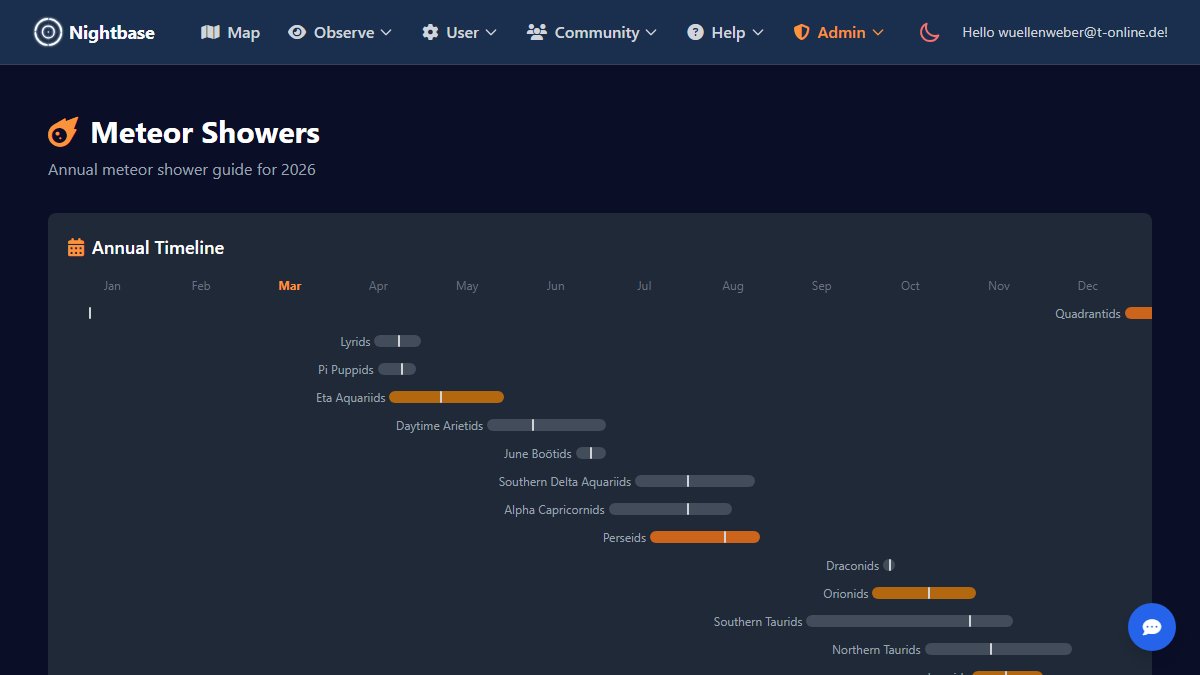 Open Meteor Showers
Sign in to get this digest by email and customize it for your location.