Export Sky Digest PDF
Include finder charts for selected objects:
Tonight at a Glance
Aurora Forecast — Slight chance
Kp just below threshold, but southward Bz may push the oval further south.
View full forecastPlanet Highlights
Moon occults 17 Tau
Star mag 3.7, Moon illumination: 23%. Visible from parts of Earth only.
View on Star MapFor Beginners (naked eye)
Binocular Targets
Small Scopes (3–6 inch)
Big Scopes (8–12 inch)
The Week Ahead
| Sun | Mon | Tue | Wed | Thu | Fri | Sat |
| 🌒 18% | 🌓 28% | 🌓 39% | 🌔 50% | 🌔 62% | 🌔 72% | 🌔 81% |
| — | — | — | — | — | — | — |
| Moon occults 17 Tau | Moon occults Beta Tau | Moon occults Kappa Gem |
NASA Astronomy Picture of the Day
Leaving Earth
What would it look like to leave planet Earth? Such an event was recorded visually in great detail by the MESSENGER spacecraft as it swung back past the Earth in 2005 on its way in toward the planet Mercury. Earth can be seen rotating in this time-lapse video, as it recedes into the distance. The sunlit half of Earth is so bright that background stars are not visible. The robotic MESSENGER spacecraft orbit around Mercury from 2011 to 2015 has conducted the first complete map of the surface. On occasion, MESSENGER peered back at its home world. MESSENGER is one of the few things created on the Earth that will never return. At the end of its mission, MESSENGER was purposefully crashed into Mercury's surface. Almost Hyperspace: Random APOD Generator
APOD is a service of NASA and Michigan Tech. U.
View on NASA APODSpace News
NASA used advanced simulations to optimize launch conditions for Artemis II, the first crewed lunar mission under the Artemis program, demonstrating critical preparations for this major milestone.
NASA — 20 Mar 2026
Artemis II rocket completed its second rollout to the launchpad at Kennedy Space Center, advancing toward the crewed lunar test flight.
ESA — 20 Mar 2026
NASA's observations of the rare interstellar comet 3I/ATLAS from over a dozen science missions will be archived as public data for future discoveries before the comet leaves our solar system.
NASA — 20 Mar 2026
NASA's newest astronaut candidate class of ten explorers is training at Johnson Space Center to become flight-eligible for future missions to the ISS, Moon, and beyond.
NASA — 19 Mar 2026
Watch Earth from Space
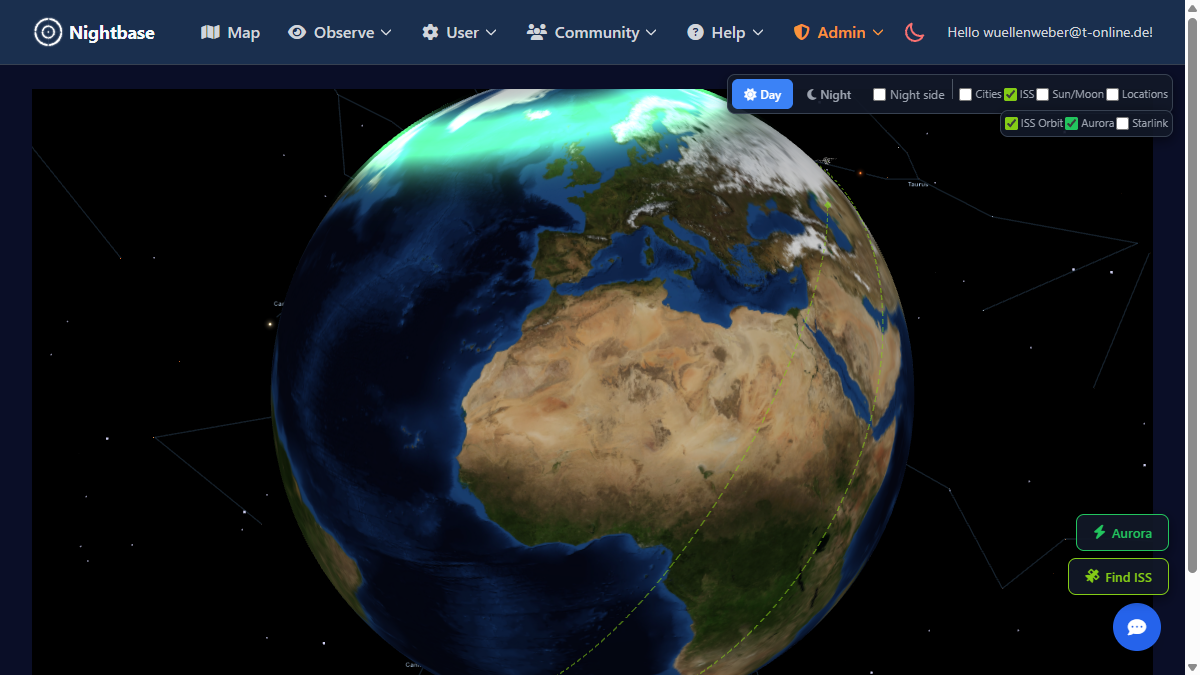
A 3D globe with real-time day/night terminator, ISS position tracking, aurora oval overlay, and city lights. See where the sun is shining — and where the stars are out.
 Open Earth
Sign in to get this digest by email and customize it for your location.