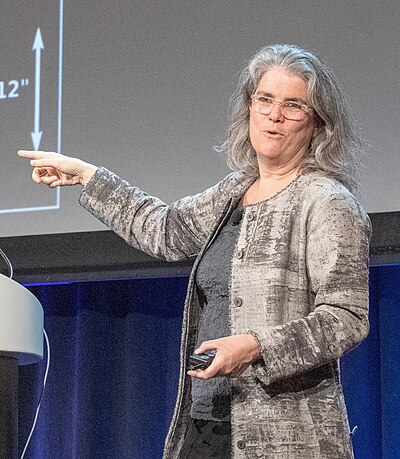
UCLA, via Wikimedia Commons
Andrea Ghez
b. 1965
American
Contemporary
Nobel Prize for discovering supermassive black hole at the Milky Way's center
Biography
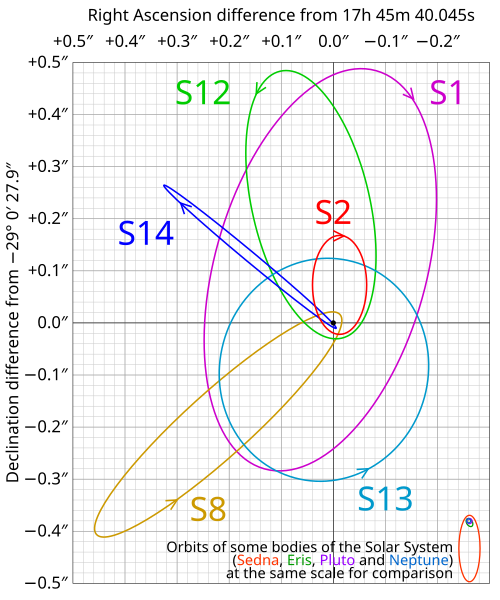
UCLA Galactic Center Group / Keck Observatory
Andrea Mia Ghez is an American astronomer and professor at the University of California, Los Angeles, who shared the 2020 Nobel Prize in Physics for her discovery that an invisible, supermassive compact object — almost certainly a black hole — governs the orbits of stars at the center of the Milky Way.
Beginning in 1995, Ghez used the W. M. Keck Observatory in Hawaii with adaptive optics and speckle imaging techniques to peer through the dense dust and gas obscuring the galactic center. She and her team tracked the orbits of stars in the immediate vicinity of the radio source Sagittarius A* (Sgr A*) over more than two decades, building up a detailed picture of their trajectories.
The star S0-2 (also known as S2) proved particularly revealing. Ghez's team tracked its complete 16-year orbit around an unseen central object. The star approaches within just 17 light-hours of Sgr A* and reaches orbital velocities exceeding 7,000 kilometers per second — nearly 3% of the speed of light. From these observations, Ghez determined that the central object has a mass of approximately four million solar masses concentrated in a region smaller than our solar system. The only known object consistent with such enormous mass in such a small volume is a supermassive black hole.
Ghez independently confirmed results obtained by Reinhard Genzel's team in Europe, providing two independent lines of evidence for the same remarkable conclusion. Her work used different telescopes, techniques, and analysis methods, making the combined result extremely robust.
Ghez is the fourth woman to be awarded the Nobel Prize in Physics. She continues to study the galactic center, using ever more precise measurements to test general relativity in the extreme gravitational environment near the black hole.
Key Discoveries
Discovered the supermassive black hole (Sgr A*) at the center of the Milky Way, mass ~4 million solar masses; Tracked stellar orbits near the galactic center over 20+ years using adaptive optics; Measured S0-2's complete 16-year orbit at nearly 3% the speed of light; Nobel Prize in Physics (2020) for this discovery; Pioneered the use of adaptive optics for galactic center observations; Tests of general relativity in extreme gravitational fields near Sgr A*