Public domain, via Wikimedia Commons
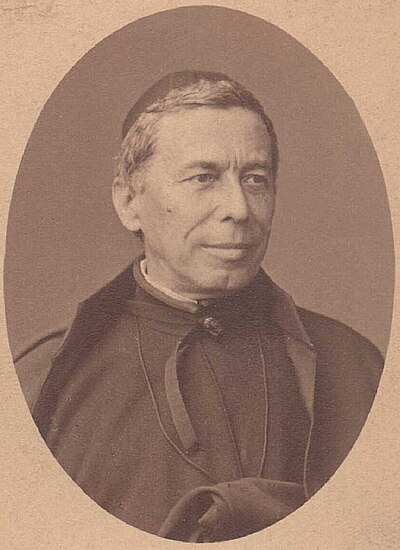
Angelo Secchi
1818 – 1878
Italian
19th Century
Pioneer of stellar spectral classification; father of astrophysics
Biography
Wikimedia Commons, public domain
Father Angelo Secchi was an Italian Jesuit priest and astronomer who is regarded as the father of stellar spectroscopy and one of the founders of astrophysics. Working from the observatory atop the Church of Sant'Ignazio in Rome, he was the first to systematically classify stars by their spectral characteristics, laying the foundation for all subsequent work in stellar classification.
Between 1863 and 1868, Secchi observed and classified the spectra of over 4,000 stars, developing a classification scheme that divided stars into five spectral types based on the patterns of absorption lines and colors in their light. His Type I stars (white and blue stars with strong hydrogen lines) correspond roughly to modern spectral types O, B, and A. Type II (yellow stars like the Sun) corresponds to types F, G, and K. Types III, IV, and V covered red stars and carbon stars. This was the first comprehensive spectral classification system and the direct precursor to the Harvard system developed by Annie Jump Cannon.
Secchi made numerous other contributions to astronomy. He was a pioneer of solar physics, studying sunspots, solar prominences, and the solar corona. He produced some of the earliest detailed drawings of Mars, noting surface features and a network of channels that he called 'canali.' He also studied cometary spectra, demonstrating that comets contained hydrocarbon compounds.
Beyond astronomy, Secchi made contributions to meteorology, designing instruments and establishing a network of weather stations across Italy. His work demonstrated that the physical sciences could be pursued rigorously within a religious vocation, and he was widely respected across Europe.
Key Discoveries
First systematic classification of stars by their spectra (Secchi spectral types I-V); Observed and classified spectra of over 4,000 stars between 1863 and 1868; Pioneer of solar physics: studied sunspots, prominences, and the corona; Early detailed observations and drawings of Mars surface features; Spectroscopic analysis of comets revealing hydrocarbon compounds; Established meteorological observation networks across Italy