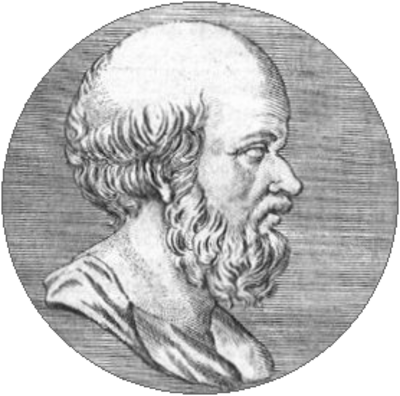
Painting, public domain, via Wikimedia Commons
Eratosthenes
c. 276 BC – c. 194 BC
Greek (Cyrene)
Ancient World
First accurate measurement of Earth's circumference; invented geography
Biography
Wikimedia Commons, public domain
Eratosthenes of Cyrene was a Greek polymath who served as the chief librarian of the great Library of Alexandria. He was a mathematician, geographer, poet, astronomer, and music theorist — a true Renaissance man two millennia before the Renaissance.
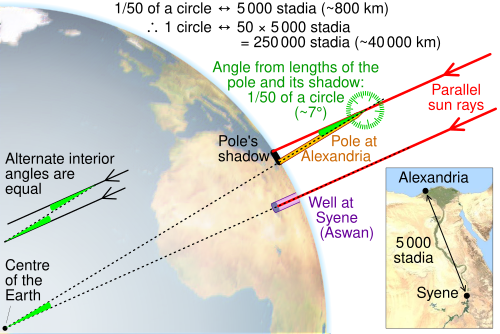
His most celebrated achievement was the first accurate measurement of Earth's circumference, accomplished around 240 BC using an elegantly simple method. He learned that at noon on the summer solstice in Syene (modern Aswan), the Sun was directly overhead, illuminating the bottom of a deep well without casting a shadow. In Alexandria, roughly 800 kilometers to the north, a vertical stick cast a measurable shadow at the same moment, indicating the Sun was about 7.2 degrees from the zenith.
Assuming the Earth was spherical and the Sun's rays were essentially parallel, Eratosthenes calculated the full circumference by scaling up: 7.2 degrees is one-fiftieth of a full circle, so the circumference must be fifty times the distance between Alexandria and Syene. His result — approximately 39,375 kilometers — was remarkably close to the modern value of 40,075 kilometers, an error of less than 2%.
Eratosthenes also devised the 'Sieve of Eratosthenes,' an algorithm for finding prime numbers that remains in use today. He created one of the earliest maps of the known world, introduced the system of latitude and longitude, and is often called the 'father of geography.' He calculated the tilt of Earth's axis to within about one degree of the correct value and estimated the distances to the Sun and Moon.
Key Discoveries
First accurate measurement of Earth's circumference (~39,375 km, within 2% of modern value); Invention of the 'Sieve of Eratosthenes' for finding prime numbers; Created one of the earliest systematic maps of the known world; Introduced latitude and longitude coordinate system; Calculated Earth's axial tilt to within ~1 degree; Estimated distances to the Sun and Moon