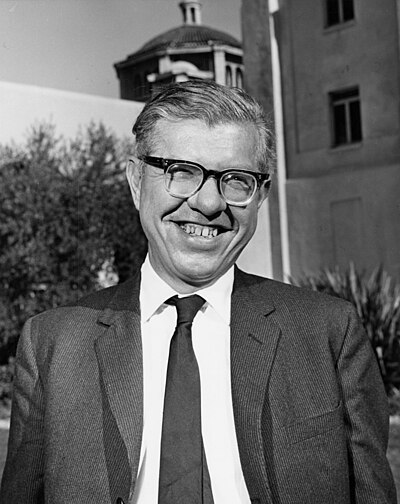
Photo (1967), via Wikimedia Commons
Fred Hoyle
1915 – 2001
British
20th Century
Stellar nucleosynthesis theory; coined the term 'Big Bang'
Biography
Wikimedia Commons, public domain
Sir Fred Hoyle was a British astronomer and mathematician who made fundamental contributions to the theory of stellar nucleosynthesis — explaining how the chemical elements are forged inside stars — and who, somewhat ironically, gave the Big Bang its name while arguing against it.
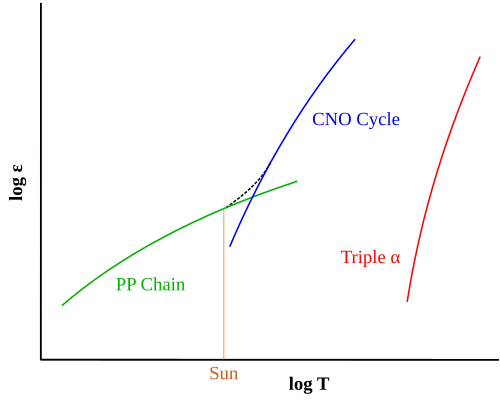
Hoyle's greatest scientific achievement was his work on stellar nucleosynthesis. In 1954, he published a landmark paper demonstrating how elements heavier than helium could be synthesized through nuclear reactions inside stars. He showed that as stars evolve, they progressively fuse lighter elements into heavier ones — hydrogen into helium, helium into carbon, carbon into oxygen, and so on up to iron. Elements heavier than iron are produced during supernovae. This work culminated in the famous 1957 B²FH paper (Burbidge, Burbidge, Fowler, and Hoyle), which provided a comprehensive theory of stellar nucleosynthesis and is one of the most cited papers in astrophysics.
Hoyle made a crucial prediction that the carbon-12 nucleus must have an excited energy state (a resonance) at a very specific energy level for carbon to be produced efficiently in stars. This 'Hoyle state' was subsequently confirmed experimentally, and is sometimes cited as an example of the anthropic principle — without this resonance, carbon-based life could not exist.
Despite his brilliant contributions, Hoyle was also a contrarian who advocated the Steady State theory of the universe, which held that the universe had no beginning and that new matter was continuously created to maintain a constant density as the universe expanded. During a 1949 BBC radio broadcast, he dismissed the rival theory by calling it 'the Big Bang' — a name that stuck, even though the theory he was mocking turned out to be correct.
Key Discoveries
Pioneered the theory of stellar nucleosynthesis (element formation in stars); Predicted the Hoyle state — a crucial carbon-12 nuclear resonance; Co-authored the B²FH paper (1957), the foundational work on how elements are made in stars; Coined the term 'Big Bang' (1949), intending it dismissively; Developed the Steady State theory of cosmology with Bondi and Gold; Contributed to understanding of supernovae as sources of heavy elements