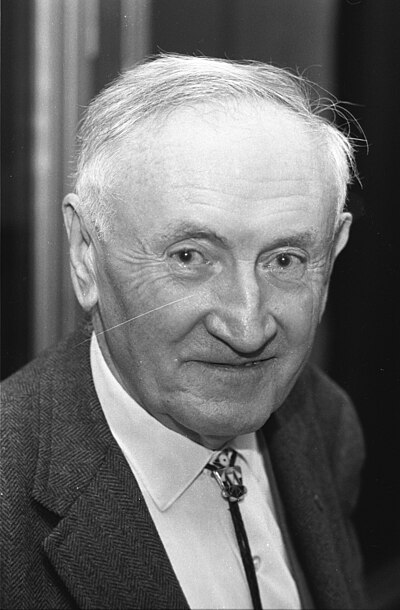
Photo (c. 1970), via Wikimedia Commons
Fritz Zwicky
1898 – 1974
Swiss-American
20th Century
First evidence for dark matter; coined the term 'supernova'
Biography
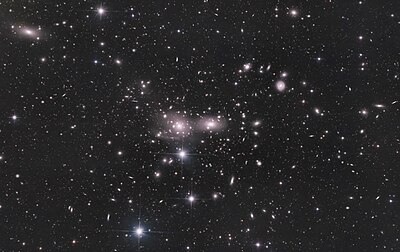
NASA/ESA/Hubble, public domain
Fritz Zwicky was a Swiss-American astronomer and physicist known for his brilliant and often controversial contributions to astrophysics. Working primarily at the California Institute of Technology and Palomar Observatory, he made some of the most prescient predictions in 20th-century astronomy, many of which were not fully appreciated until decades later.
In 1933, Zwicky made his most profound discovery while studying the Coma Cluster of galaxies. By measuring the velocities of individual galaxies within the cluster, he found that they were moving far too fast to be held together by the visible matter alone. He calculated that the cluster must contain about 400 times more mass than could be accounted for by its luminous galaxies. He called this unseen mass 'dunkle Materie' (dark matter). This was the first observational evidence for dark matter, a mystery that remains one of the greatest unsolved problems in physics.
Together with Walter Baade, Zwicky coined the term 'supernova' in 1934 to describe the catastrophic explosion of dying stars, distinguishing them from ordinary novae. They proposed that supernovae represented the transition of normal stars into neutron stars — an idea that was remarkably ahead of its time, as neutron stars were only confirmed observationally in 1967. Zwicky conducted the first systematic supernova search, personally discovering over 120 supernovae during his career.
Zwicky also proposed gravitational lensing as an observational tool decades before it was first observed, predicted the existence of galaxy clusters acting as cosmic lenses, and cataloged thousands of galaxies and galaxy clusters in his monumental six-volume 'Catalogue of Galaxies and of Clusters of Galaxies.'
Key Discoveries
First observational evidence for dark matter in the Coma Cluster (1933); Coined the term 'supernova' with Walter Baade (1934); Proposed that supernovae produce neutron stars; Predicted gravitational lensing as an observational tool; Personally discovered over 120 supernovae in systematic searches; Compiled the six-volume Catalogue of Galaxies and of Clusters of Galaxies