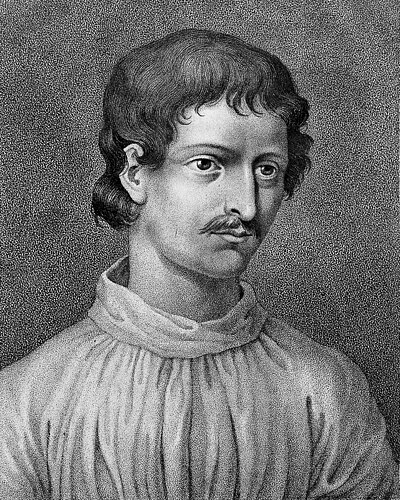
Engraving from "Opere", public domain
Giordano Bruno
1548 – 1600
Italian
Renaissance
Proposed infinite universe with innumerable worlds orbiting other stars
Biography
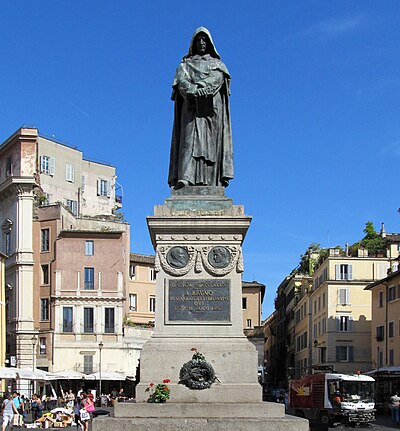
Monument at Campo de' Fiori, Rome, via Wikimedia Commons
Giordano Bruno was an Italian Dominican friar, philosopher, mathematician, and cosmological theorist whose visionary ideas about the universe were centuries ahead of his time. Born in Nola, near Naples, he entered the Dominican Order at age 17 but soon came into conflict with Church authorities over his unorthodox views.
Bruno's most revolutionary contribution was his cosmological vision. Building on the Copernican heliocentric model, he went far beyond what Copernicus had proposed. Bruno argued that the universe was infinite, with no center and no boundary. He proposed that the stars were distant suns, each potentially orbited by their own planets — and that some of these worlds might harbor life. This was a staggering conceptual leap at a time when even the Copernican model placed the stars on a fixed outer sphere.
He articulated these ideas in works such as 'De l'infinito, universo e mondi' (On the Infinite, Universe and Worlds, 1584) and 'De immenso' (On the Immeasurable, 1591). He also proposed that the apparent motion of stars was partly due to Earth's own movement through space, anticipating the concept of stellar parallax.
Bruno traveled widely across Europe, lecturing at universities in France, England, and Germany, but his ideas attracted increasing hostility from religious authorities. In 1592, he was arrested by the Venetian Inquisition and transferred to Rome, where he was imprisoned for eight years. Refusing to recant his philosophical positions, Bruno was burned at the stake in the Campo de' Fiori in Rome on February 17, 1600. Today he is regarded as a martyr for free thought and a visionary precursor of modern cosmology.
Key Discoveries
Proposed that the universe is infinite with no center or boundary; Hypothesized that stars are distant suns orbited by their own planets; Suggested the existence of extraterrestrial life on other worlds; Extended Copernican heliocentrism into a fully infinite cosmology; Anticipated stellar parallax by proposing Earth moves through space; Pioneered the concept of a homogeneous, isotropic universe