
Photo (1970), via Wikimedia Commons
Jan Oort
1900 – 1992
Dutch
20th Century
Oort cloud, galactic rotation, pioneer of radio astronomy
Biography
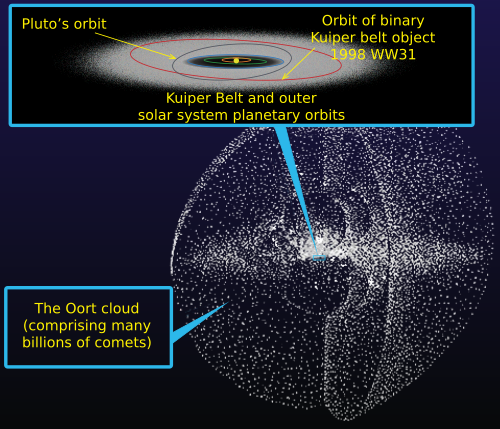
NASA, public domain
Jan Hendrik Oort was a Dutch astronomer who is widely regarded as one of the greatest astronomers of the 20th century. His work spanned galactic dynamics, radio astronomy, and cometary science, and he played a central role in establishing the Netherlands as a world leader in astronomical research.
In 1927, Oort provided the first observational proof that the Milky Way rotates. By analyzing the motions of stars, he confirmed and refined Bertil Lindblad's theoretical model of galactic rotation, demonstrating that stars closer to the galactic center orbit faster than those farther out — producing differential rotation rather than rigid-body rotation. The mathematical description of this differential rotation uses what are now called 'Oort constants,' which remain fundamental to galactic dynamics.
Oort was a pioneer of radio astronomy. After World War II, he immediately recognized the potential of the 21-centimeter hydrogen emission line predicted by his student Hendrik van de Hulst. Using radio telescopes, Oort and his colleagues mapped the spiral structure of the Milky Way for the first time, peering through the dust that blocked optical observations. This was a transformative advance in understanding our galaxy's structure.
In 1950, Oort proposed that long-period comets originate from a vast, spherical cloud of icy bodies surrounding the solar system at distances of 50,000 to 100,000 AU — now known as the Oort Cloud. He deduced this from the observation that long-period comets arrive from all directions and have orbits suggesting they originate at enormous distances. The Oort Cloud remains the accepted explanation for the origin of long-period comets, though it has never been directly observed.
Key Discoveries
Proposed the Oort Cloud as the source of long-period comets (1950); First observational proof of the Milky Way's differential rotation (1927); Oort constants describing galactic rotation dynamics; Pioneered radio astronomical mapping of the Milky Way's spiral structure using the 21-cm hydrogen line; Established the Netherlands as a world center for radio astronomy; Determined the distance to the galactic center and the Sun's orbital velocity