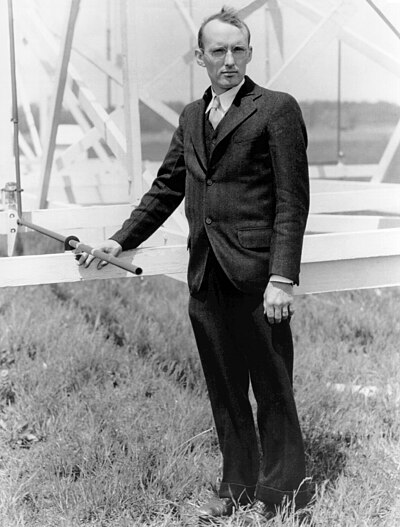
Bell Telephone Laboratories, public domain
Karl Jansky
1905 – 1950
American
20th Century
Discovered extraterrestrial radio waves; father of radio astronomy
Biography
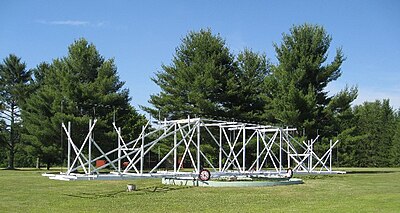
NRAO/AUI, via Wikimedia Commons
Karl Guthe Jansky was an American physicist and radio engineer whose accidental discovery of radio waves from space founded the entirely new field of radio astronomy. His discovery opened a window on the universe that would ultimately reveal pulsars, quasars, the cosmic microwave background, and countless other phenomena invisible to optical telescopes.
In 1931, Jansky was working at Bell Telephone Laboratories in Holmdel, New Jersey, investigating sources of static that interfered with transatlantic radio-telephone communications. He built a large rotating antenna (nicknamed 'Jansky's Merry-Go-Round') that operated at a frequency of 20.5 MHz (14.6-meter wavelength) and could be rotated to determine the direction of incoming radio signals.
Jansky identified three types of static: nearby thunderstorms, distant thunderstorms, and a persistent faint hiss of unknown origin. Over months of careful observation, he determined that this mysterious signal repeated on a cycle of 23 hours and 56 minutes — a sidereal day rather than a solar day. This meant the source was not the Sun or anything on Earth, but something fixed relative to the stars. By 1933, he had traced the signal to the center of the Milky Way in the direction of the constellation Sagittarius.
Jansky published his results and suggested building a large dish antenna to study cosmic radio emissions in detail, but Bell Labs was not interested in pursuing non-commercial research, and the astronomical community largely overlooked the discovery. It was left to amateur radio operator Grote Reber to build the first dedicated radio telescope in 1937. The unit of radio flux density, the 'jansky' (Jy), is named in his honor.
Key Discoveries
Discovery of extraterrestrial radio waves from the Milky Way's center (1932-1933); Founded the field of radio astronomy; Identified the galactic center in Sagittarius as a strong radio source; Developed techniques for identifying and characterizing radio frequency interference; Demonstrated that cosmic phenomena could be studied in the radio spectrum; The unit of radio flux density (jansky, Jy) is named in his honor