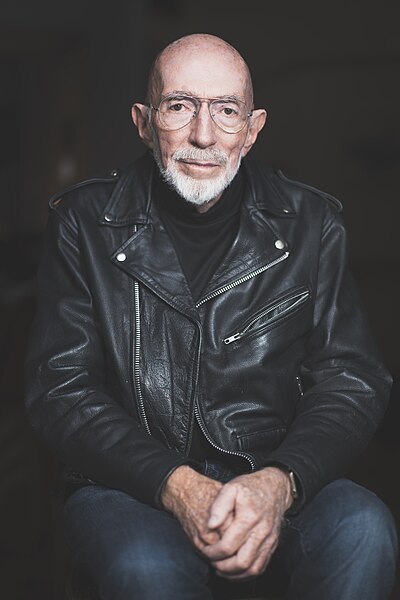
Photo by Christopher Michel (2022), CC BY-SA 4.0
Kip Thorne
b. 1940
American
Contemporary
Nobel Prize for gravitational wave detection (LIGO); black hole physics
Biography
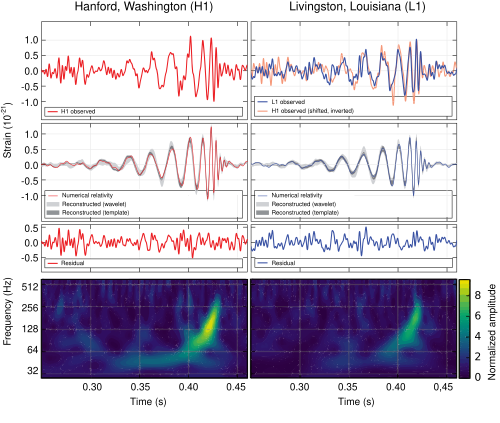
LIGO/Caltech/MIT, public domain
Kip Stephen Thorne is an American theoretical physicist who shared the 2017 Nobel Prize in Physics for decisive contributions to the LIGO detector and the observation of gravitational waves — ripples in spacetime first predicted by Albert Einstein in 1916 but not directly detected for another hundred years.
Thorne spent decades developing the theoretical framework that made gravitational wave detection possible. He and his colleagues calculated what gravitational wave signals from various astrophysical sources — merging black holes, colliding neutron stars, supernovae — would look like, providing the templates against which LIGO's detections could be matched. Along with Rainer Weiss and Ronald Drever, Thorne co-founded the LIGO project in the 1980s, shepherding it through decades of development.
On September 14, 2015, LIGO made the first direct detection of gravitational waves, produced by two black holes spiraling together and merging about 1.3 billion light-years away. The signal matched the theoretical predictions precisely, confirming a century-old prediction of general relativity and opening an entirely new way of observing the universe.
Beyond gravitational waves, Thorne has made fundamental contributions to black hole physics, including the theory of black hole collisions, the behavior of matter falling into black holes, and the properties of wormholes. His work on the physics of wormholes and time warps, while theoretical, has explored the boundaries of what general relativity permits.
Thorne has been an influential teacher and communicator of science. His textbook 'Gravitation' (1973, with Misner and Wheeler) is a foundational text in general relativity. He served as scientific consultant and executive producer for the film 'Interstellar' (2014), ensuring its depictions of black holes and wormholes were scientifically grounded.
Key Discoveries
Co-founded LIGO and provided theoretical foundations for gravitational wave detection; Nobel Prize in Physics (2017) for the first direct detection of gravitational waves; Developed theoretical templates for gravitational wave signals from merging black holes; Fundamental contributions to the theory of black hole collisions and dynamics; Theoretical work on wormholes and the limits of general relativity; Scientific consultant for 'Interstellar' (2014), advancing public understanding of black hole physics