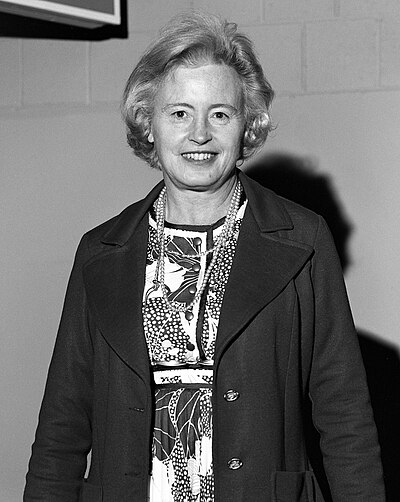
Photo (1974), via Wikimedia Commons
Margaret Burbidge
1919 – 2020
British-American
20th Century
B²FH paper on stellar nucleosynthesis; galaxy rotation curves
Biography
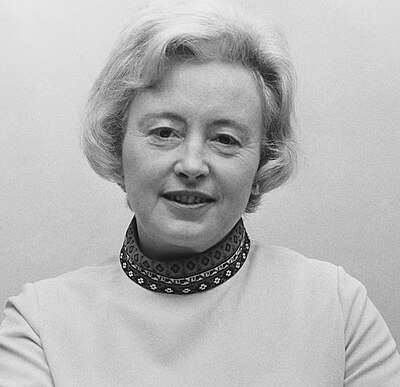
Wikimedia Commons, public domain
Eleanor Margaret Burbidge (née Peachey) was a British-American observational astronomer and astrophysicist whose career spanned over seven decades. She is best known as one of the four authors of the landmark 1957 B²FH paper, which provided the definitive theory of how chemical elements are created inside stars.
The B²FH paper — named for its authors Burbidge, Burbidge, Fowler, and Hoyle — demonstrated that virtually all elements heavier than hydrogen and helium are synthesized through nuclear reactions within stars and during stellar explosions. Margaret Burbidge's role was crucial: she was the primary observer, obtaining the stellar spectra that provided the empirical foundation for the theoretical framework. Her precise measurements of element abundances in stars of different types and ages provided the key evidence for the theory.
Burbidge made equally important contributions to the study of galaxies. She was a pioneer in measuring galaxy rotation curves — plotting how the orbital velocities of stars and gas vary with distance from a galaxy's center. Her extensive observations, published throughout the 1960s and 1970s, helped lay the groundwork for the discovery that galaxies contain far more mass than is visible — a key line of evidence for dark matter.
She also conducted important early research on quasars, the extraordinarily luminous nuclei of distant galaxies. Her measurements of quasar spectra helped establish their enormous distances and energy output.
Burbidge was a trailblazer for women in astronomy, famously turning down the Annie Jump Cannon Prize because it was restricted to women, arguing for recognition on equal terms. She served as the first female director of the Royal Greenwich Observatory and as president of the American Astronomical Society.
Key Discoveries
Co-authored the B²FH paper (1957), explaining stellar nucleosynthesis; Obtained stellar spectra providing empirical evidence for element formation in stars; Pioneered measurement of galaxy rotation curves, contributing to dark matter evidence; Early research on quasar spectra establishing their enormous distances; First female director of the Royal Greenwich Observatory; President of the American Astronomical Society