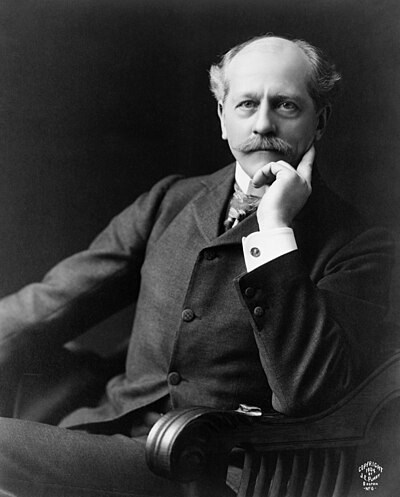
Photo by James E. Purdy (1904), public domain
Percival Lowell
1855 – 1916
American
19th Century
Founded Lowell Observatory; predicted the existence of Planet X (Pluto)
Biography
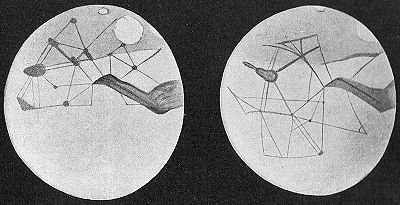
Percival Lowell Mars drawing, public domain
Percival Lawrence Lowell was an American businessman, author, and astronomer who founded one of the most important observatories in the United States and whose prediction of a trans-Neptunian planet eventually led to the discovery of Pluto. A member of the prominent Boston Lowell family, he devoted the second half of his life entirely to astronomy.
Inspired by Giovanni Schiaparelli's observations of 'canali' on Mars and Angelo Secchi's earlier work, Lowell became convinced that Mars harbored intelligent life that had built a network of canals to distribute water from the polar ice caps. He established Lowell Observatory in Flagstaff, Arizona, in 1894, specifically chosen for its excellent seeing conditions at high altitude. From there, he produced elaborate maps of Martian canals and published three popular books: 'Mars' (1895), 'Mars and Its Canals' (1906), and 'Mars as the Abode of Life' (1908).
While his Mars canal theory was ultimately wrong — the canals proved to be optical illusions — Lowell's lasting contribution was his mathematical prediction of a ninth planet beyond Neptune. Analyzing perturbations in the orbits of Uranus and Neptune, he calculated the approximate position of what he called 'Planet X.' He searched for the planet from 1905 until his death in 1916 without success. Fourteen years later, in 1930, Clyde Tombaugh discovered Pluto at Lowell Observatory, very near Lowell's predicted position (though modern analysis shows this was partly coincidental).
Lowell Observatory remains a world-class research institution. It was there that Vesto Slipher first measured the redshifts of galaxies, observations that later helped establish the expansion of the universe.
Key Discoveries
Founded Lowell Observatory in Flagstaff, Arizona (1894), still active today; Mathematical prediction of 'Planet X' beyond Neptune, leading to Pluto's discovery; Popularized planetary astronomy through books and public lectures; Pioneered site selection for astronomical observing (high altitude, clear skies); Early spectroscopic studies of planetary atmospheres; Lowell Observatory later yielded Slipher's galaxy redshift measurements