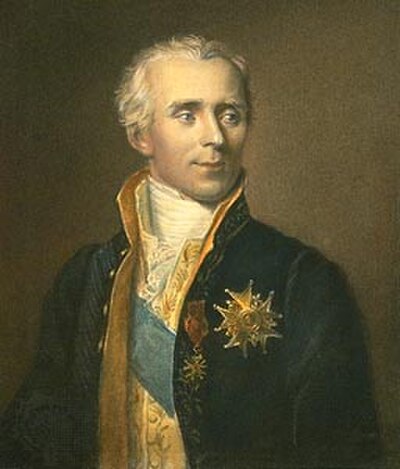
Public domain, via Wikimedia Commons
Pierre-Simon Laplace
1749 – 1827
French
18th Century
Celestial mechanics, nebular hypothesis, Laplace's equation
Biography
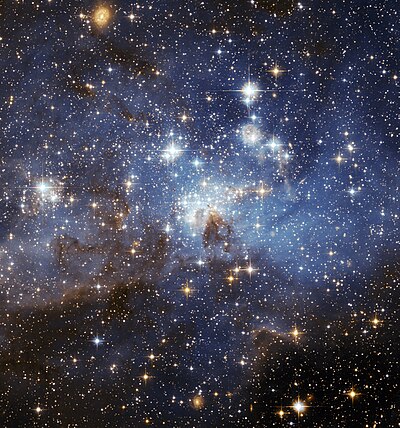
NASA/ESA, via Wikimedia Commons
Pierre-Simon, marquis de Laplace, was a French mathematician and astronomer who is often referred to as the 'French Newton' for his monumental contributions to celestial mechanics and mathematical physics. His work provided the mathematical framework that demonstrated the long-term stability of the solar system.
Laplace's magnum opus, 'Mécanique céleste' (Celestial Mechanics, published in five volumes from 1799 to 1825), translated Newton's geometrical approach to planetary motion into the language of calculus and resolved numerous apparent anomalies in planetary orbits. Where Newton had suggested that divine intervention might be needed to keep the solar system stable, Laplace proved mathematically that the observed irregularities in planetary orbits were periodic and self-correcting. When Napoleon asked him why his work made no mention of God, Laplace reportedly replied, 'I had no need of that hypothesis.'
His nebular hypothesis (1796) proposed that the solar system formed from a rotating cloud of gas that gradually contracted and flattened, throwing off rings of material that condensed into planets. While the details have been revised, this basic concept remains the foundation of modern theories of solar system formation.
Laplace also made fundamental contributions to probability theory, publishing 'Théorie analytique des probabilités' (1812), which laid the mathematical foundations of the field. Laplace's equation and Laplace transforms remain essential tools across physics and engineering. He predicted the existence of black holes (which he called 'dark stars') — objects so massive that light could not escape their gravitational pull — over a century before general relativity.
Key Discoveries
Mathematical proof of long-term stability of the solar system (Mécanique céleste); Nebular hypothesis for the formation of the solar system from a rotating gas cloud; Prediction of 'dark stars' (black holes) from which light cannot escape; Foundational contributions to probability theory (Théorie analytique des probabilités); Laplace's equation and Laplace transforms, essential tools in mathematical physics; Demonstrated that planetary orbital irregularities are periodic and self-correcting