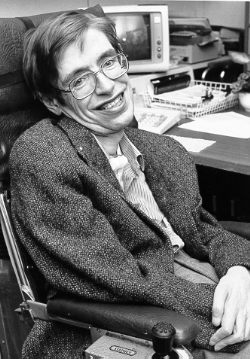
NASA StarChild, public domain
Stephen Hawking
1942 – 2018
British
20th Century
Hawking radiation, black hole thermodynamics, popular science icon
Biography
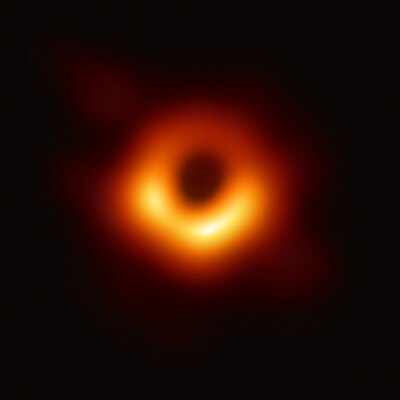
EHT Collaboration, CC BY 4.0
Stephen William Hawking was a British theoretical physicist and cosmologist who made groundbreaking contributions to our understanding of black holes, the origin of the universe, and the nature of time. Despite being diagnosed with motor neuron disease (ALS) at age 21 and given only a few years to live, he went on to become one of the most celebrated scientists of the modern era, living until the age of 76.
Hawking's most important scientific contribution came in 1974 when he demonstrated theoretically that black holes are not entirely black. By combining quantum mechanics with general relativity, he showed that black holes should emit thermal radiation — now called Hawking radiation — due to quantum effects near the event horizon. This was a revolutionary result because it implied that black holes gradually lose mass and can eventually evaporate completely. Hawking radiation remains one of the most important theoretical predictions in modern physics, connecting gravity, quantum mechanics, and thermodynamics.
Working with Roger Penrose in the late 1960s, Hawking proved the singularity theorems, demonstrating that under very general conditions, gravitational collapse must produce singularities — points where the known laws of physics break down. Applied to the universe as a whole, this work showed that the Big Bang must have begun from a singularity, providing rigorous mathematical support for the Big Bang theory.
Hawking also contributed to the black hole information paradox — the question of whether information that falls into a black hole is destroyed or preserved — which remains one of the deepest unsolved problems in theoretical physics. His 'no-boundary proposal' with James Hartle suggested that the universe has no boundary in imaginary time, offering a framework for understanding the origin of the universe without invoking a singularity.
His popular science book 'A Brief History of Time' (1988) became one of the best-selling science books ever, making cosmology accessible to millions of readers worldwide.
Key Discoveries
Theoretical prediction of Hawking radiation — thermal emission from black holes (1974); Singularity theorems with Roger Penrose proving the Big Bang began from a singularity; Black hole area theorem (black hole entropy increases); No-boundary proposal with James Hartle for the origin of the universe; Contributions to the black hole information paradox; 'A Brief History of Time' (1988), one of the best-selling science books ever