Public domain, via Wikimedia Commons
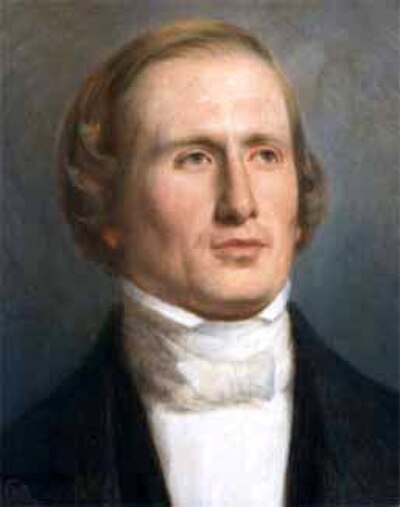
Urbain Le Verrier
1811 – 1877
French
19th Century
Predicted the position of Neptune through mathematical calculation alone
Biography
NASA/JPL (Voyager 2), public domain
Urbain Jean Joseph Le Verrier was a French mathematician and astronomer whose prediction of the existence and position of the planet Neptune is one of the most celebrated triumphs of mathematical astronomy. His work demonstrated the extraordinary power of Newtonian mechanics to reveal unseen objects through their gravitational influence.
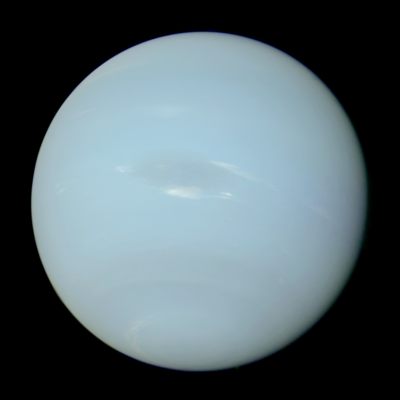
By the 1840s, astronomers had long been troubled by discrepancies between the observed orbit of Uranus and the orbit predicted by Newtonian theory. Le Verrier tackled this problem with a comprehensive mathematical analysis, hypothesizing that the perturbations were caused by an unknown planet beyond Uranus. Through months of painstaking calculation, he predicted the mass, orbit, and current position of this unseen world.
On September 23, 1846, Le Verrier sent his predictions to Johann Galle at the Berlin Observatory. That very night, Galle and his assistant Heinrich d'Arrest found the new planet within one degree of Le Verrier's predicted position. The discovery of Neptune was hailed as a spectacular vindication of gravitational theory and made Le Verrier internationally famous. The French astronomer François Arago declared that Le Verrier had 'discovered a planet with the tip of his pen.'
Le Verrier later attempted to explain a similar anomaly in Mercury's orbit by proposing the existence of a planet called 'Vulcan' inside Mercury's orbit. This prediction ultimately proved incorrect — the anomaly in Mercury's orbit would only be explained decades later by Einstein's general theory of relativity. Le Verrier served twice as director of the Paris Observatory and developed the first modern weather forecasting service in France after a storm devastated the French fleet during the Crimean War.
Key Discoveries
Mathematical prediction of Neptune's existence and position (1846), confirmed by observation the same night; Comprehensive analysis of Uranus's orbital perturbations using Newtonian mechanics; Detailed tables of planetary motions for all known planets; Identified the anomalous precession of Mercury's perihelion (later explained by general relativity); Established the first modern meteorological service in France; Proposed the hypothetical planet Vulcan (later disproven)