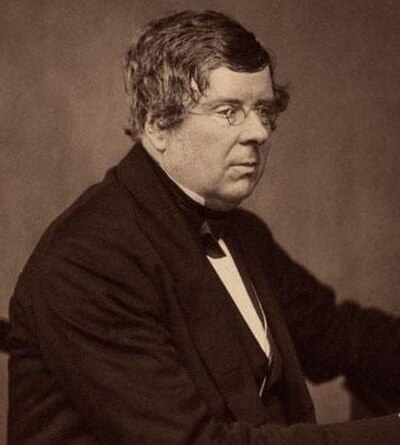
Photo by Maull and Polyblank, public domain
William Parsons
1800 – 1867
Irish
19th Century
Built the Leviathan of Parsonstown; first to resolve spiral structure of nebulae
Biography
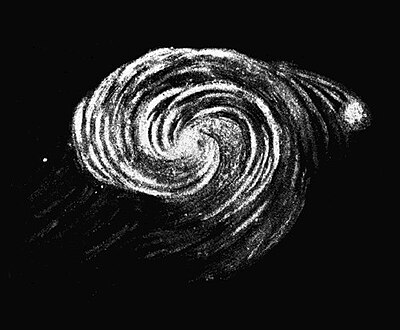
Lord Rosse sketch of M51 (1845), public domain
William Parsons, 3rd Earl of Rosse, was an Irish astronomer and nobleman who built the largest telescope in the world and used it to make discoveries that transformed our understanding of the universe. His 72-inch (1.83-meter) reflecting telescope, known as the 'Leviathan of Parsonstown,' held the record as the world's largest telescope for over 70 years, from 1845 to 1917.
Constructed at Birr Castle in County Offaly, Ireland, the Leviathan featured a speculum metal mirror that Parsons cast and polished himself after years of experimentation. The telescope was mounted between two massive masonry walls and could track objects near the meridian. Despite Ireland's often cloudy skies, Parsons used every clear night to push the boundaries of observational astronomy.
His most significant discovery came in 1845 when he observed the nebula M51 and resolved its spiral structure for the first time, producing a remarkably accurate drawing that revealed its pinwheel shape. This was the first time anyone had seen spiral structure in what we now know to be a galaxy. He went on to identify spiral structure in fourteen other nebulae, including M99 and M101. These observations were decades ahead of their theoretical understanding — it would take until the 1920s for Edwin Hubble to prove that these 'spiral nebulae' were actually entire galaxies beyond the Milky Way.
Parsons also studied and drew many other nebulae in unprecedented detail, including the Crab Nebula (M1), which he named for its filamentary structure resembling crab legs. His observations provided crucial data for the later debate over the nature of nebulae.
Key Discoveries
Built the Leviathan of Parsonstown (72-inch reflector), world's largest telescope for 70+ years; First to resolve and draw the spiral structure of M51 (Whirlpool Galaxy) in 1845; Identified spiral structure in fifteen nebulae, including M99 and M101; Named the Crab Nebula (M1) for its filamentary appearance; Pioneered large-scale speculum metal mirror casting techniques; Produced detailed drawings of nebulae that advanced understanding of deep-sky objects