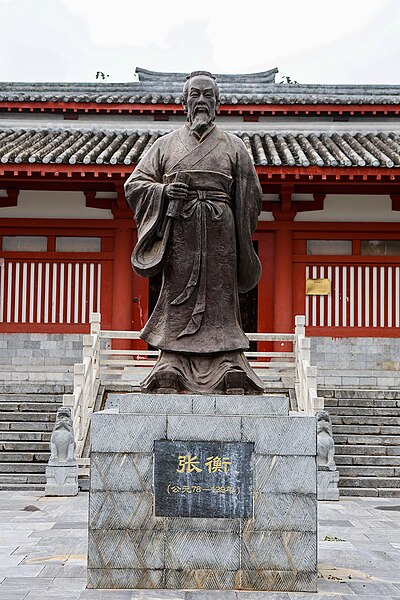
Statue at tomb in Nanyang, via Wikimedia Commons
Zhang Heng
78 – 139
Chinese
Ancient World
Celestial globe, first seismoscope, cataloged 2,500 stars
Biography
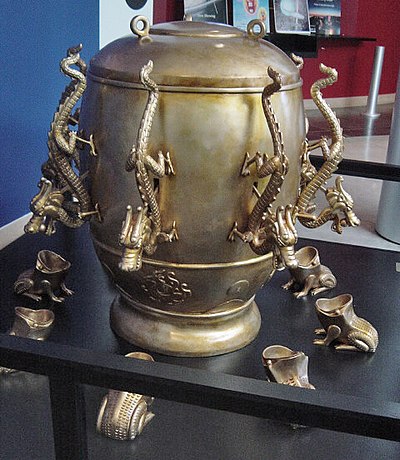
Replica of Eastern Han seismograph, via Wikimedia Commons
Zhang Heng was a Chinese polymath of the Eastern Han Dynasty who made groundbreaking contributions to astronomy, mathematics, seismology, hydraulics, and literature. He served as Chief Astronomer and later as Palace Attendant at the imperial court in Luoyang.
In astronomy, Zhang Heng constructed a water-powered armillary sphere — a rotating celestial globe that accurately represented the positions of stars and the movements of celestial bodies. His star catalog documented approximately 2,500 stars grouped into 124 constellations, one of the most comprehensive star surveys of the ancient world. He correctly identified that the Moon does not produce its own light but reflects sunlight, and provided one of the earliest correct explanations of lunar eclipses.
His most famous invention was the seismoscope (houfeng didong yi), created around 132 AD. This ingenious bronze vessel could detect earthquakes hundreds of kilometers away and indicate their direction, predating European seismographic instruments by over 1,700 years. When an earthquake occurred, a mechanism inside the device would cause a bronze ball to drop from one of eight dragon heads into the mouth of a corresponding toad below, pointing toward the quake's direction.
Zhang Heng also calculated pi as approximately 3.1466 (the square root of 10), improved the Chinese calendar, and wrote extensively on mathematics. He estimated that the observable sky contained 11,520 stars and noted that the sky was like a hen's egg, with Earth as the yolk — articulating a spherical cosmology centuries before it became accepted in Europe.
Key Discoveries
Water-powered armillary sphere (celestial globe) representing star positions and planetary motion; Star catalog of approximately 2,500 stars in 124 constellations; Invention of the first seismoscope (132 AD), detecting distant earthquakes and their direction; Correct explanation of lunar eclipses (Moon reflects sunlight); Approximation of pi as the square root of 10 (~3.1466); Contributions to Chinese calendar reform