Apophis — Near-Earth Object in Scorpius
99942 Apophis, 2004 MN4
About Apophis
Description
Apophis (99942 Apophis) is a near-Earth asteroid roughly 370 meters (0.37 km) in diameter, classified as an Aten-type asteroid with an orbit that crosses Earth's. Discovered in 2004, it initially caused worldwide alarm when preliminary calculations gave it a 2.7% chance of striking Earth in 2029 — the highest impact probability ever assigned to an asteroid. Subsequent observations eliminated the impact risk, but confirmed that on April 13, 2029, Apophis will pass just 31,000 km from Earth's surface — closer than geostationary satellites and easily visible to the naked eye from parts of Europe, Africa, and Asia. It is an Sq-type asteroid composed of silicates with some metal content.
Observing Tips
Apophis is normally very faint at magnitude 19–22, far beyond visual range. However, during its historic close approach on April 13, 2029, it will brighten to about magnitude 3.1 — easily visible to the naked eye as a fast-moving point of light crossing the sky. From Europe and Africa, observers will be able to watch it move noticeably against the star background in real time. Before and after the close approach, it may be visible in large amateur telescopes (12 inches or more) for several weeks. This will be an unprecedented event — the first time a potentially hazardous asteroid of this size will be visible to the unaided eye.
History
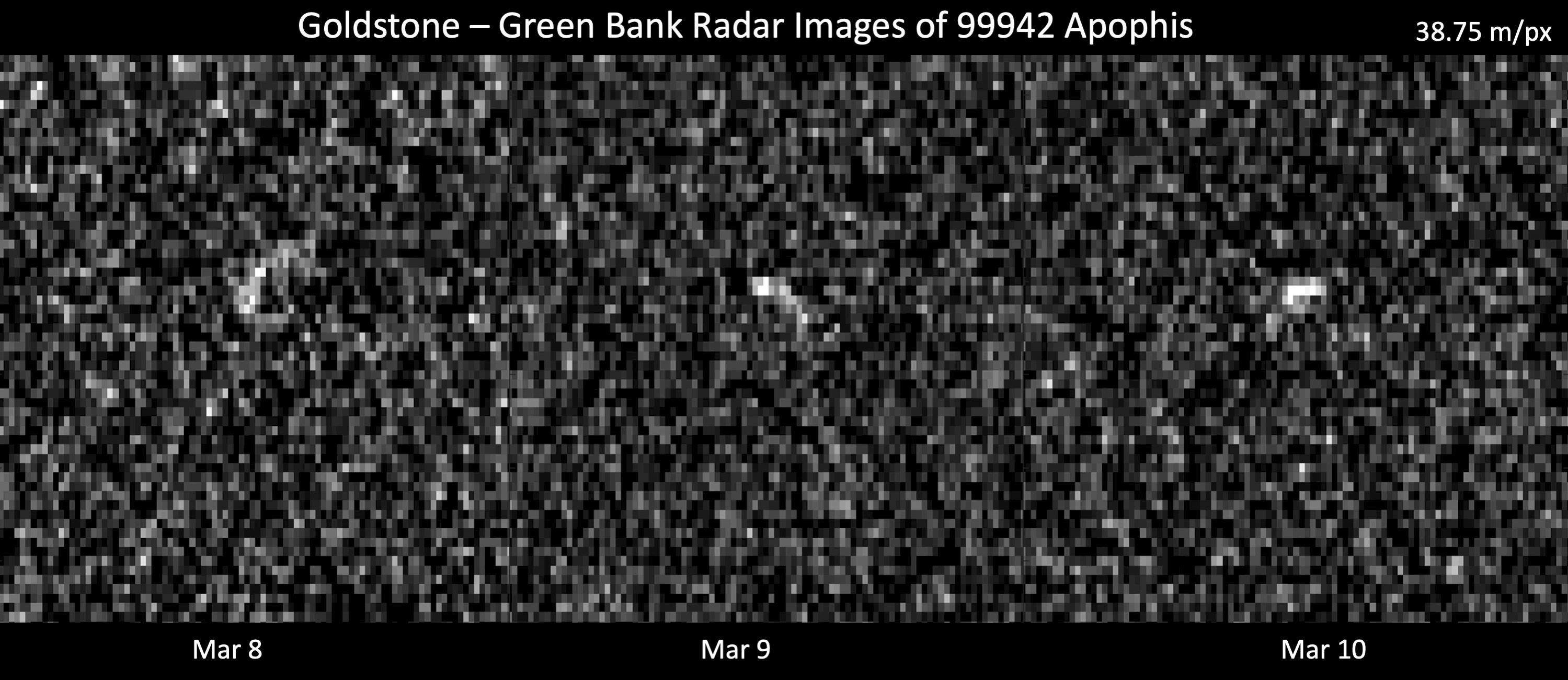
Apophis was discovered on June 19, 2004 by Roy Tucker, David Tholen, and Fabrizio Bernardi at Kitt Peak National Observatory. Initial orbit calculations in December 2004 gave a startling 2.7% impact probability for April 13, 2029, briefly raising it to Level 4 on the Torino Impact Hazard Scale — the highest level ever assigned to any asteroid. Additional observations progressively reduced the risk, and by 2021, radar observations from Goldstone completely ruled out any impact for at least 100 years. The asteroid was named after Apophis (Apep), the Egyptian serpent god of chaos and destruction.
Fun Facts
The 2029 flyby of Apophis will be so close that Earth's gravity will significantly alter the asteroid's orbit — it will arrive as an Aten-type asteroid (orbiting mostly inside Earth's orbit) and leave as an Apollo-type (orbiting mostly outside). Tidal forces during the pass may cause detectable surface changes like landslides. Multiple space agencies are planning observation campaigns, and ESA's Ramses mission aims to rendezvous with Apophis shortly after the encounter to study how the flyby affected it. The date of closest approach — Friday, April 13 — adds an ironic touch.
Properties
Position & Identifiers
Physical Properties
Orbital Properties
Brightness Forecast (next 12 months)
Apparent magnitude as Earth–asteroid distance changes through the year. The peak marks the brightest moment in the window — usually around opposition, when the asteroid is closest and fully illuminated.
Computed from JPL orbital elements via m = H + 5·log10(r·Δ). Phase-function correction is omitted, so curves trace distance variation only — accurate within a few tenths for main-belt asteroids; coarse for fast-moving NEOs near Earth.
Observing Tips
Discovery
Current Ephemeris
How easy to spot?
| Telescope | Bortle 3 | Bortle 4 | Bortle 5 |
|---|---|---|---|
| 80 mm refractor 80mm refr. | Imp. | Imp. | Imp. |
| 150 mm Newton 150mm Newt. | Imp. | Imp. | Imp. |
| Celestron C8 (203 mm SCT) C8 203mm | Imp. | Imp. | Imp. |
Bortle 3 = rural · 4 = outer suburbs · 5 = suburbs
Visibility
Set a location in User Settings to see visibility data.
Explore Nightbase
Related knowledge, tools, and stories — no observation planning required.
