Eros — Near-Earth Object in Ophiuchus
433 Eros
About Eros
Description
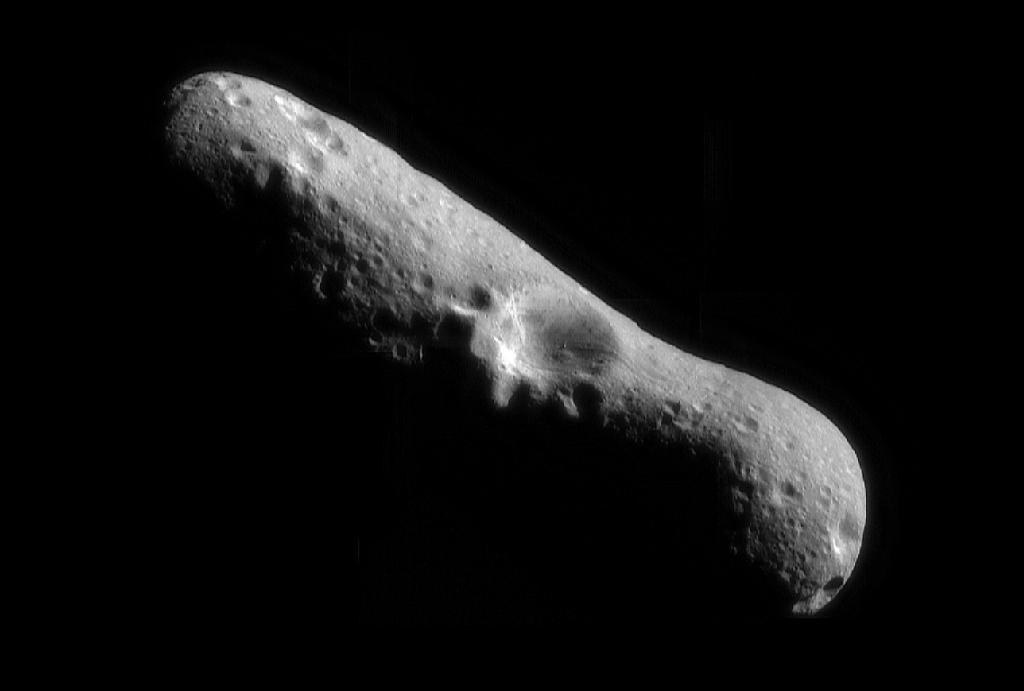
Eros (433 Eros) is a near-Earth asteroid and the second-largest member of the Amor group, with dimensions of roughly 34 × 11 × 11 km — making it shaped like a curved potato or peanut. It orbits the Sun at a mean distance of 1.46 AU, with a perihelion of 1.13 AU that brings it inside the orbit of Mars but not quite to Earth's orbit. Eros is an S-type asteroid with a stony composition of silicates and some metal. It was the first near-Earth asteroid ever discovered and the first asteroid to be orbited and landed on by a spacecraft. Its elongated shape and tumbling rotation produce dramatic brightness variations visible from Earth.
Observing Tips
Eros is typically faint (magnitude 11–15), but during close approaches to Earth it can brighten dramatically — reaching magnitude 7 or even brighter during rare favorable oppositions, making it visible in binoculars. Its next very close approach will occur in January 2056, when it may reach magnitude 6.7. When bright, Eros can show rapid motion against the stars and noticeable brightness changes over hours due to its elongated shape and 5.27-hour rotation period. Check ephemeris data for upcoming apparitions. At typical magnitudes of 11–13, a 6-inch or larger telescope is needed. Its near-Earth orbit means it can appear in any part of the sky.
History
Eros was discovered on August 13, 1898, independently by Gustav Witt in Berlin and Auguste Charlois in Nice. It was the first known near-Earth asteroid, and its close approaches were used for decades to improve measurements of the astronomical unit (the Earth-Sun distance). In February 2000, NASA's NEAR Shoemaker spacecraft entered orbit around Eros, returning over 160,000 images during its year-long mission. On February 12, 2001, NEAR Shoemaker gently touched down on Eros's surface — the first spacecraft landing on an asteroid — continuing to transmit data for over two weeks from the surface.
Fun Facts
Eros is so large that if it ever struck Earth, it would be an extinction-level event — similar in scale to the Chicxulub impactor that killed the dinosaurs. Fortunately, its orbit currently does not intersect Earth's. The NEAR Shoemaker landing was never planned in the original mission — NASA engineers improvised the touchdown as a bonus after the orbital mission was complete, and were astonished when the spacecraft survived and kept transmitting. Eros contains more gold, silver, and platinum than has ever been mined in all of human history.
Properties
Position & Identifiers
Physical Properties
Orbital Properties
Brightness Forecast (next 12 months)
Apparent magnitude as Earth–asteroid distance changes through the year. The peak marks the brightest moment in the window — usually around opposition, when the asteroid is closest and fully illuminated.
Computed from JPL orbital elements via m = H + 5·log10(r·Δ). Phase-function correction is omitted, so curves trace distance variation only — accurate within a few tenths for main-belt asteroids; coarse for fast-moving NEOs near Earth.
Observing Tips
Discovery
Current Ephemeris
How easy to spot?
| Telescope | Bortle 3 | Bortle 4 | Bortle 5 |
|---|---|---|---|
| 80 mm refractor 80mm refr. | Easy | Easy | Easy |
| 150 mm Newton 150mm Newt. | Easy | Easy | Easy |
| Celestron C8 (203 mm SCT) C8 203mm | Easy | Easy | Easy |
Bortle 3 = rural · 4 = outer suburbs · 5 = suburbs
Visibility
Set a location in User Settings to see visibility data.
Explore Nightbase
Related knowledge, tools, and stories — no observation planning required.
