Phaethon
3200 Phaethon, 1983 TB
Properties
Position & Identifiers
Physical Properties
Orbital Properties
Observing Tips
Discovery
Current Ephemeris
Visibility
Set a location in User Settings to see visibility data.
About Phaethon
Description
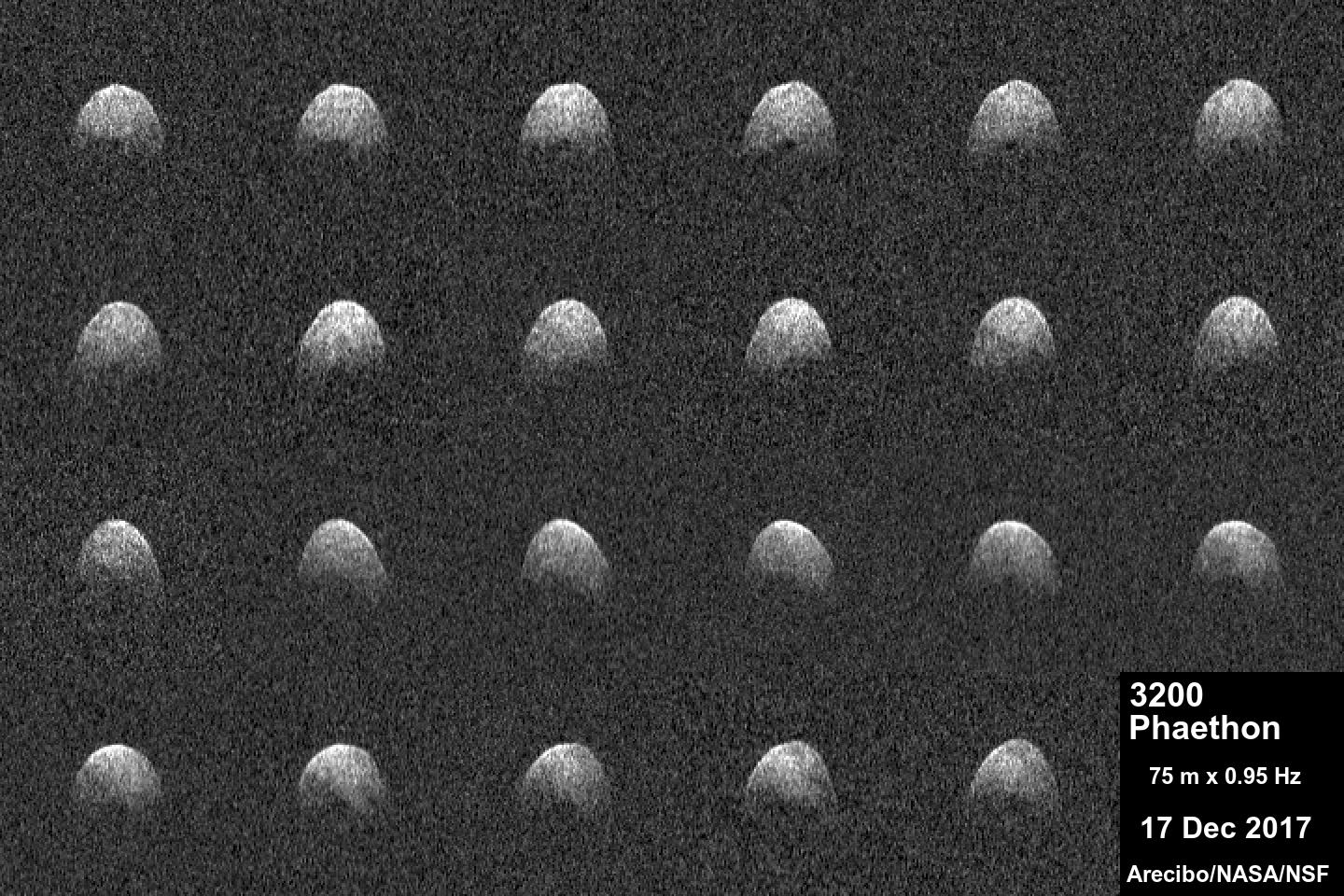
Phaethon (3200 Phaethon) is an unusual near-Earth asteroid about 5.8 km in diameter with an orbital period of just 1.43 years. It is the parent body of the Geminid meteor shower, one of the strongest and most reliable annual meteor displays. Phaethon's orbit takes it closer to the Sun than any other named asteroid, with a perihelion of just 0.14 AU — well inside Mercury's orbit — where surface temperatures exceed 750°C. This extreme solar heating may cause thermal fracturing that releases the dust and debris responsible for the Geminids. Phaethon is classified as a B-type asteroid with a very dark, carbon-rich surface, and it may be a dormant or 'rock comet' — an asteroid that sheds material through thermal stress rather than ice sublimation.
Observing Tips
Phaethon is typically faint at magnitude 14–18, requiring a large amateur telescope. During close approaches to Earth, it can brighten to magnitude 10–11 and become accessible to medium-sized telescopes. Its fast orbital speed means it can move noticeably against the stars within a single night. The best way to 'observe' Phaethon's legacy is to watch the Geminid meteor shower, which peaks around December 13–14 each year and can produce 120–150 meteors per hour under ideal conditions. Phaethon itself is best found using precise ephemeris data and a go-to telescope, as it is a challenging target that looks like any other faint star.
History
Phaethon was discovered on October 11, 1983 by Simon Green and John Davies using data from the Infrared Astronomical Satellite (IRAS) — making it the first asteroid discovered via a spacecraft rather than ground-based observation. Fred Whipple quickly identified its orbital similarity to the Geminid meteor stream, establishing the first confirmed link between an asteroid (rather than a comet) and a meteor shower. It was named after Phaethon, the son of the sun god Helios in Greek mythology, who drove his father's chariot too close to the Sun — fitting for the asteroid that approaches the Sun most closely. JAXA's DESTINY+ mission, planned for the late 2020s, will fly past Phaethon to study its surface and dust emission.
Fun Facts
Phaethon challenges the traditional distinction between asteroids and comets. While it looks and behaves like an asteroid, it produces a meteor shower like a comet. Scientists have observed faint dust tails when Phaethon is near the Sun, likely from rock literally cracking apart under extreme heat rather than ice evaporating. The Geminids are unusual among meteor showers for being denser than typical cometary debris — Geminid meteors are rocky rather than icy, producing brighter, more colorful streaks. Phaethon's surface is among the bluest (most negatively sloped in reflectance) of any asteroid, possibly due to its repeated solar roasting.