Sky Digest
Export Sky Digest PDF
Include finder charts for selected objects:
Tonight at a Glance
Planet Highlights
Comets
For Beginners (naked eye)
Binocular Targets
Small Scopes (3–6 inch)
Big Scopes (8–12 inch)
The Week Ahead
| Wed | Thu | Fri | Sat | Sun | Mon | Tue |
| 🌘 4% | 🌑 1% | 🌑 0% | 🌑 1% | 🌑 3% | 🌒 7% | 🌒 13% |
| — | — | — | — | — | — | — |
NASA Astronomy Picture of the Day
W5: The Soul Nebula
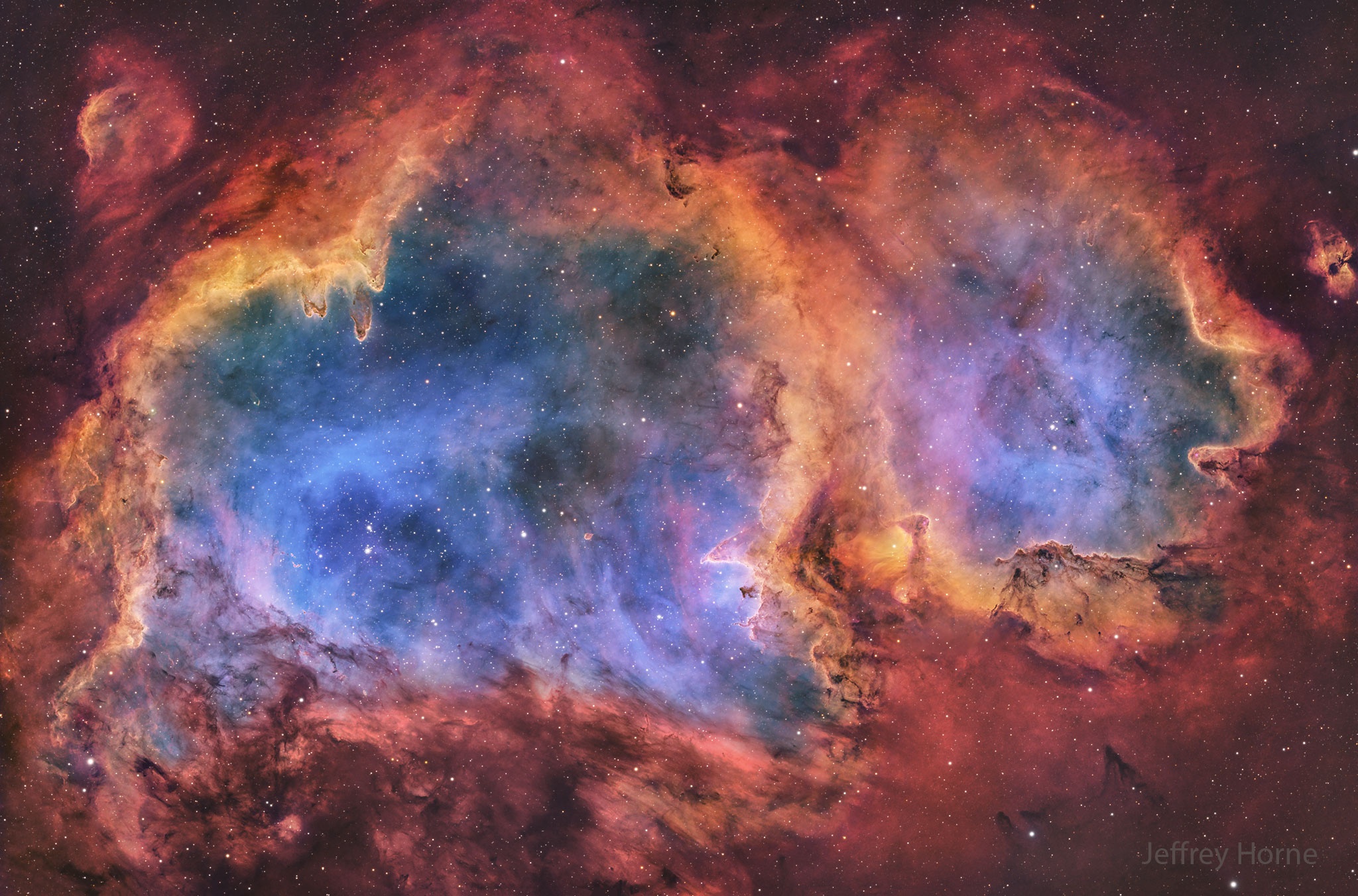
Stars are forming in the Soul of the Queen of Aethopia. More specifically, a large star forming region called the Soul Nebula can be found in the direction of the constellation Cassiopeia, whom Greek mythology credits as the vain wife of a King who long ago ruled lands surrounding the upper Nile river. Also known as Westerhout 5 (W5), the Soul Nebula houses several open clusters of stars, ridges and pillars darkened by cosmic dust, and huge evacuated bubbles formed by the winds of young massive stars. Located about 6,500 light years away, the Soul Nebula spans about 100 light years and is usually imaged next to its celestial neighbor the Heart Nebula (IC 1805). The featured image, taken from near Nashville, Tennessee, USA, is a composite of 234 hours of exposures made in different colors: red as emitted by hydrogen gas, yellow as emitted by sulfur, and blue as emitted by oxygen. Explore the Universe: Random APOD Generator
Image credit: Jeffrey Horne — APOD is a service of NASA and Michigan Tech. U.
View on NASA APODSpace News
Artemis II, the first crewed mission to the Moon in over 50 years, is scheduled to launch on April 1, 2026, carrying four astronauts on a 10-day journey around the Moon.
ESA — 31 Mar 2026
Europe's Service Module, built by ESA and containing 33 engines, will provide the essential propulsion, power, and life support for the Artemis II spacecraft during its historic lunar mission.
ESA — 30 Mar 2026
NASA awarded Intuitive Machines $180.4 million to deliver science payloads to the lunar surface as part of the Commercial Lunar Payload Services initiative supporting the Artemis program.
NASA — 27 Mar 2026
Plan your session before dark
Use Tonight to find targets, then add them to a Plan so you have a checklist ready when you're outside.
Open TonightSign in to get this digest by email and customize it for your location.