Sky Digest
Export Sky Digest PDF
Include finder charts for selected objects:
Tonight at a Glance
Planet Highlights
Comets
For Beginners (naked eye)
Binocular Targets
Small Scopes (3–6 inch)
Big Scopes (8–12 inch)
The Week Ahead
| Thu | Fri | Sat | Sun | Mon | Tue | Wed |
| 🌑 1% | 🌑 0% | 🌑 1% | 🌑 3% | 🌒 7% | 🌒 13% | 🌒 21% |
| — | — | — | — | — | — | — |
NASA Astronomy Picture of the Day
Jupiter and the Meteors from Gemini
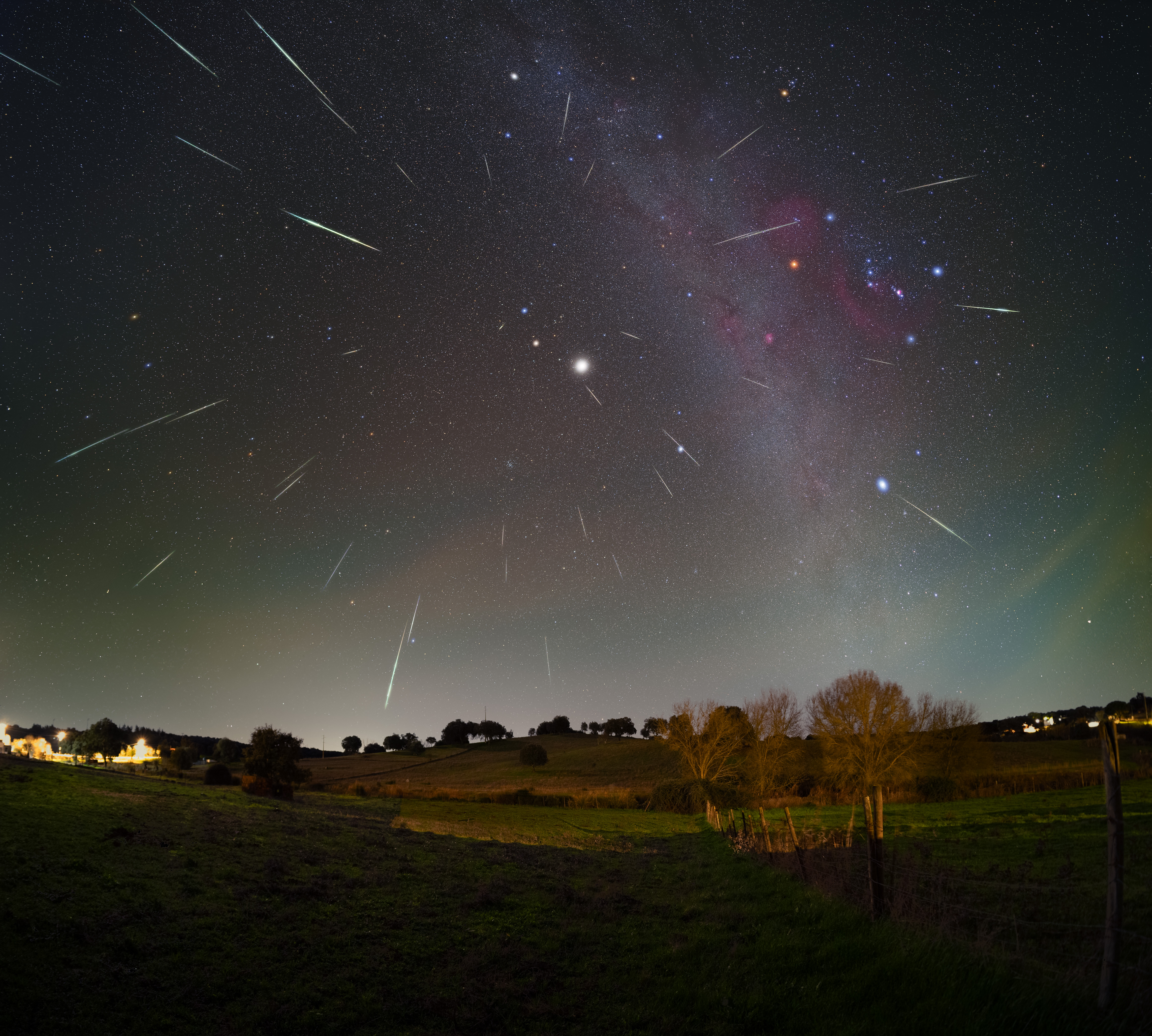
Jupiter, the Solar System's ruling gas giant, is the brightest celestial beacon at the center of this composite night skyscape. The scene was constructed by selecting the 40 exposures containing meteors from about 500 exposures made on the nights of December 13 and 14, near peak activity for this year's annual Geminid meteor shower. With each selected exposure registered in the night sky above Alentejo, Portugal, planet Earth, it does look like the meteors are streaming away from Jupiter. But the apparent radiant of the Geminid meteors is actually closer to bright star Castor, in the shower's eponymous constellation Gemini. In this frame that's just a little above and left of the Solar System's most massive planet. Still, the parent body of Geminid meteors is known to be rocky, near-Earth asteroid 3200 Phaethon. And the orbit of Phaethon itself is influenced by the gravitational attraction exerted by massive Jupiter, in concert with planets of the inner Solar System.
Image credit: David Cruz — APOD is a service of NASA and Michigan Tech. U.
View on NASA APODSpace News
Artemis II, the first crewed mission to the Moon in over 50 years, is scheduled to launch on April 1, 2026, carrying four astronauts on a historic 10-day journey around the Moon and back to Earth.
ESA — 31 Mar 2026
Europe's Service Module, built by ESA and equipped with 33 engines, will provide critical propulsion, power, and life support for the Artemis II spacecraft during its crewed lunar mission.
ESA — 30 Mar 2026
NASA awarded Intuitive Machines $180.4 million to deliver NASA-funded science payloads to the lunar surface as part of the Commercial Lunar Payload Services initiative supporting the Artemis program.
NASA — 27 Mar 2026
Artemis II will carry not only four astronauts but also European engineers and medical specialists, with the European Service Module as a key component powering humanity's return to lunar exploration.
ESA — 31 Mar 2026
Plan your session before dark
Use Tonight to find targets, then add them to a Plan so you have a checklist ready when you're outside.
Open TonightSign in to get this digest by email and customize it for your location.