Sky Digest
Export Sky Digest PDF
Include finder charts for selected objects:
Tonight at a Glance
Planet Highlights
Comets
For Beginners (naked eye)
Binocular Targets
Small Scopes (3–6 inch)
Big Scopes (8–12 inch)
The Week Ahead
| Tue | Wed | Thu | Fri | Sat | Sun | Mon |
| 🌒 13% | 🌒 21% | 🌓 30% | 🌓 40% | 🌔 50% | 🌔 61% | 🌔 72% |
| — | — | — | — | — | — | — |
NASA Astronomy Picture of the Day
Red Sprites and Circular Elves Lightning over Italy
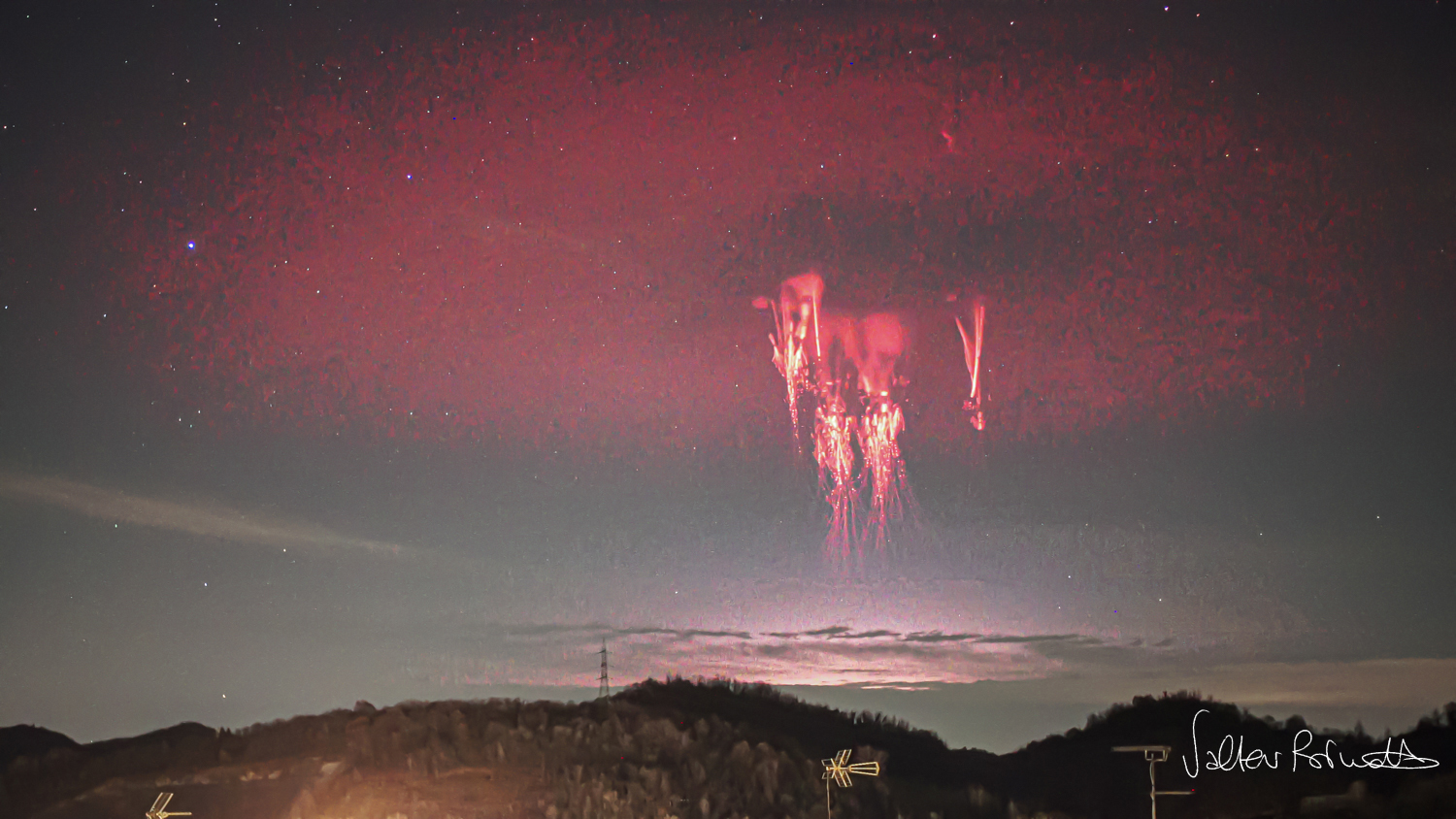
What's happening in the sky? Lightning. The most commonly seen type of lightning involves flashes of bright white light between clouds. Over the past 50 years, though, other types of upper-atmospheric lightning have been confirmed, including tentacled red sprites and ringed ELVES. Although both last only a small fraction of a second, sprites are brighter and easier to photograph than their more common electrical-discharge cousins. ELVES are rapidly expanding rings that are thought to be created when an electromagnetic pulse shoots upward from charged clouds and impacts the ionosphere, causing nitrogen molecules to glow. Capturing either form of lightning takes patience and experience -- capturing them both together, since they usually occur separately, is rare. The featured image is a frame from a video recorded from Possagno, Italy late last month above a distant thunderstorm over the Adriatic Sea.
Image credit: Valter Binotto — APOD is a service of NASA and Michigan Tech. U.
View on NASA APODSpace News
NASA officially presents the Artemis II crew (Reid Wiseman, Victor Glover, Christina Koch, and Jeremy Hansen) ahead of their historic crewed mission around the Moon.
NASA — 30 Mar 2026
NASA awards Intuitive Machines $180.4 million to deliver science payloads to the lunar surface as part of the Commercial Lunar Payload Services initiative supporting the Artemis program.
NASA — 27 Mar 2026
NASA releases the launch countdown timeline for Artemis II, targeting no earlier than April 1, 2026, for the first crewed lunar mission in over 50 years.
NASA — 26 Mar 2026
NASA selects 10 scientists to develop the lunar south pole science plan for Artemis astronauts, including instrument deployment and sample collection on the Moon.
NASA — 27 Mar 2026
Plan your session before dark
Use Tonight to find targets, then add them to a Plan so you have a checklist ready when you're outside.
Open TonightSign in to get this digest by email and customize it for your location.