Sky Digest
Export Sky Digest PDF
Include finder charts for selected objects:
Tonight at a Glance
Planet Highlights
Comets
For Beginners (naked eye)
Binocular Targets
Small Scopes (3–6 inch)
Big Scopes (8–12 inch)
The Week Ahead
| Wed | Thu | Fri | Sat | Sun | Mon | Tue |
| 🌒 21% | 🌓 30% | 🌓 40% | 🌔 50% | 🌔 61% | 🌔 72% | 🌔 82% |
| — | — | — | — | — | — | — |
NASA Astronomy Picture of the Day
Mystery: Little Red Dots in the Early Universe
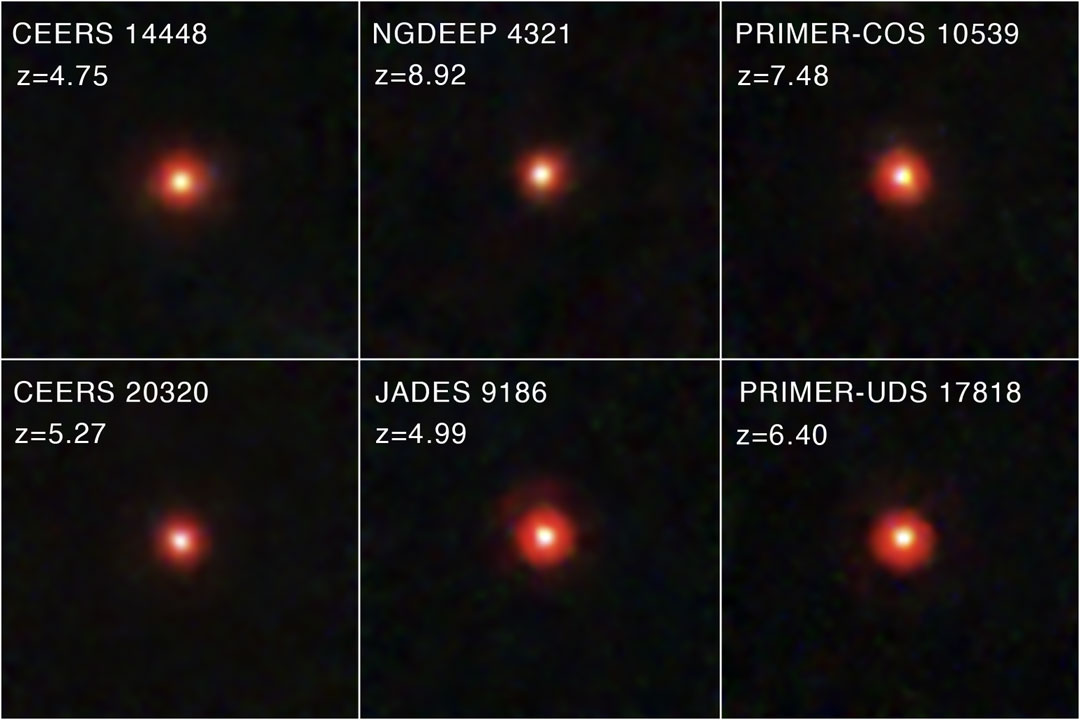
What are these little red dots (LRDs)? Nobody knows. Discovered only last year, hundreds of LRDs have now been found by the James Webb Space Telescope in the early universe. Although extremely faint, LRDs are now frequently identified in deep observations made for other purposes. A wide-ranging debate is raging about what LRDs may be and what importance they may have. Possible origin hypotheses include accreting supermassive black holes inside clouds of gas and dust, bursts of star formation in young dust-reddened galaxies, and dark matter powered gas clouds. The highlighted images show six nearly featureless LRDs listed under the JWST program that found them, and z, a distance indicator called cosmological redshift. Additionally, searches are underway in our nearby universe to try to find whatever previous LRDs might have become today.
APOD is a service of NASA and Michigan Tech. U.
View on NASA APODSpace News
NASA's Artemis II crew—astronauts Andre Douglas, Victor Glover, Christina Koch, Reid Wiseman, and Canadian astronauts Jenni Gibbons and Jeremy Hansen—were formally presented before their historic crewed lunar mission.
NASA — 30 Mar 2026
NASA awarded Intuitive Machines $180.4 million to deliver seven science payloads to the lunar surface under the CLPS initiative, supporting Artemis program objectives.
NASA — 27 Mar 2026
NASA released the launch countdown for Artemis II, targeting no earlier than April 1, 2026, for the first crewed mission to send astronauts around the Moon in over 50 years.
NASA — 26 Mar 2026
NASA selected 10 scientists to develop the science plan for Artemis lunar surface operations, including instrument deployment and sample collection at the Moon's south pole.
NASA — 27 Mar 2026
Plan your session before dark
Use Tonight to find targets, then add them to a Plan so you have a checklist ready when you're outside.
Open TonightSign in to get this digest by email and customize it for your location.