Sky Digest
Export Sky Digest PDF
Include finder charts for selected objects:
Tonight at a Glance
Planet Highlights
Comets
For Beginners (naked eye)
Binocular Targets
Small Scopes (3–6 inch)
Big Scopes (8–12 inch)
The Week Ahead
| Thu | Fri | Sat | Sun | Mon | Tue | Wed |
| 🌓 30% | 🌓 40% | 🌔 50% | 🌔 61% | 🌔 72% | 🌔 82% | 🌔 90% |
| — | — | — | — | — | — | — |
NASA Astronomy Picture of the Day
Unicorn, Fox Fur and Christmas Tree
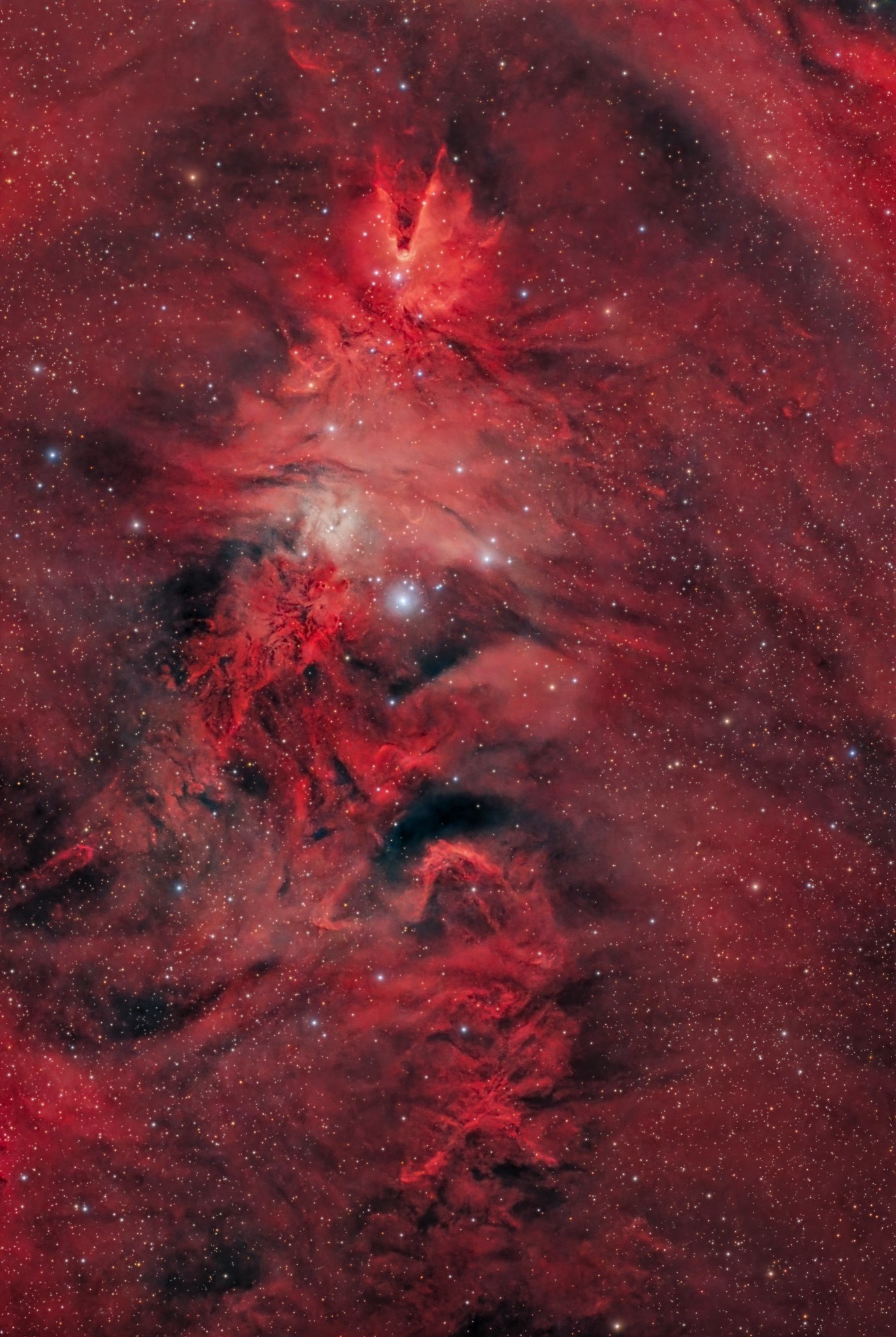
A star forming region cataloged as NGC 2264, this beautiful but complex arrangement of interstellar gas and dust is about 2,700 light-years distant in the faint but fanciful constellation Monoceros, the Unicorn. Seen toward the celestial equator and near the plane of our Milky Way galaxy, the seasonal skyscape mixes reddish emission nebulae excited by energetic light from newborn stars with dark interstellar dust clouds. Where the otherwise obscuring dust clouds lie close to the hot, young stars, they also reflect starlight, forming blue reflection nebulae. In fact, bright variable star S Monocerotis is immersed in a blue-tinted haze near center. Arrayed with a simple triangular outline above S Monocerotis, the stars of NGC 2264 are popularly known as the Christmas Tree star cluster. Carved by energetic starlight, the Cone Nebula sits upside down at the apex of this cosmic Christmas tree while the dusty, convoluted pelt of glowing gas and dust under the tree is called the Fox Fur Nebula. This rich telescopic frame spans about 1.5 degrees or 3 full moons on the sky top to bottom, covering nearly 80 light-years at the distance of NGC 2264.
Image credit: Michael Kalika — APOD is a service of NASA and Michigan Tech. U.
View on NASA APODSpace News
NASA confirmed the Artemis II crew lineup featuring astronauts Reid Wiseman, Victor Glover, Christina Koch, and Canadian astronaut Jeremy Hansen, marking humanity's return to lunar exploration after over 50 years.
NASA — 30 Mar 2026
NASA released the launch countdown for Artemis II, targeting no earlier than April 1, 2026, for the first crewed mission to send astronauts around the Moon and back to Earth.
NASA — 26 Mar 2026
NASA awarded Intuitive Machines $180.4 million to deliver NASA science payloads to the lunar surface through the Commercial Lunar Payload Services initiative, supporting the Artemis program.
NASA — 27 Mar 2026
NASA selected 10 scientists to develop the lunar surface science plan for Artemis astronauts, including deployment of instruments and collection of lunar samples at the Moon's South Pole.
NASA — 27 Mar 2026
Plan your session before dark
Use Tonight to find targets, then add them to a Plan so you have a checklist ready when you're outside.
Open TonightSign in to get this digest by email and customize it for your location.