Sky Digest
Export Sky Digest PDF
Include finder charts for selected objects:
Tonight at a Glance
Bright moon tonight — deep-sky viewing will be limited
Planet Highlights
Comets
For Beginners (naked eye)
Binocular Targets
Small Scopes (3–6 inch)
Big Scopes (8–12 inch)
The Week Ahead
| Mon | Tue | Wed | Thu | Fri | Sat | Sun |
| 🌕 99% | 🌖 96% | 🌖 90% | 🌖 83% | 🌖 75% | 🌖 66% | 🌖 57% |
| — | — | — | — | — | — | — |
NASA Astronomy Picture of the Day
Orion: The Running Man Nebula
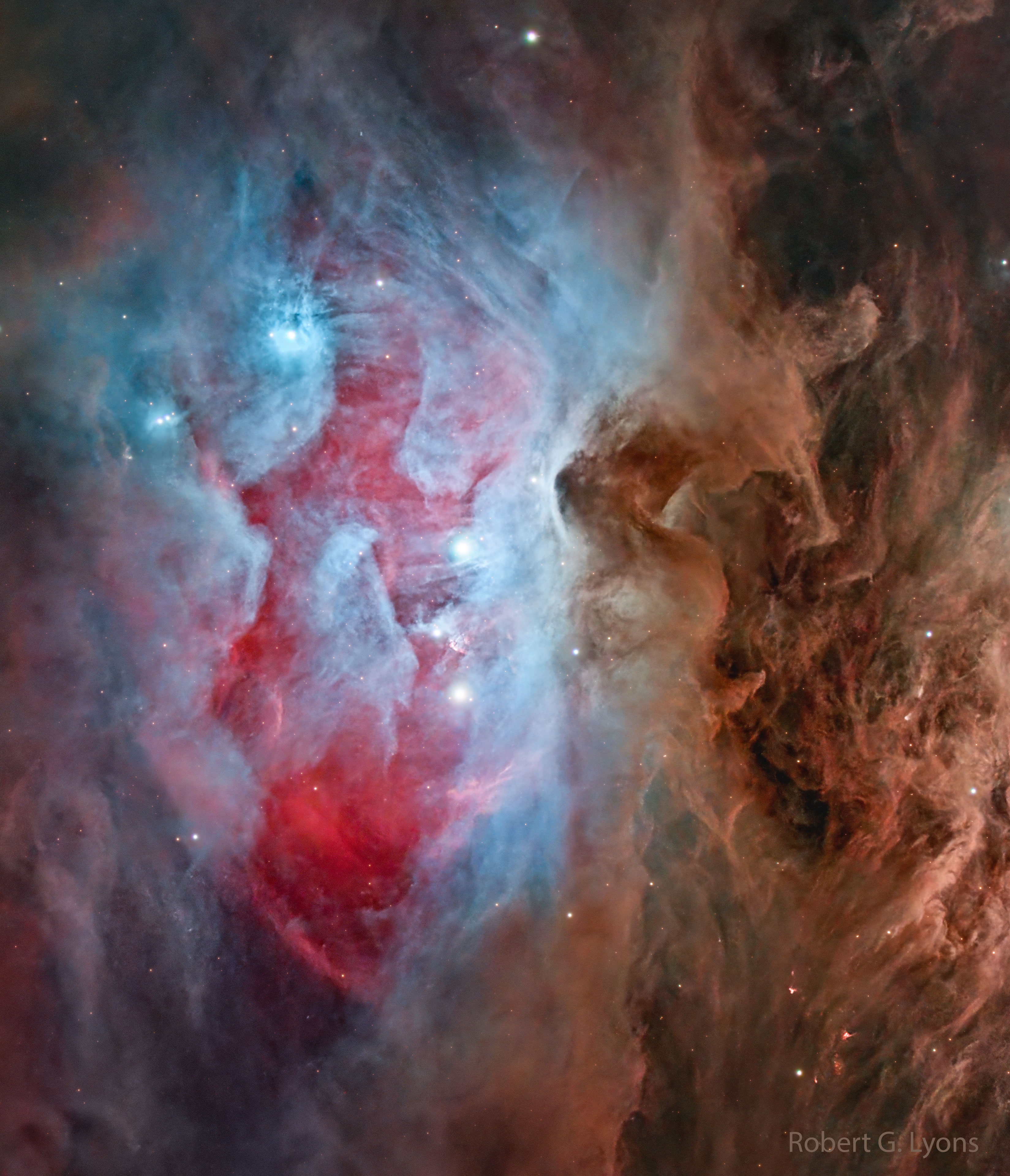
What part of Orion is this? Just north of the famous Orion Nebula is a picturesque star forming region in Orion's Sword that contains a lot of intricate dust -- some of which appears blue because it reflects the light of bright embedded stars. The region's popular name is the Running Man Nebula because, looked at from the right, part of the brown dust appears to be running legs. Cataloged as Sharpless 279, the reflection nebula is not only part of the constellation of Orion, but part of the greater Orion molecular cloud complex. Light from the Running Man's bright stars, including 42 Orionis, the bright star closest to the featured image center, is slowly destroying and reshaping the surrounding dust, which will likely be completely gone in about 10 million years. The nebula spans about 15 light years and lies about 1,500 light years away. Jigsaw Nebula: Astronomy Puzzle of the Day
Image credit: Robert G. Lyons (Robservatory) — APOD is a service of NASA and Michigan Tech. U.
View on NASA APODSpace News
NASA releases Artemis II Moon mission launch countdown targeting April 1, 2026, with astronauts Reid Wiseman, Victor Glover, Christina Koch, and Canadian astronaut Jeremy Hansen preparing for their crewed lunar flyby mission.
NASA — 26 Mar 2026
NASA's Nancy Grace Roman Space Telescope completes construction and wraps up prelaunch testing, with a media briefing scheduled for April 21 to showcase this major new observatory before launch.
NASA — 26 Mar 2026
Hubble Space Telescope discovers the first-ever spin reversal of a small comet, demonstrating how volatile activity can dramatically affect the rotation and evolution of small solar system bodies.
NASA — 26 Mar 2026
NASA's IXPE mission captures a new observation of supernova RCW 86, combining X-ray polarimetry data with legacy observations to provide deeper insights into supernova physics.
NASA — 26 Mar 2026
Understand Your Telescope
See the light path through six telescope designs: refractor, Newtonian, SCT, Maksutov, RC, and Gregorian. Adjust aperture, focal length, and eyepiece to calculate magnification and field of view.
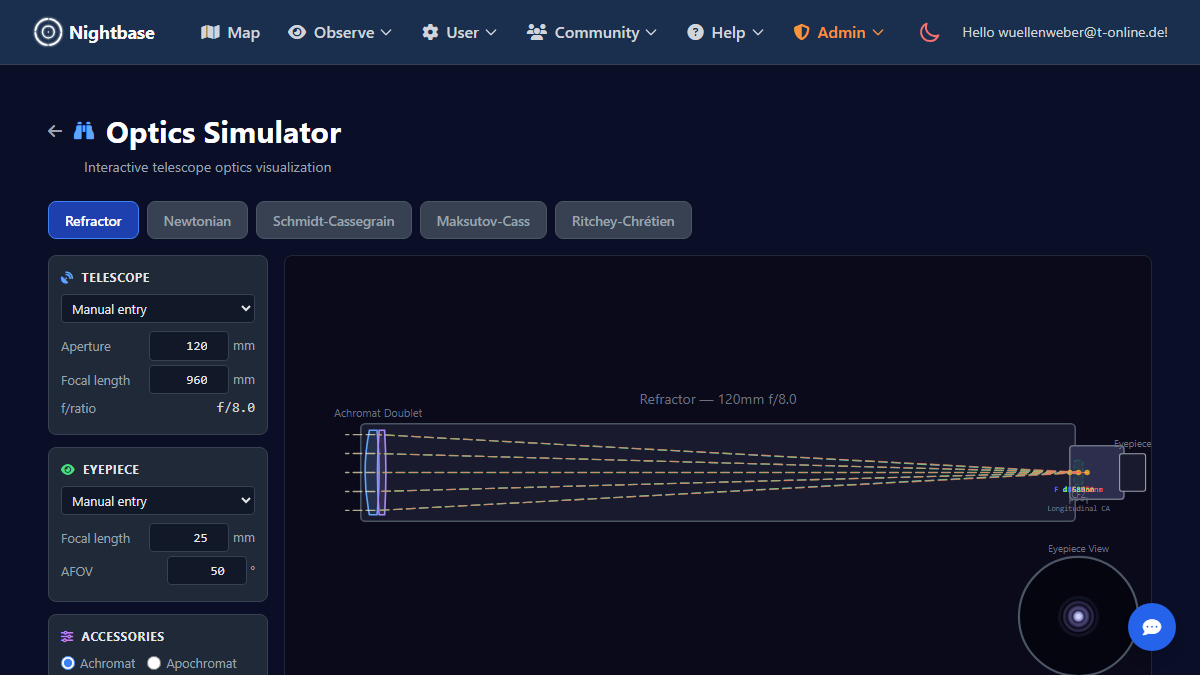 Open Optics Simulator
Sign in to get this digest by email and customize it for your location.