Der Sternenbote
Sternenbote-PDF exportieren
Aufsuchkarten für ausgewählte Objekte einschließen:
Heute Nacht auf einen Blick
Heller Mond heute Nacht — beste Deep-Sky-Beobachtung vor Mondaufgang (19:00)
Planeten-Highlights
Kometen
Für Einsteiger (mit bloßem Auge)
Fernglasziele
Kleine Teleskope (3–6 Zoll)
Große Teleskope (8–12 Zoll)
Wochenausblick
| Di | Mi | Do | Fr | Sa | So | Mo |
| 🌖 96% | 🌖 90% | 🌖 83% | 🌖 75% | 🌖 66% | 🌖 57% | 🌗 47% |
| — | — | — | — | — | — | — |
NASA Astronomiebild des Tages
Red Spider Planetary Nebula from Webb
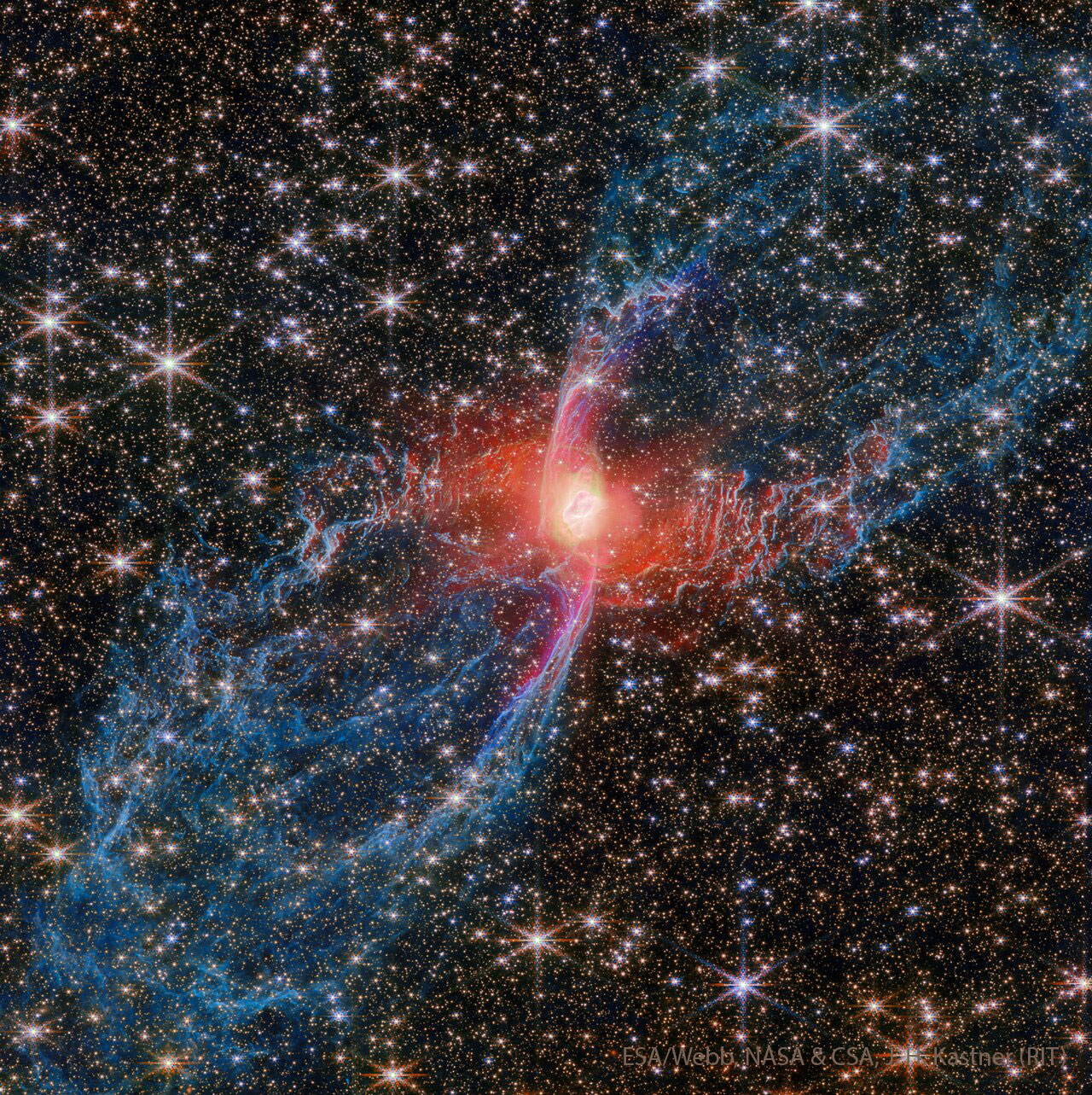
Oh what a tangled web a planetary nebula can weave. The Red Spider Planetary Nebula shows the complex structure that can result when a normal star ejects its outer gases and becomes a white dwarf star. Officially tagged NGC 6537, this two-lobed symmetric planetary nebula houses one of the hottest white dwarfs ever observed, probably as part of a binary star system. Internal winds flowing out from the central stars, have been measured in excess of 1,000 kilometers per second. These winds expand the nebula, flow along the nebula's walls, and cause waves of hot gas and dust to collide. Atoms caught in these colliding shocks radiate light shown in the featured false-color infrared picture by the James Webb Space Telescope. The Red Spider Nebula lies toward the constellation of the Archer (Sagittarius). Its distance is not well known but has been estimated by some to be about 4,000 light-years.
APOD ist ein Service der NASA und Michigan Tech. U.
Auf NASA APOD ansehenSpace News
NASA releases Artemis II Moon mission launch countdown with target date of no earlier than April 1, 2026, marking the first crewed lunar mission in over 50 years with astronauts Reid Wiseman, Victor Glover, Christina Koch, and Jeremy Hansen.
NASA — 26 Mar 2026
NASA's Nancy Grace Roman Space Telescope, recently completed construction and undergoing prelaunch testing, will be unveiled at a media briefing on April 21, representing a major new observatory for the agency.
NASA — 26 Mar 2026
NASA's Hubble Space Telescope detects the first-ever spin reversal of a small comet, providing new insights into how volatile activity affects the evolution of small bodies in the solar system.
NASA — 26 Mar 2026
Understand Your Telescope
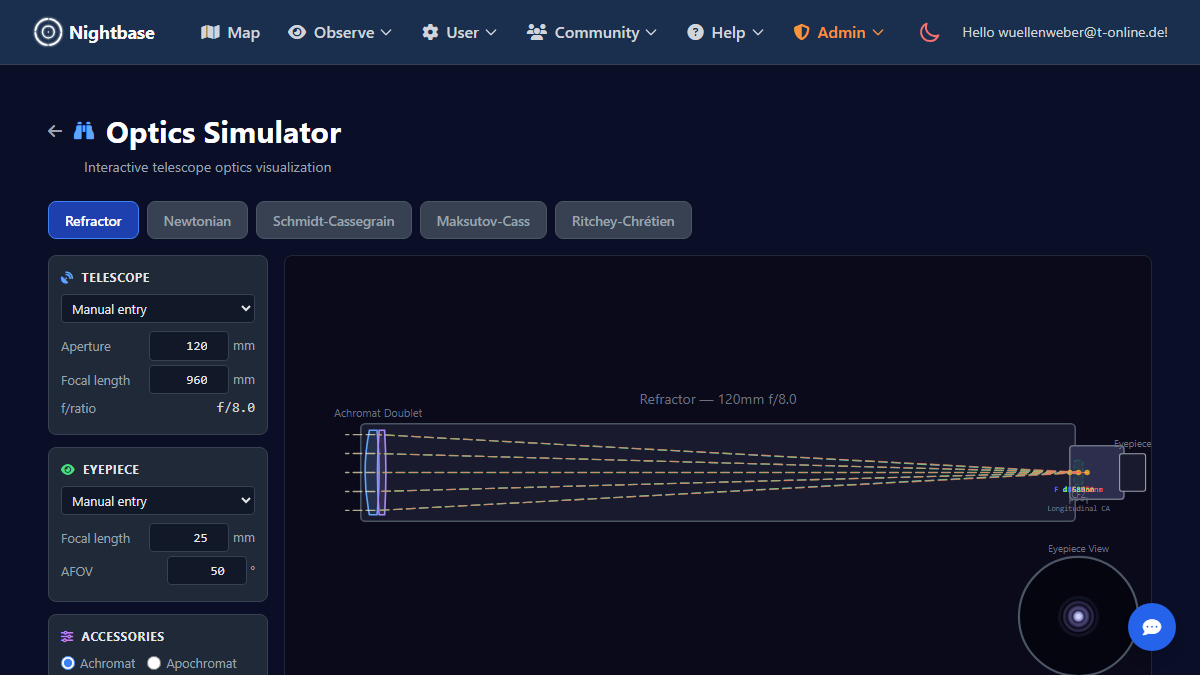
See the light path through six telescope designs: refractor, Newtonian, SCT, Maksutov, RC, and Gregorian. Adjust aperture, focal length, and eyepiece to calculate magnification and field of view.
 Open Optics Simulator
Anmelden, um den Sternenboten per E-Mail zu erhalten und für Ihren Standort anzupassen.