Der Sternenbote
Sternenbote-PDF exportieren
Aufsuchkarten für ausgewählte Objekte einschließen:
Heute Nacht auf einen Blick
Heller Mond heute Nacht — beste Deep-Sky-Beobachtung vor Mondaufgang (20:20)
Polarlicht-Vorhersage — Sehr unwahrscheinlich
Geomagnetische Aktivität weit unter dem benötigten Kp 7 für Ihren Breitengrad.
Vollständige VorhersagePlaneten-Highlights
Kometen
Für Einsteiger (mit bloßem Auge)
Fernglasziele
Kleine Teleskope (3–6 Zoll)
Große Teleskope (8–12 Zoll)
Wochenausblick
| Mi | Do | Fr | Sa | So | Mo | Di |
| 🌖 90% | 🌖 83% | 🌖 75% | 🌖 66% | 🌖 57% | 🌗 47% | 🌗 38% |
| — | — | — | — | — | — | — |
NASA Astronomiebild des Tages
Spiral Galaxy NGC 1512: Wide Field
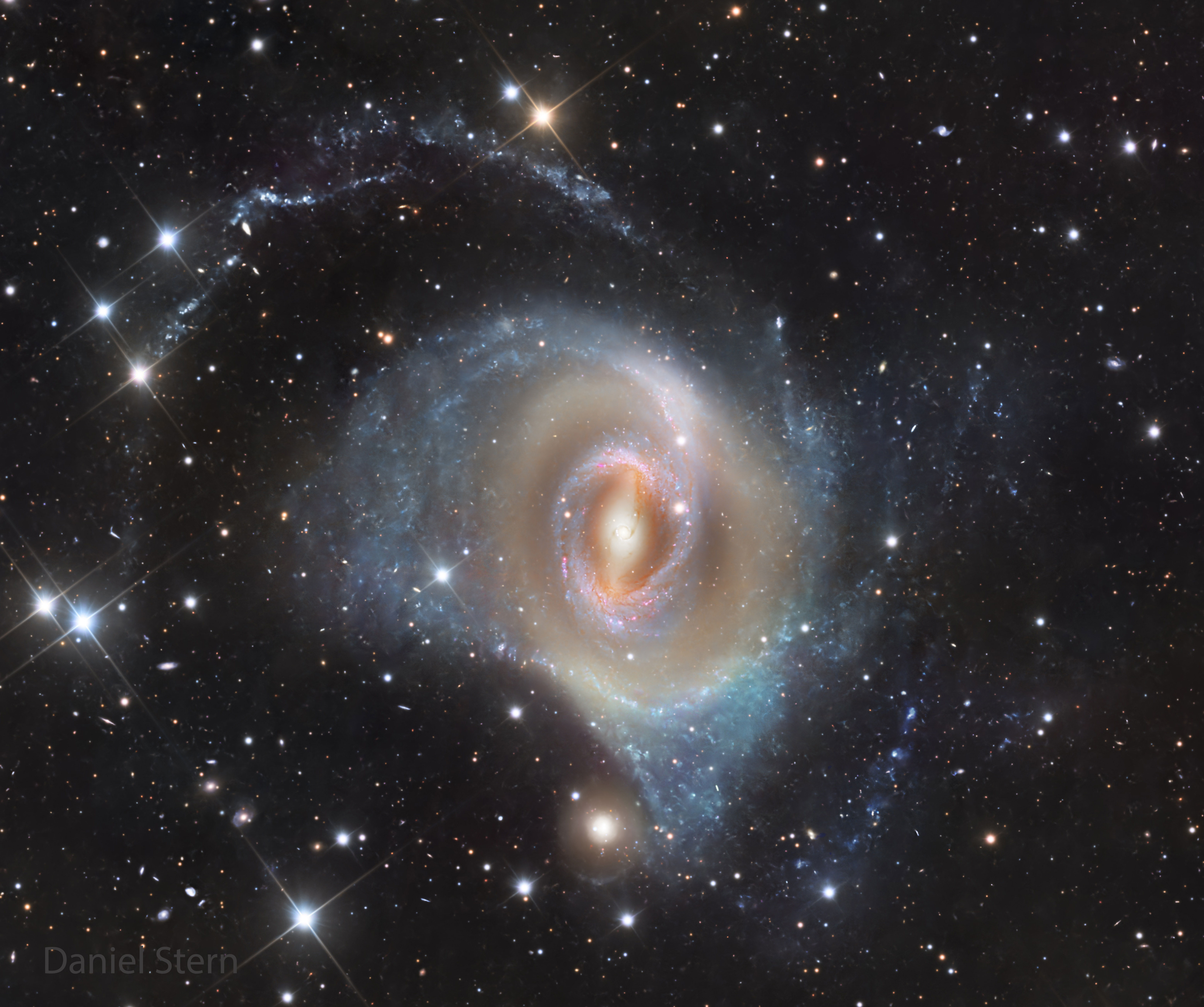
Most galaxies don't have any rings -- why does this galaxy have three? To begin, a ring that's near NGC 1512's center -- and so hard to see here -- is the nuclear ring which glows brightly with recently formed stars. Next out is a ring of stars and dust appearing both red and blue, called, counter-intuitively, the inner ring. This inner ring connects ends of a diffuse central bar of stars that runs horizontally across the galaxy. Farthest out in this wide field image is a ragged structure that might be considered an outer ring. This outer ring appears spiral-like and is dotted with clusters of bright blue stars. All these ring structures are thought to be affected by NGC 1512's own gravitational asymmetries in a drawn-out process called secular evolution. The featured image was captured last month from a telescope at Deep Sky Chile in Chile.
Bildnachweis: Daniel Stern — APOD ist ein Service der NASA und Michigan Tech. U.
Auf NASA APOD ansehenSpace News
NASA's Artemis II mission, carrying astronauts Reid Wiseman, Victor Glover, Christina Koch, and Canadian astronaut Jeremy Hansen, is entering launch countdown phase with a target date of no earlier than April 1, 2026, marking humanity's first crewed lunar mission in over 50 years.
NASA — 26 Mar 2026
NASA's Curiosity rover has concluded an intense week of science observations on Mars, wrapping up its monthslong investigation of the Boxwork terrain, continuing to advance our understanding of Martian geology.
NASA — 26 Mar 2026
NASA's Hubble Space Telescope has detected the first-ever spin reversal of a small comet, providing new insights into how volatile activity affects the physical evolution of small bodies in the solar system.
NASA — 26 Mar 2026
Understand Your Telescope
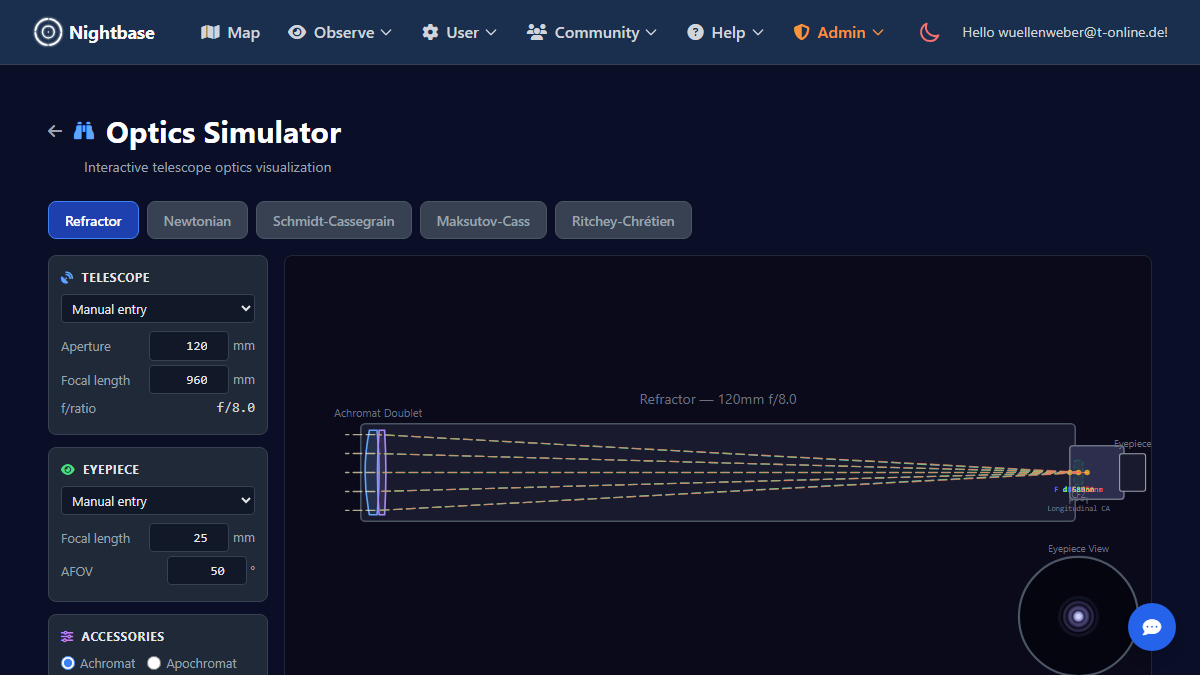
See the light path through six telescope designs: refractor, Newtonian, SCT, Maksutov, RC, and Gregorian. Adjust aperture, focal length, and eyepiece to calculate magnification and field of view.
 Open Optics Simulator
Anmelden, um den Sternenboten per E-Mail zu erhalten und für Ihren Standort anzupassen.