Der Sternenbote
Sternenbote-PDF exportieren
Aufsuchkarten für ausgewählte Objekte einschließen:
Heute Nacht auf einen Blick
Heller Mond heute Nacht — beste Deep-Sky-Beobachtung vor Mondaufgang (21:36)
Polarlicht-Vorhersage — Sehr unwahrscheinlich
Geomagnetische Aktivität weit unter dem benötigten Kp 7 für Ihren Breitengrad.
Vollständige VorhersagePlaneten-Highlights
Kometen
Für Einsteiger (mit bloßem Auge)
Fernglasziele
Kleine Teleskope (3–6 Zoll)
Große Teleskope (8–12 Zoll)
Wochenausblick
| Do | Fr | Sa | So | Mo | Di | Mi |
| 🌖 83% | 🌖 75% | 🌖 66% | 🌖 57% | 🌗 47% | 🌗 38% | 🌗 29% |
| — | — | — | — | — | — | — |
NASA Astronomiebild des Tages
NGC 1275 in the Perseus Cluster
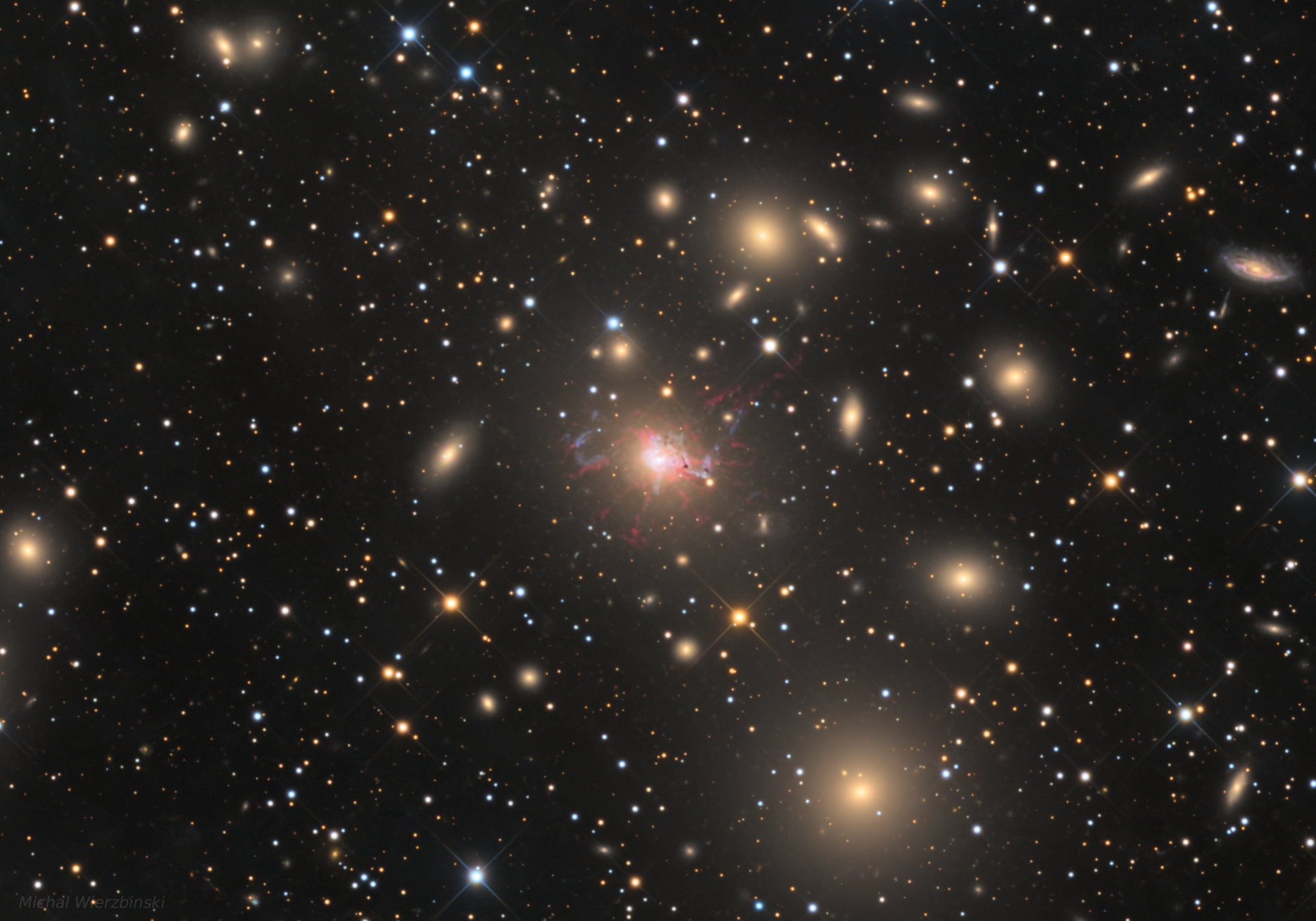
Active galaxy NGC 1275 is the central, dominant member of the large and relatively nearby Perseus Cluster of Galaxies. Wild-looking at visible wavelengths, the active galaxy is also a prodigious source of x-rays and radio emission. NGC 1275 accretes matter as entire galaxies fall into it, ultimately feeding a supermassive black hole at the galaxy's core. Narrowband image data used in this sharp telescopic image highlights the resulting galactic debris and filaments of glowing gas, some up to 20,000 light-years long. The filaments persist in NGC 1275, even though the turmoil of galactic collisions should destroy them. What keeps the filaments together? Observations indicate that the structures, pushed out from the galaxy's center by the black hole's activity, are held together by magnetic fields. Also known as Perseus A, NGC 1275 itself spans over 100,000 light years and lies about 230 million light years away.
Bildnachweis: Michal Wierzbinski — APOD ist ein Service der NASA und Michigan Tech. U.
Auf NASA APOD ansehenSpace News
Artemis II will return humans to the Moon for the first time in over 50 years, with four astronauts on a 10-day lunar journey, marking a major milestone in NASA's lunar exploration program.
ESA — 26 Mar 2026
NASA's Artemis II crewed test flight around the Moon is targeted for no earlier than April 1, 2026, with live coverage of prelaunch and mission events.
NASA — 25 Mar 2026
NASA's Hubble Space Telescope detected the first-ever spin reversal of a small comet, providing new insights into how volatile activity affects the physical evolution of solar system bodies.
NASA — 26 Mar 2026
NASA's Curiosity rover has concluded an intense week of science observations investigating the Boxwork terrain on Mars, continuing its long-term exploration mission.
NASA — 26 Mar 2026
Understand Your Telescope
See the light path through six telescope designs: refractor, Newtonian, SCT, Maksutov, RC, and Gregorian. Adjust aperture, focal length, and eyepiece to calculate magnification and field of view.
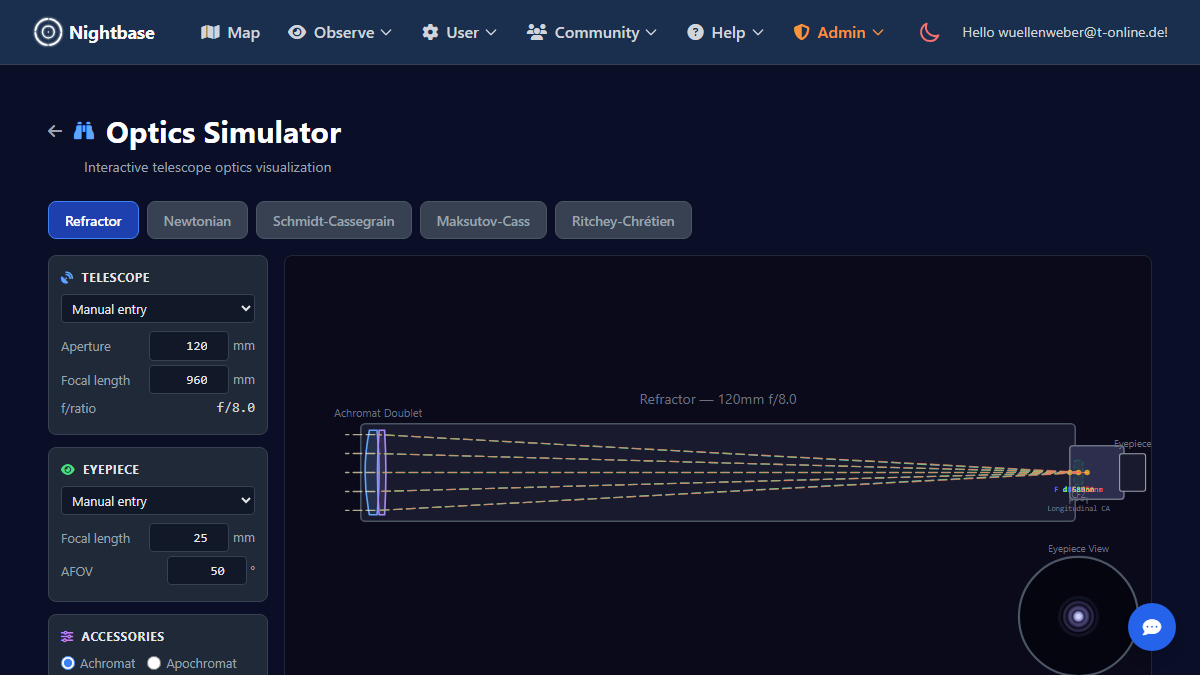 Open Optics Simulator
Anmelden, um den Sternenboten per E-Mail zu erhalten und für Ihren Standort anzupassen.