Sky Digest
Export Sky Digest PDF
Include finder charts for selected objects:
Tonight at a Glance
Bright moon tonight — best deep-sky viewing before moonrise (22:51)
Planet Highlights
Comets
For Beginners (naked eye)
Binocular Targets
Small Scopes (3–6 inch)
Big Scopes (8–12 inch)
The Week Ahead
| Fri | Sat | Sun | Mon | Tue | Wed | Thu |
| 🌖 75% | 🌖 66% | 🌖 57% | 🌗 47% | 🌗 38% | 🌗 29% | 🌘 21% |
| — | — | — | — | — | — | — |
NASA Astronomy Picture of the Day
Supernova Remnant Cassiopeia A
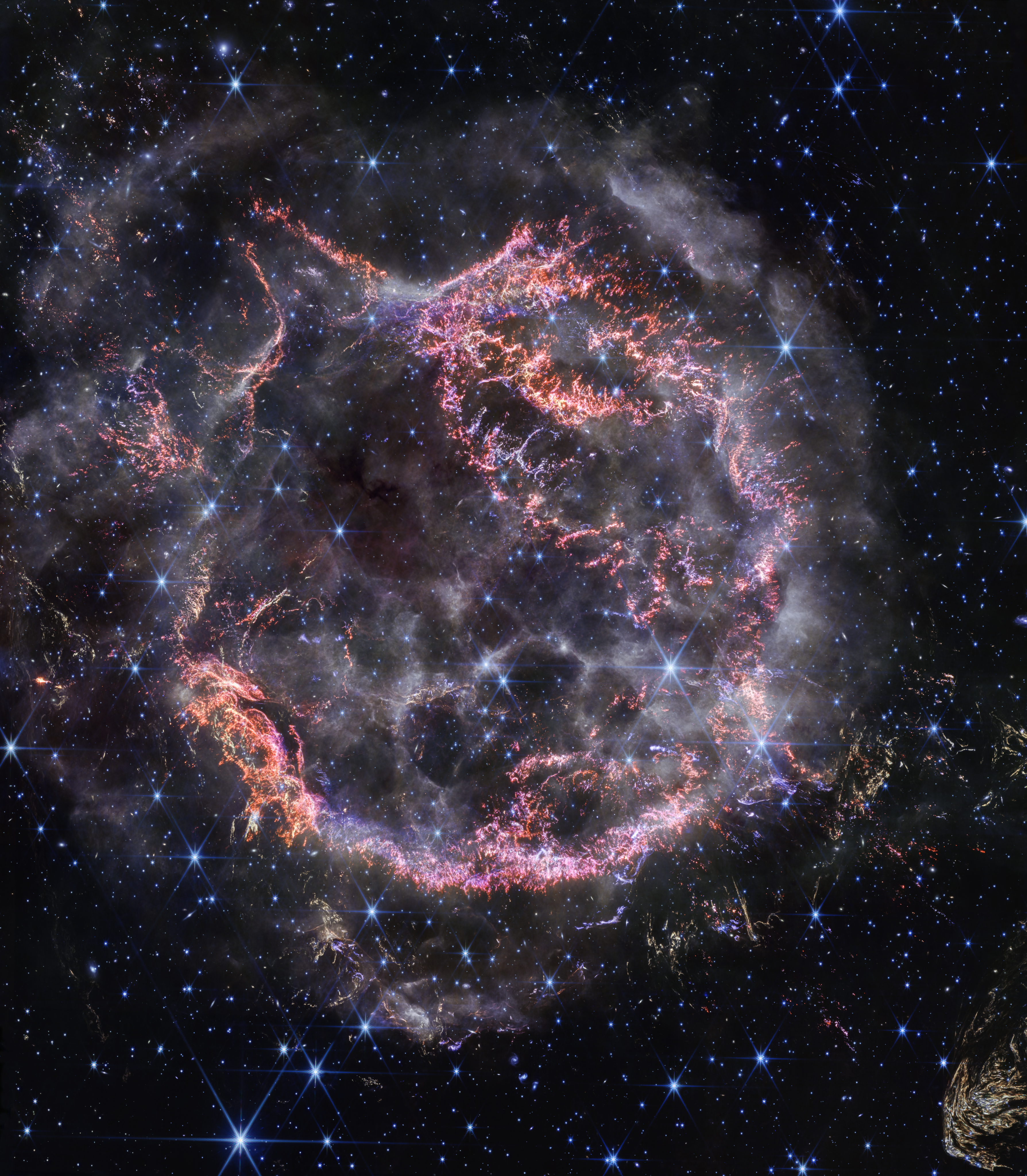
Massive stars in our Milky Way Galaxy live spectacular lives. Collapsing from vast cosmic clouds, their nuclear furnaces ignite and create heavy elements in their cores. After only a few million years for the most massive stars, the enriched material is blasted back into interstellar space where star formation can begin anew. The expanding debris cloud known as Cassiopeia A is an example of this final phase of the stellar life cycle. Light from the supernova explosion that created this remnant would have been first seen in planet Earth's sky about 350 years ago, although it took that light 11,000 years to reach us. This sharp NIRCam image from the James Webb Space Telescope shows the still-hot filaments and knots in the supernova remnant. The whitish, smoke-like outer shell of the expanding blast wave is about 20 light-years across. A series of light echoes from the massive star's cataclysmic explosion are also identified in Webb's detailed images of the surrounding interstellar medium.
APOD is a service of NASA and Michigan Tech. U.
View on NASA APODSpace News
NASA's Artemis II crewed mission around the Moon is targeting launch no earlier than April 1, 2026, marking the first human lunar mission in over 50 years.
NASA — 25 Mar 2026
NASA's Hubble Space Telescope detected the first-ever spin reversal of a small comet, providing new insights into how volatile activity affects the physical evolution of solar system bodies.
NASA — 26 Mar 2026
ESA astronaut Sophie Adenot documented multiple cargo vehicle departures from the International Space Station within a three-week period, highlighting active ISS resupply operations.
ESA — 20 Mar 2026
Understand Your Telescope
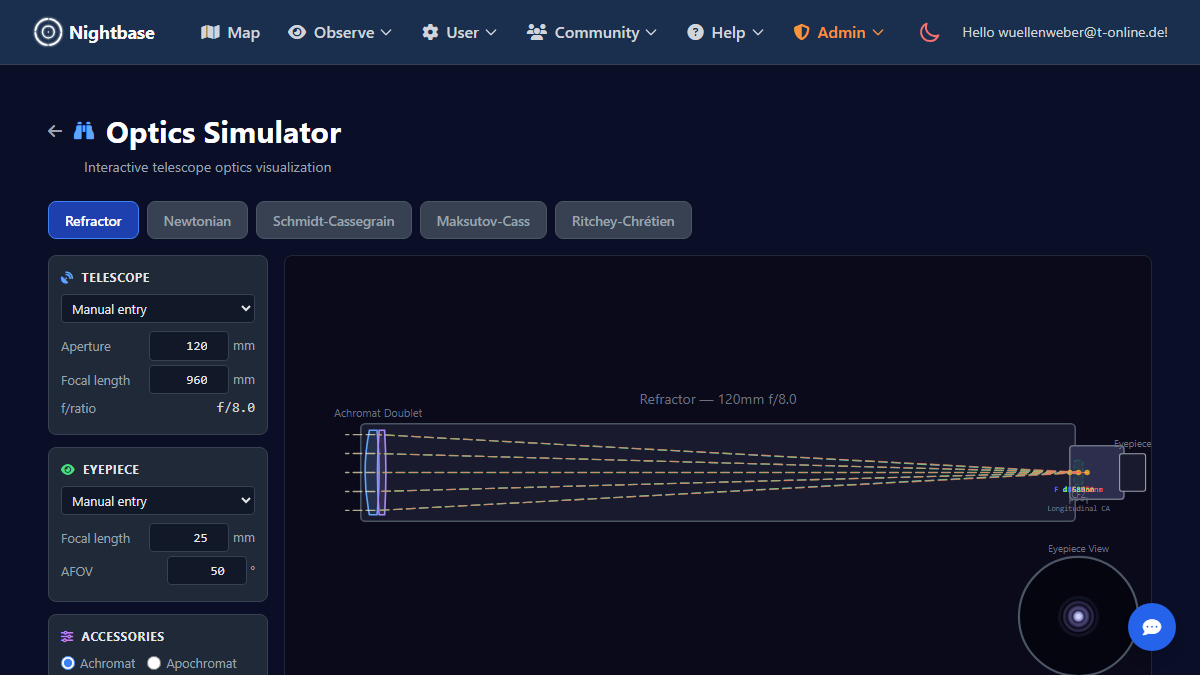
See the light path through six telescope designs: refractor, Newtonian, SCT, Maksutov, RC, and Gregorian. Adjust aperture, focal length, and eyepiece to calculate magnification and field of view.
 Open Optics Simulator
Sign in to get this digest by email and customize it for your location.