Sky Digest
Export Sky Digest PDF
Include finder charts for selected objects:
Tonight at a Glance
Planet Highlights
For Beginners (naked eye)
Binocular Targets
Small Scopes (3–6 inch)
Big Scopes (8–12 inch)
The Week Ahead
| Thu | Fri | Sat | Sun | Mon | Tue | Wed |
| 🌒 6% | 🌒 13% | 🌒 21% | 🌓 31% | 🌓 42% | 🌔 54% | 🌔 65% |
| — | — | — | — | — | — | — |
NASA Astronomy Picture of the Day
IC 2574: Coddington's Nebula
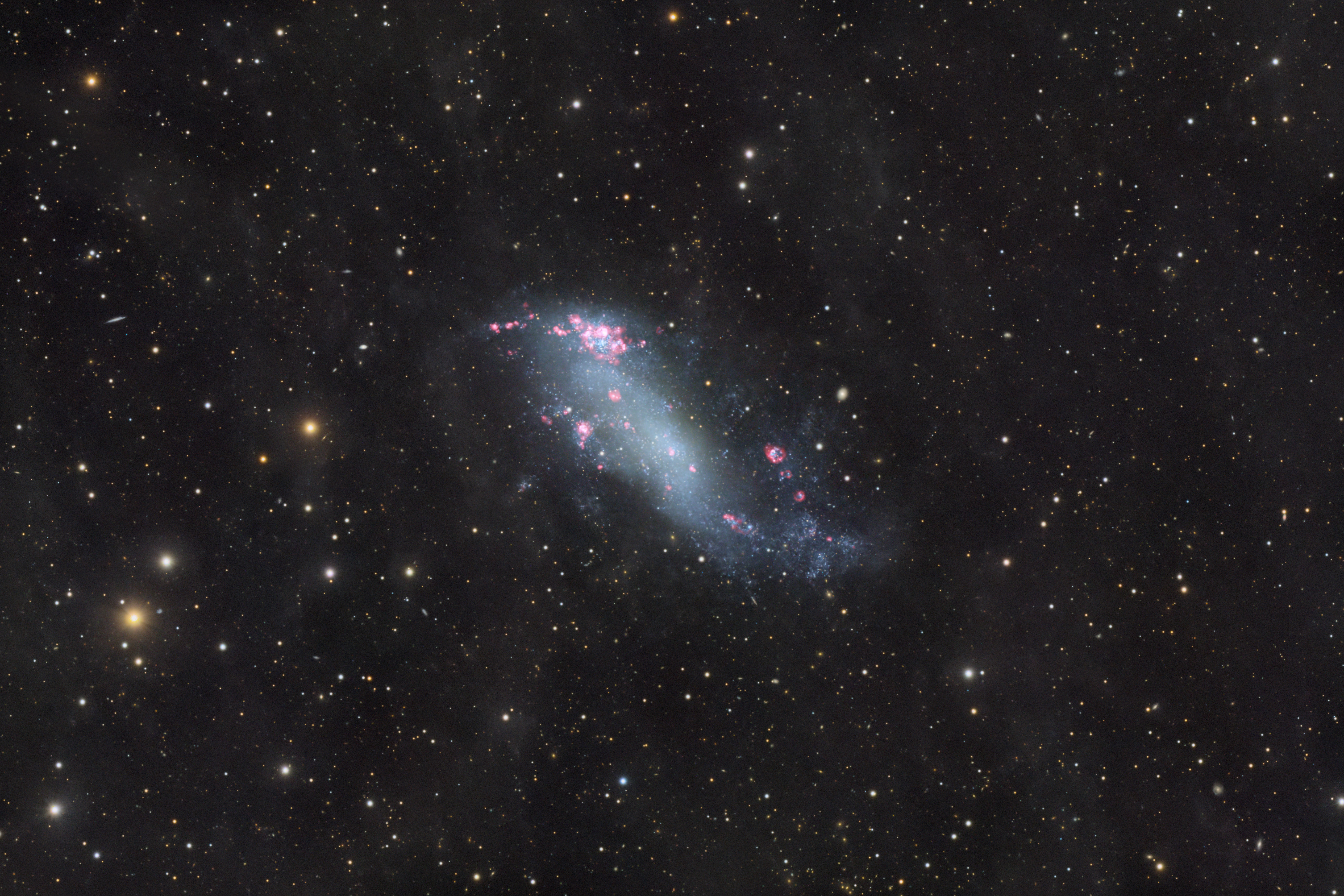
Grand spiral galaxies often seem to get all the glory, flaunting their young, bright, blue star clusters in beautiful, symmetric spiral arms. But small, irregular galaxies form stars too. In fact, dwarf galaxy IC 2574 shows clear evidence of intense star forming activity in its telltale reddish regions of glowing hydrogen gas. Just as in spiral galaxies, the turbulent star-forming regions in IC 2574 are churned by stellar winds and supernova explosions spewing material into the galaxy's interstellar medium and triggering further star formation. A mere 12 million light-years distant, IC 2574 is part of the M81 group of galaxies, seen toward the northern constellation Ursa Major. Also known as Coddington's Nebula, the faint but intriguing island universe is about 50,000 light-years across, discovered by American astronomer Edwin Coddington in 1898.
Image credit: Dane Vetter — APOD is a service of NASA and Michigan Tech. U.
View on NASA APODSpace News
Artemis II rocket completed its second rollout to the launchpad at Kennedy Space Center, advancing NASA's lunar return mission toward launch.
ESA — 20 Mar 2026
NASA is providing a water-detecting instrument to Japan's LUPEX mission to hunt for ice on the Moon's south pole in support of future human exploration.
NASA — 24 Mar 2026
NASA's IXPE mission obtained new observations of the 2,000-year-old supernova RCW 86, providing fresh insights into stellar explosions.
NASA — 24 Mar 2026
NASA astronaut Chris Williams completed spacesuit fit verification on the International Space Station, ensuring equipment readiness for future spacewalks.
NASA — 20 Mar 2026
Explore the Three-Body Problem
Simulate chaotic gravitational dynamics with preset scenarios: circumbinary planets, Lagrange points, and the famous Figure-8 choreography. Switch between inertial and co-rotating frames.
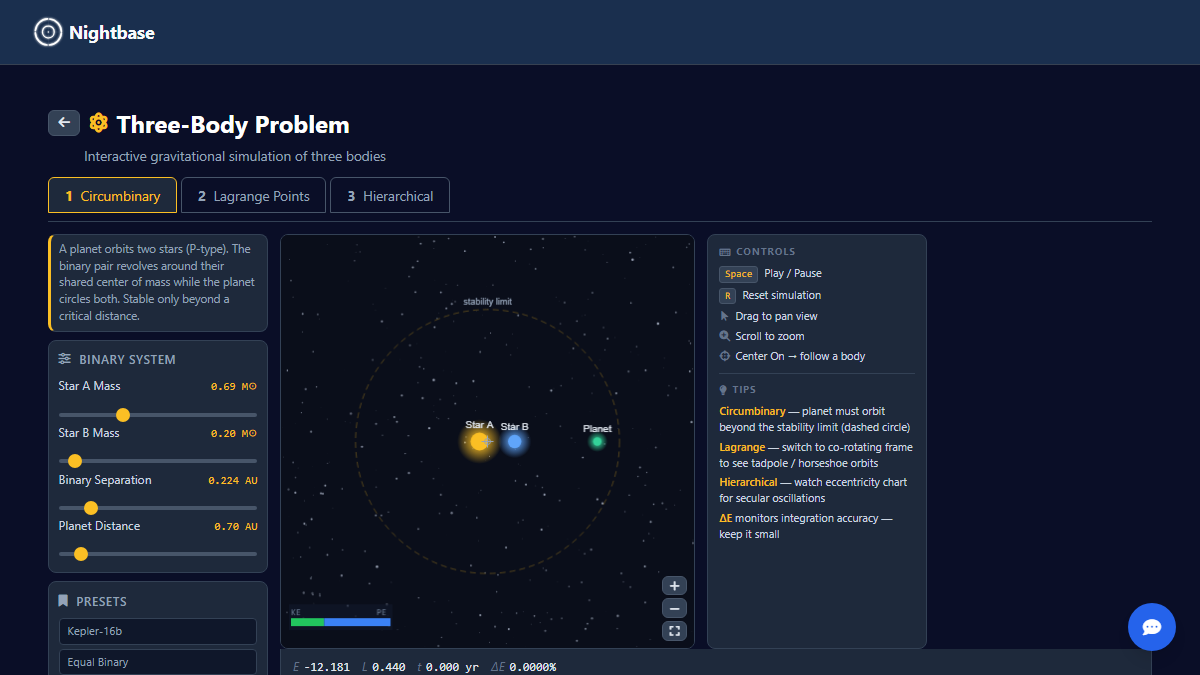 Open Three-Body
Sign in to get this digest by email and customize it for your location.