Sky Digest
Export Sky Digest PDF
Include finder charts for selected objects:
Tonight at a Glance
Planet Highlights
For Beginners (naked eye)
Binocular Targets
Small Scopes (3–6 inch)
Big Scopes (8–12 inch)
The Week Ahead
| Wed | Thu | Fri | Sat | Sun | Mon | Tue |
| 🌑 2% | 🌒 6% | 🌒 13% | 🌒 21% | 🌓 31% | 🌓 42% | 🌔 54% |
| — | — | — | — | — | — | — |
NASA Astronomy Picture of the Day
Orion's Cradle
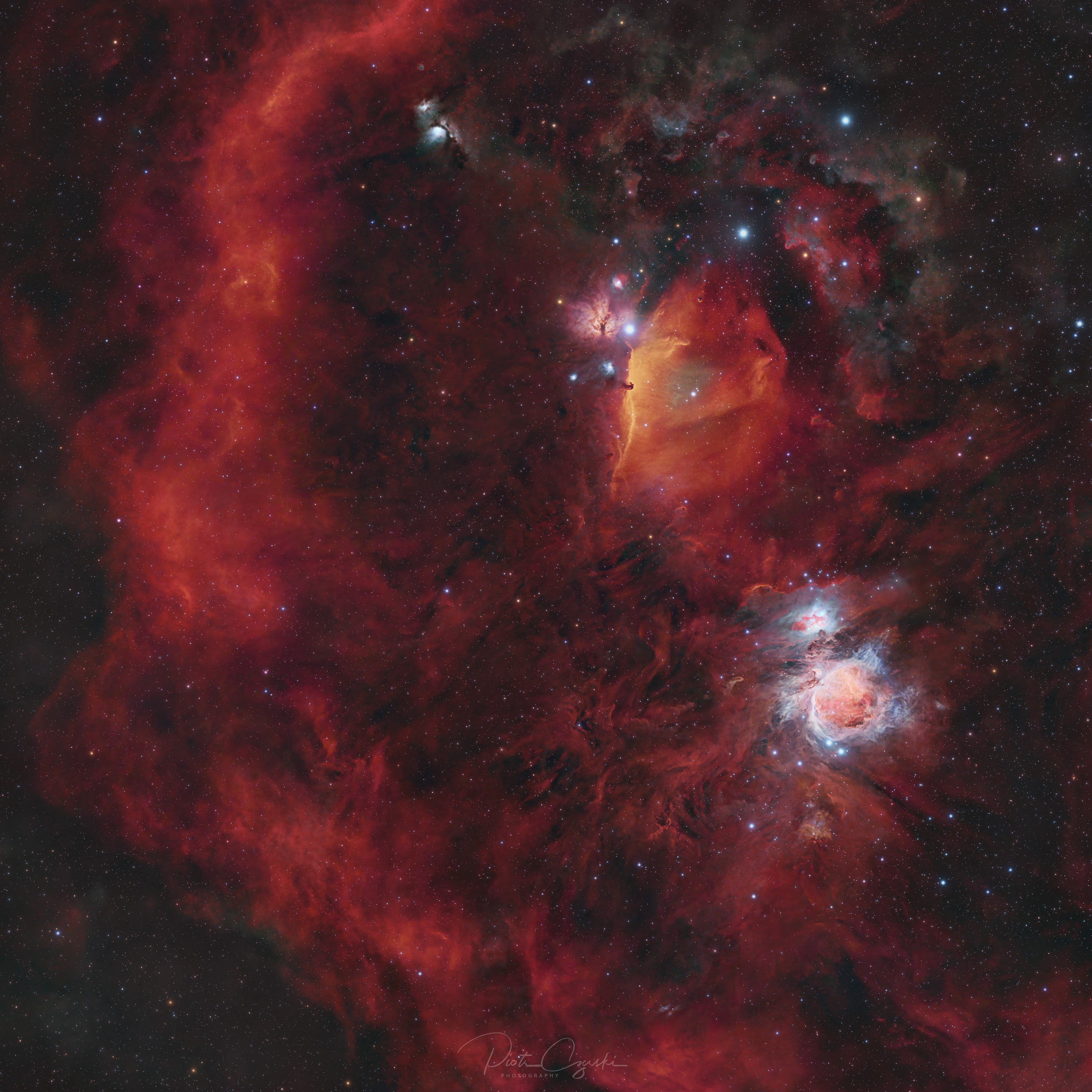
Cradled in red-glowing hydrogen gas, stars are being born in Orion. These stellar nurseries lie at the edge of the giant Orion molecular cloud complex, some 1,500 light-years away. This detailed view spans about 12 degrees across the center of the well-known constellation, with the Great Orion Nebula, the closest large star-forming region, visible toward the lower right. The deep mosaic also includes, near the top center, the Flame Nebula and the Horsehead Nebula. Image data acquired with a hydrogen-alpha filter adds other remarkable features to this wide-angle cosmic vista: pervasive tendrils of energized atomic hydrogen gas and portions of the surrounding Barnard's Loop. While the Orion Nebula and many stars in Orion are easy to see with the unaided eye, emission from the extensive interstellar gas is faint and much harder to record, even in telescopic views of the nebula-rich complex. Sky Surprise: What picture did APOD feature on your birthday? (after 1995)
Image credit: Piotr Czerski — APOD is a service of NASA and Michigan Tech. U.
View on NASA APODSpace News
NASA's IXPE mission captured new observations of the 2,000-year-old supernova RCW 86, providing complementary X-ray data that enhances understanding of this ancient cosmic explosion.
NASA — 24 Mar 2026
Artemis II rocket completed its second rollout to the launchpad at Kennedy Space Center, marking continued progress toward NASA's crewed lunar mission.
ESA — 20 Mar 2026
NASA astronaut Chris Williams completed spacesuit fit verification on the ISS, demonstrating ongoing preparations for upcoming spacewalks and extravehicular activities.
NASA — 20 Mar 2026
Explore the Three-Body Problem
Simulate chaotic gravitational dynamics with preset scenarios: circumbinary planets, Lagrange points, and the famous Figure-8 choreography. Switch between inertial and co-rotating frames.
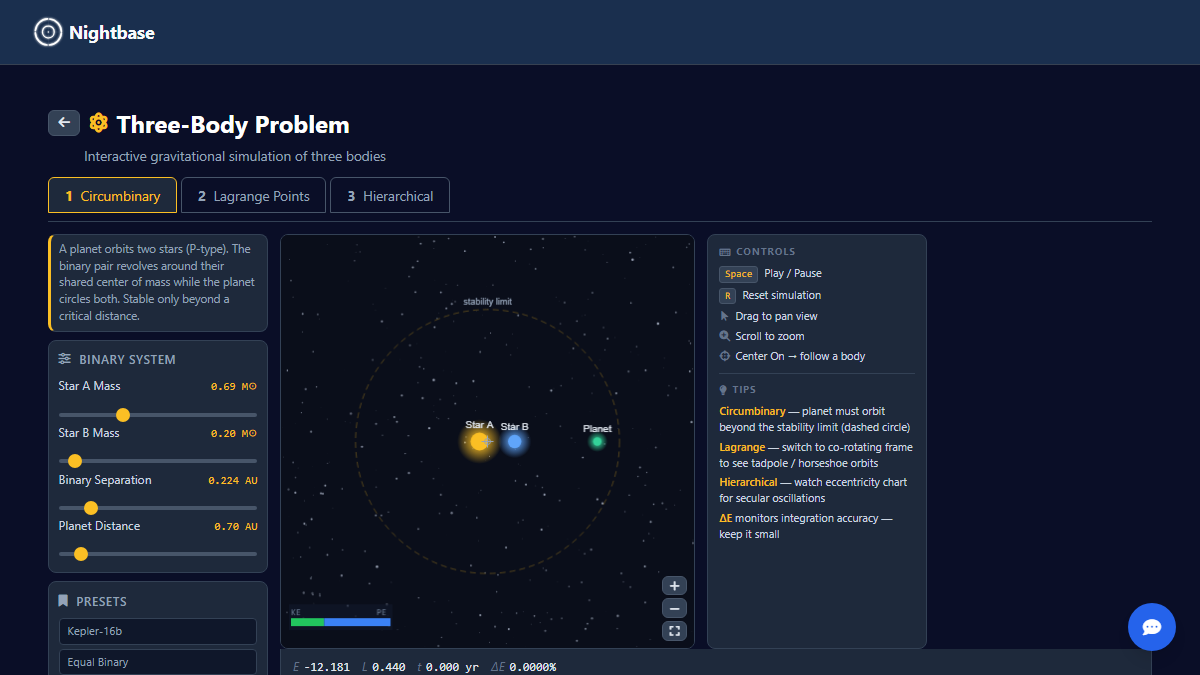 Open Three-Body
Sign in to get this digest by email and customize it for your location.