Sky Digest
Export Sky Digest PDF
Include finder charts for selected objects:
Tonight at a Glance
Planet Highlights
For Beginners (naked eye)
Binocular Targets
Small Scopes (3–6 inch)
Big Scopes (8–12 inch)
The Week Ahead
| Tue | Wed | Thu | Fri | Sat | Sun | Mon |
| 🌑 0% | 🌑 2% | 🌒 6% | 🌒 13% | 🌒 21% | 🌓 31% | 🌓 42% |
| — | — | — | — | — | — | — |
NASA Astronomy Picture of the Day
Tails of Comet Wierzchoś
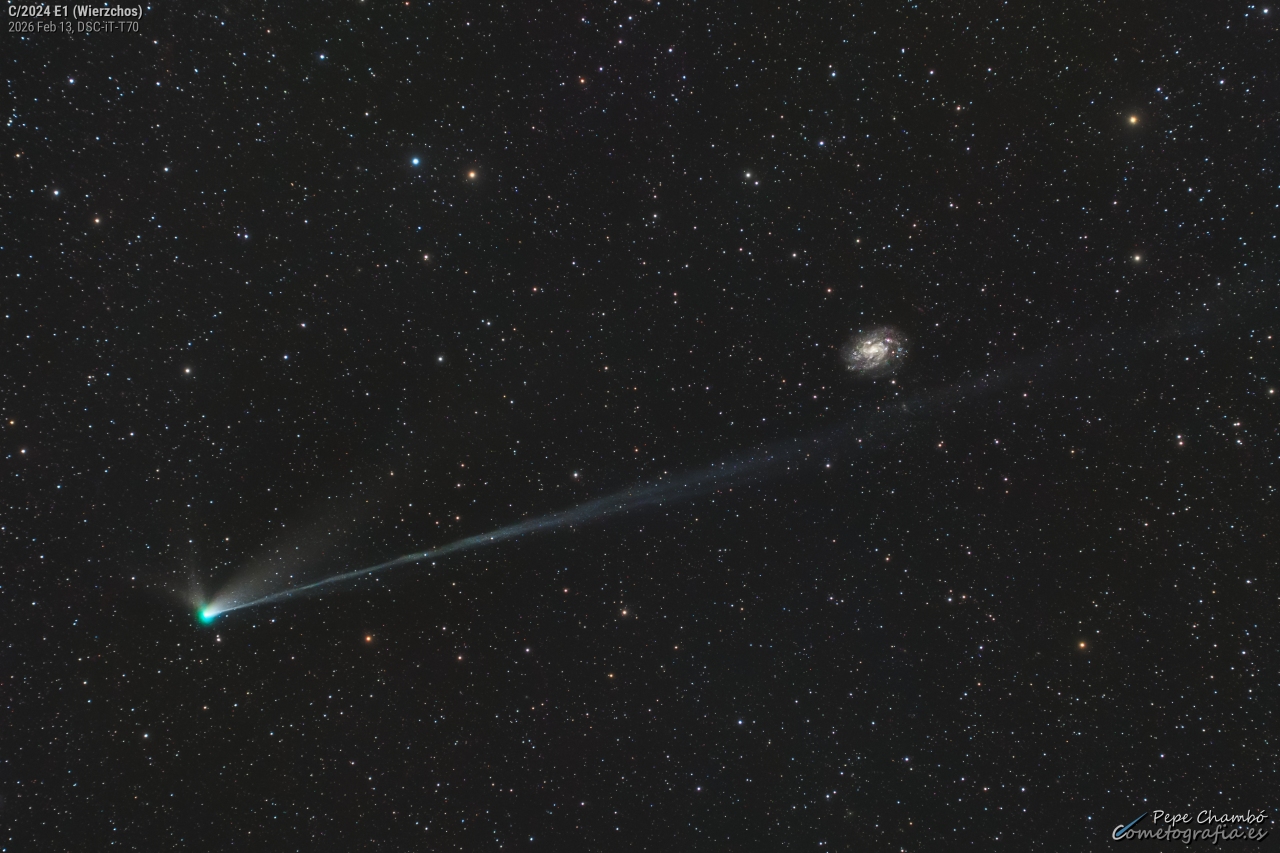
Some comets are regular guests of our solar neighborhood; others come by only once, never to return. We won’t have another chance to see Comet C/2024 E1 (Wierzchoś), which is currently making its way through the inner Solar System. The hyperbolic orbit of this comet indicates that it will likely become an interstellar traveler. Comet Wierzchoś is today near its closest approach to the Earth, passing roughly the same distance from the Earth as is the Sun. The featured 30-minute exposure was taken last week in Chile and shows a 5-degree long ion tail as well as three shorter dust tails. The green hue of the coma comes from the breakdown of dicarbon molecules by sunlight, but that process does not last long enough to also tinge the tails. On the far right lies a spiral galaxy far in the distance: NGC 300.
Image credit: José J. Chambó; Text: Cecilia Chirenti (NASA GSFC, UMCP, CRESST II) — APOD is a service of NASA and Michigan Tech. U.
View on NASA APODSpace News
NASA's James Webb and Hubble Space Telescopes have partnered to provide the most comprehensive view of Saturn to date, observing in complementary wavelengths to reveal new insights about the planet's atmosphere and rings.
NASA — 25 Mar 2026
The NASA-JAXA XRISM telescope has directly measured the speed of superheated gas from the galaxy M82 for the first time, advancing understanding of galactic winds and stellar activity.
NASA — 25 Mar 2026
The Artemis II rocket has completed its second rollout to the launchpad at Kennedy Space Center, marking progress toward the crewed lunar mission.
ESA — 20 Mar 2026
NASA's newest astronaut candidate class of ten explorers, selected in 2025 and currently training at Johnson Space Center, are preparing for future missions to the ISS and Moon.
NASA — 19 Mar 2026
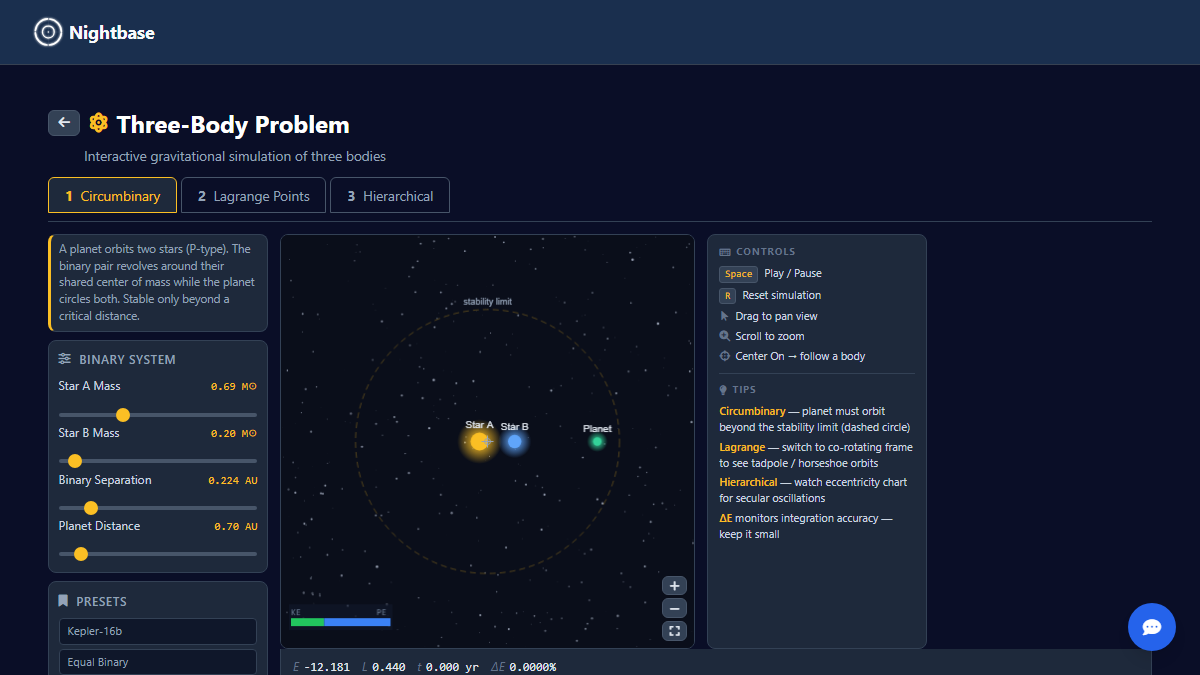
Explore the Three-Body Problem
Simulate chaotic gravitational dynamics with preset scenarios: circumbinary planets, Lagrange points, and the famous Figure-8 choreography. Switch between inertial and co-rotating frames.
 Open Three-Body
Sign in to get this digest by email and customize it for your location.