Sky Digest
Export Sky Digest PDF
Include finder charts for selected objects:
Tonight at a Glance
Planet Highlights
For Beginners (naked eye)
Binocular Targets
Small Scopes (3–6 inch)
Big Scopes (8–12 inch)
The Week Ahead
| Mon | Tue | Wed | Thu | Fri | Sat | Sun |
| 🌑 0% | 🌑 0% | 🌑 2% | 🌒 6% | 🌒 13% | 🌒 21% | 🌓 31% |
| — | — | — | — | — | — | — |
NASA Astronomy Picture of the Day
Unexplained Shocks Around a White Dwarf Star
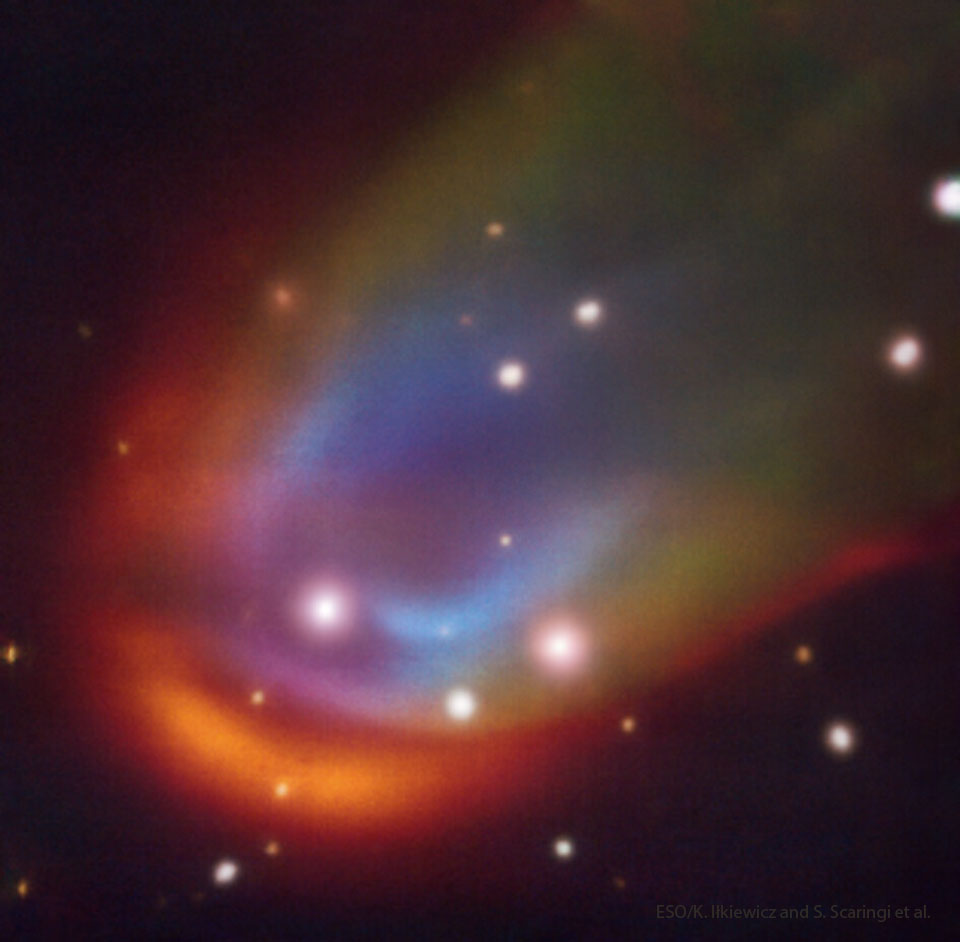
How is RXJ0528+2838 creating such shock waves? A recently discovered white dwarf star, the farther left of the two largest white spots, RXJ0528+2838, was found 730 light-years away from Earth. Most stars, when done fusing nuclei in their cores for energy, become red giant stars, the cores of which live on as faint dense white dwarfs that slowly cool down for the rest of time. White dwarfs are so dense that the only thing that stops them from collapsing further is quantum mechanics. In about 5 billion years, our Sun will become a white dwarf, too. The featured image, obtained with the European Southern Observatory’s Very Large Telescope, shows unexplained bow shocks around RXJ0528+2838, similar to the bow wave of water around a fast-moving ship. Astronomers don’t yet know what is powering these shocks, which have existed for at least 1,000 years. The red, green and blue colors represent trace amounts of glowing hydrogen, nitrogen and oxygen gas. Open Science: Browse 3,900+ codes in the Astrophysics Source Code Library
APOD is a service of NASA and Michigan Tech. U.
View on NASA APODSpace News
NASA's James Webb and Hubble Space Telescopes have jointly captured the most comprehensive view of Saturn to date, observing in complementary wavelengths to provide unprecedented understanding of the planet.
NASA — 25 Mar 2026
The NASA-JAXA XRISM Telescope has directly measured the speed of superheated gas from the galaxy M82's core for the first time, advancing understanding of galactic-scale stellar activity.
NASA — 25 Mar 2026
The Artemis II rocket has rolled back to its launchpad at Kennedy Space Center, marking a major milestone in preparation for the crewed lunar mission.
ESA — 20 Mar 2026
NASA's newest astronaut candidate class of ten explorers selected in 2025 is now training at Johnson Space Center for future ISS and lunar missions.
NASA — 19 Mar 2026
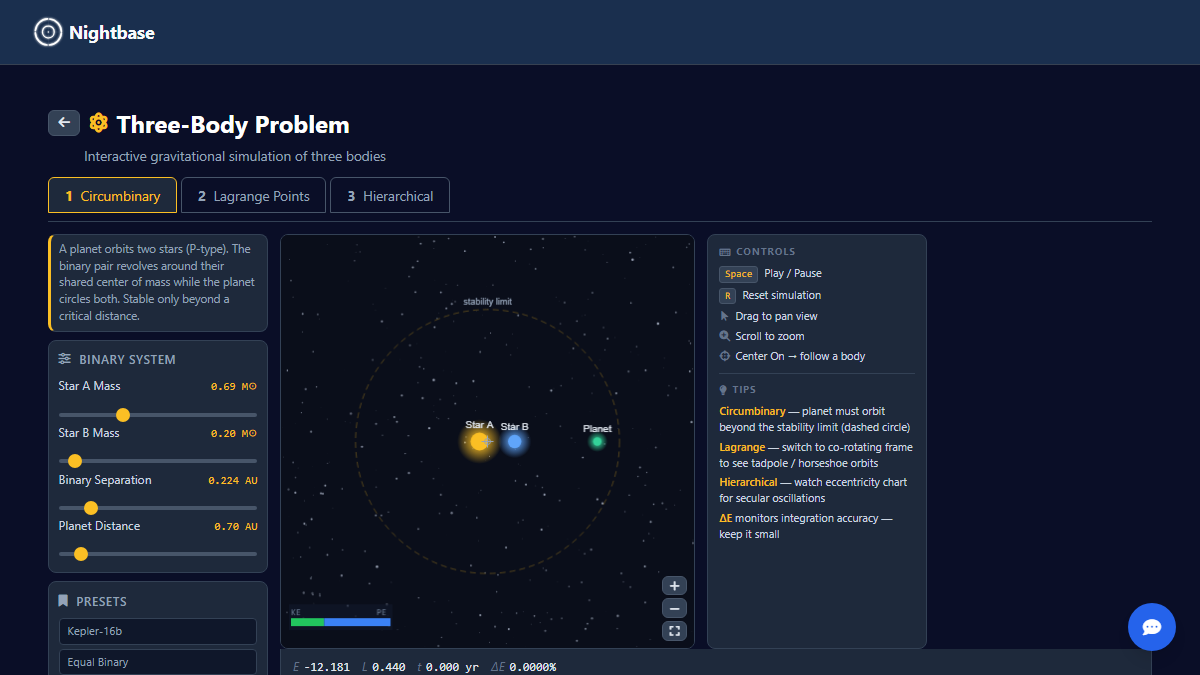
Explore the Three-Body Problem
Simulate chaotic gravitational dynamics with preset scenarios: circumbinary planets, Lagrange points, and the famous Figure-8 choreography. Switch between inertial and co-rotating frames.
 Open Three-Body
Sign in to get this digest by email and customize it for your location.