Sky Digest
Export Sky Digest PDF
Include finder charts for selected objects:
Tonight at a Glance
Aurora Forecast — Very unlikely
Geomagnetic activity far below the Kp 7 needed at your latitude.
View full forecastPlanet Highlights
For Beginners (naked eye)
Binocular Targets
Small Scopes (3–6 inch)
Big Scopes (8–12 inch)
The Week Ahead
| Mon | Tue | Wed | Thu | Fri | Sat | Sun |
| 🌓 42% | 🌔 54% | 🌔 65% | 🌔 75% | 🌔 84% | 🌔 92% | 🌔 97% |
| — | — | — | — | — | — | — |
| Moon occults Kappa Gem |
NASA Astronomy Picture of the Day
Pleiades: The Seven Sisters Star Cluster
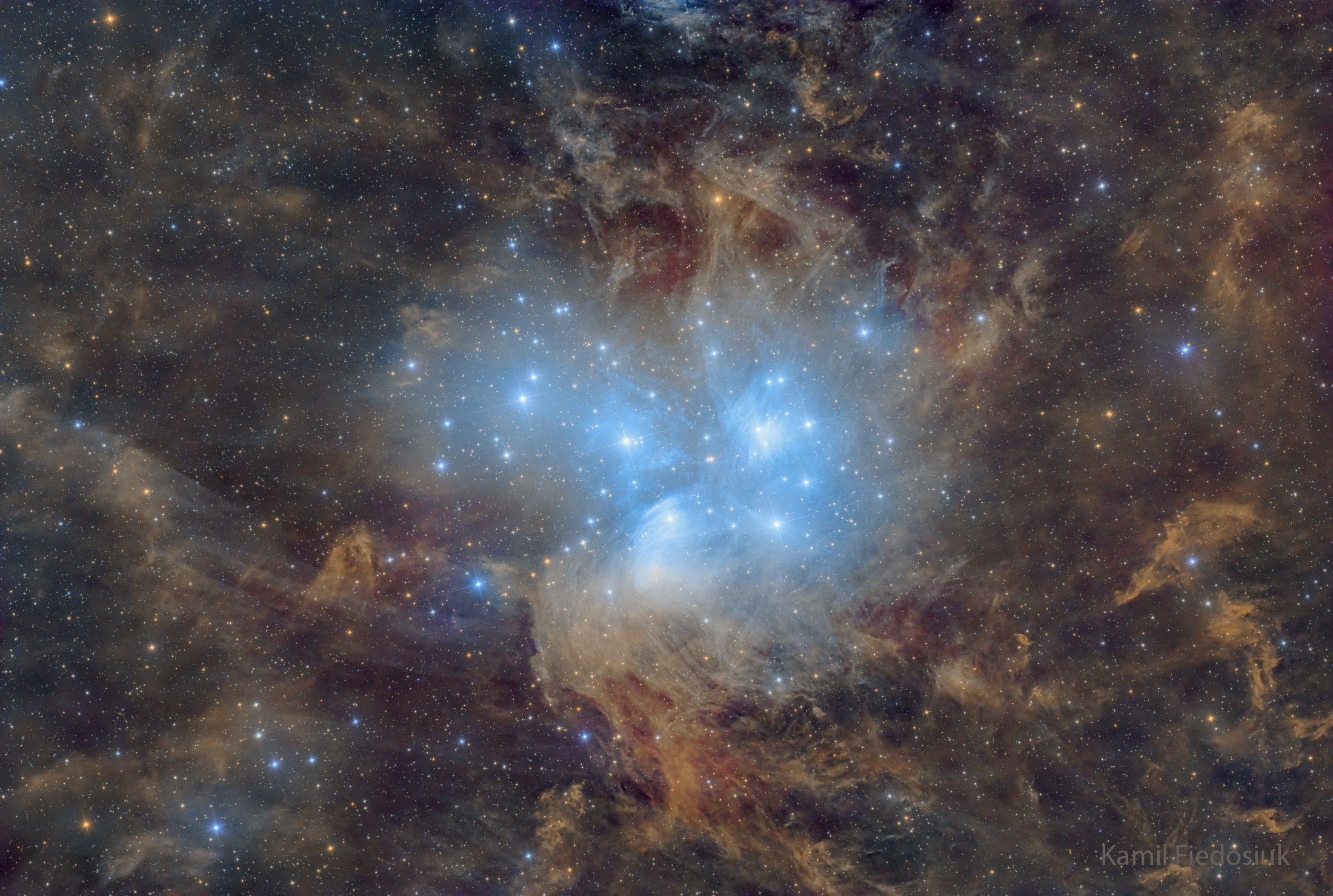
Have you ever seen the Pleiades star cluster? Even if you have, you probably have never seen it as large and clear as this. Perhaps the most famous star cluster on the sky, the bright stars of the Pleiades can be seen with the unaided eye even from the depths of a light-polluted city. With a long exposure from a dark location, though, the dust cloud surrounding the Pleiades star cluster becomes very evident. The featured 18-hour exposure, taken from Bory Tucholskie, Poland covers a sky area several times the size of the full moon. Also known as the Seven Sisters and M45, the Pleiades lies about 400 light years away toward the constellation of the Bull (Taurus). A common legend with a modern twist is that one of the brighter stars faded since the cluster was named, leaving only six of the sister stars visible to the unaided eye. The actual number of Pleiades stars visible, however, may be more or less than seven, depending on the darkness of the surrounding sky and the clarity of the observer's eyesight. Sky Surprise: What picture did APOD feature on your birthday? (after 1995)
Image credit: Kamil Fiedosiuk — APOD is a service of NASA and Michigan Tech. U.
View on NASA APODSpace News
Artemis II rocket rolled out to the launchpad at Kennedy Space Center, marking progress toward NASA's crewed lunar mission.
ESA — 20 Mar 2026
NASA will provide a water-detecting instrument for JAXA's Lunar Polar Exploration mission to hunt for ice at the Moon's south pole in support of future human exploration.
NASA — 24 Mar 2026
NASA's IXPE mission obtained new X-ray observations of the 2,000-year-old supernova RCW 86, providing new insights into this ancient cosmic event.
NASA — 24 Mar 2026
NASA astronaut Chris Williams completed a spacesuit fit verification on the International Space Station to ensure proper function for future spacewalks and missions.
NASA — 20 Mar 2026
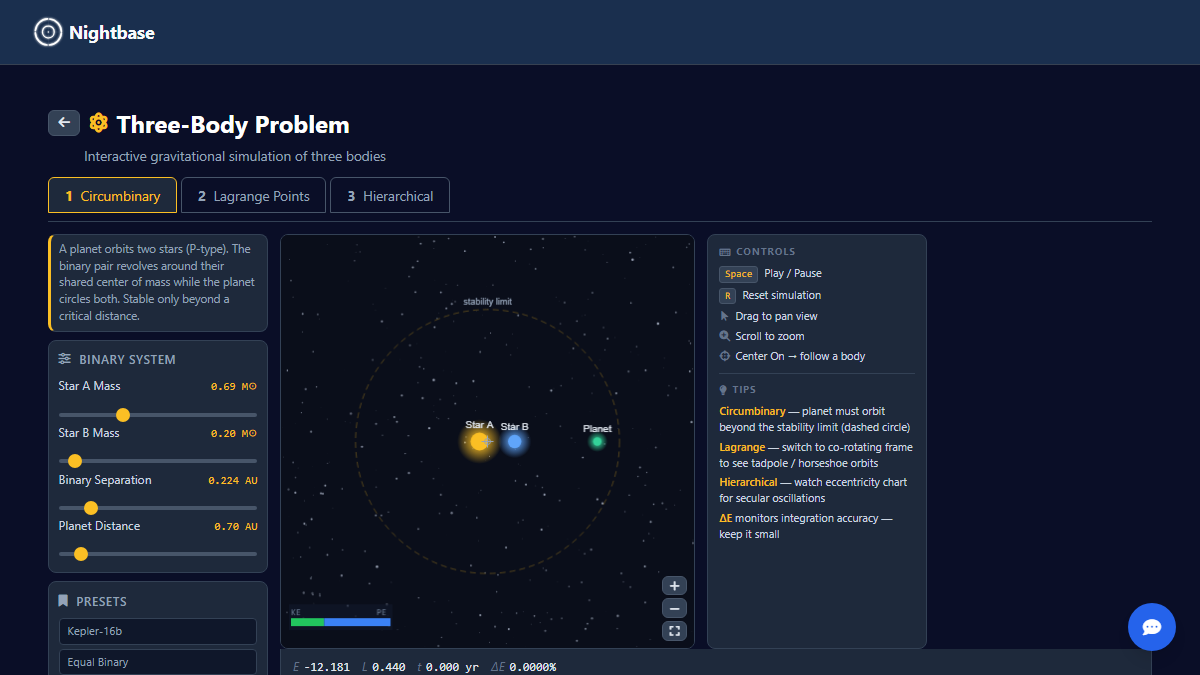
Explore the Three-Body Problem
Simulate chaotic gravitational dynamics with preset scenarios: circumbinary planets, Lagrange points, and the famous Figure-8 choreography. Switch between inertial and co-rotating frames.
 Open Three-Body
Sign in to get this digest by email and customize it for your location.