Sky Digest
Export Sky Digest PDF
Include finder charts for selected objects:
Tonight at a Glance
Bright moon tonight — best deep-sky viewing after moonset (03:13)
Planet Highlights
Comets
For Beginners (naked eye)
Binocular Targets
Small Scopes (3–6 inch)
Big Scopes (8–12 inch)
The Week Ahead
| Tue | Wed | Thu | Fri | Sat | Sun | Mon |
| 🌔 54% | 🌔 65% | 🌔 75% | 🌔 84% | 🌔 92% | 🌔 97% | 🌕 100% |
| — | — | — | — | — | — | — |
| Moon occults Kappa Gem |
NASA Astronomy Picture of the Day
Planet Parade over Sydney Opera House
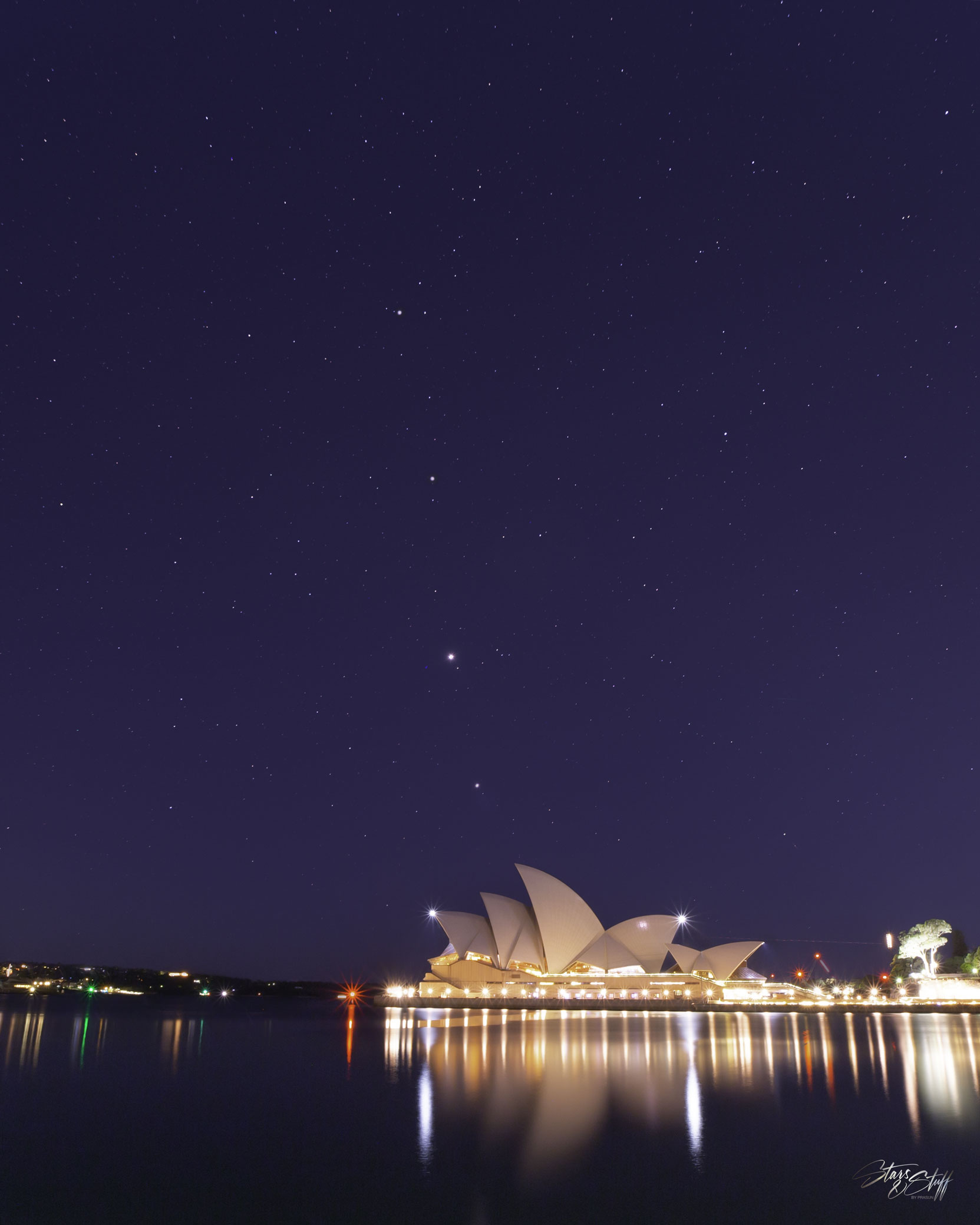
Look up this week and see a whole bunch of planets. Just after sunset, looking west (mostly), planets Mercury, Venus, Saturn, and Jupiter will all be visible to the unaided eye simultaneously. If you have a telescope, planets Uranus and Neptune can also be seen. In order up from the horizon, the lineup this week will be Venus (the brightest), Mercury, Saturn, Neptune, Uranus, and Jupiter (second brightest). It doesn't matter where on Earth you live because this early evening planet parade will be visible through clear skies all around the globe. The planets will appear to be nearly in a line because they all orbit the Sun in nearly the same plane: the ecliptic. The featured image shows a similar planet parade that occurred in 2022, captured over the Sydney Opera House in southern Australia. Although visible all week, the planets will be most easily seen together this weekend.
Image credit: Prasun Agrawal — APOD is a service of NASA and Michigan Tech. U.
View on NASA APODSpace News
NASA's X-59 experimental supersonic aircraft completed its second flight, marking the start of dozens of test flights planned for 2026 to validate quiet supersonic flight technology.
NASA — 20 Mar 2026
More than a dozen NASA science missions observed the interstellar comet 3I/ATLAS, only the third identified interstellar object, with observations now archived in NASA's public data system for future research.
NASA — 20 Mar 2026
Artemis II rocket returned to its launchpad at Kennedy Space Center after rollout, advancing preparations for the first crewed lunar mission under the Artemis program.
ESA — 20 Mar 2026
NASA used advanced simulations to optimize launch conditions for Artemis II by analyzing airflow effects on the rocket during ascent to space.
NASA — 20 Mar 2026
Kepler's Laws Come Alive
Drag velocity vectors to reshape orbits, watch equal areas sweep in equal times, and discover why distant planets orbit slower — all three laws animated in real time.
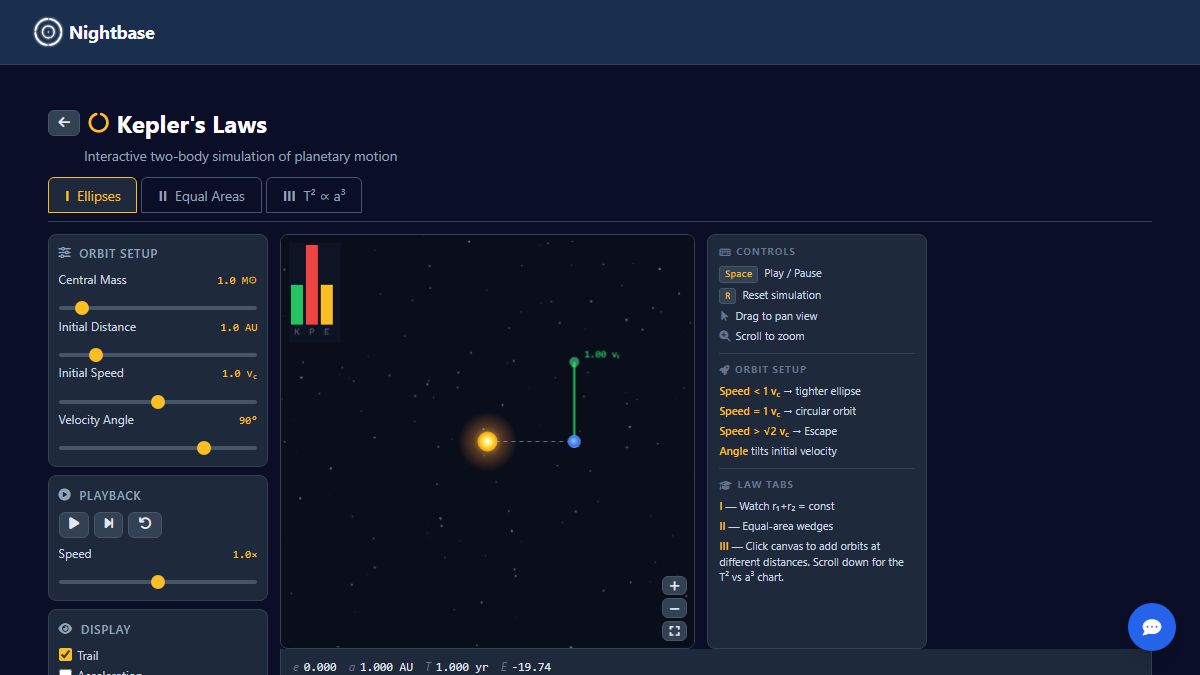 Open Kepler's Laws
Sign in to get this digest by email and customize it for your location.