Sky Digest
Export Sky Digest PDF
Include finder charts for selected objects:
Tonight at a Glance
Bright moon tonight — deep-sky viewing will be limited
Aurora Forecast — Very unlikely
Geomagnetic activity far below the Kp 7 needed at your latitude.
View full forecastPlanet Highlights
Comets
Moon occults Kappa Gem
Star mag 3.6, Moon illumination: 85%. Visible from parts of Earth only.
View on Star MapFor Beginners (naked eye)
Binocular Targets
Small Scopes (3–6 inch)
Big Scopes (8–12 inch)
The Week Ahead
| Fri | Sat | Sun | Mon | Tue | Wed | Thu |
| 🌔 84% | 🌔 92% | 🌔 97% | 🌕 100% | 🌕 100% | 🌕 98% | 🌖 94% |
| — | — | — | — | — | — | — |
| Moon occults Kappa Gem | Full Moon | Ursa Major Best Placed |
NASA Astronomy Picture of the Day
Sharpless 249 and the Jellyfish Nebula

Normally faint and elusive, the Jellyfish Nebula is caught in this alluring telescopic field of view. Floating in the interstellar sea, the nebula is anchored right and left by two bright stars, Mu and Eta Geminorum, at the foot of the celestial twins. The Jellyfish Nebula itself is right of center, seen as a brighter arcing ridge of emission with dangling tentacles. In fact, this cosmic jellyfish is part of bubble-shaped supernova remnant IC 443, the expanding debris cloud from a massive star that exploded. Light from the explosion first reached planet Earth over 30,000 years ago. Like its cousin in astrophysical waters the Crab Nebula supernova remnant, the Jellyfish Nebula is known to harbor a neutron star, the ultradense remnant of the collapsed stellar core. An emission nebula cataloged as Sharpless 249 fills the field at the upper left. The Jellyfish Nebula is about 5,000 light-years away. At that distance, this image would be about 300 light-years across.
Image credit: Katelyn Beecroft — APOD is a service of NASA and Michigan Tech. U.
View on NASA APODSpace News
NASA's X-59 experimental supersonic aircraft completed its second flight, initiating a series of dozens of test flights planned for 2026 to advance quiet supersonic flight technology.
NASA — 20 Mar 2026
Artemis II rocket completed its second rollout to the launchpad at Kennedy Space Center, marking progress toward NASA's crewed lunar mission.
ESA — 20 Mar 2026
NASA used advanced simulations to optimize launch conditions for Artemis II, improving understanding of airflow dynamics around rockets during ascent to space.
NASA — 20 Mar 2026
NASA's observations of the interstellar comet 3I/ATLAS, only the third identified interstellar object, will be preserved in public data archives for future scientific discoveries.
NASA — 20 Mar 2026
Kepler's Laws Come Alive
Drag velocity vectors to reshape orbits, watch equal areas sweep in equal times, and discover why distant planets orbit slower — all three laws animated in real time.
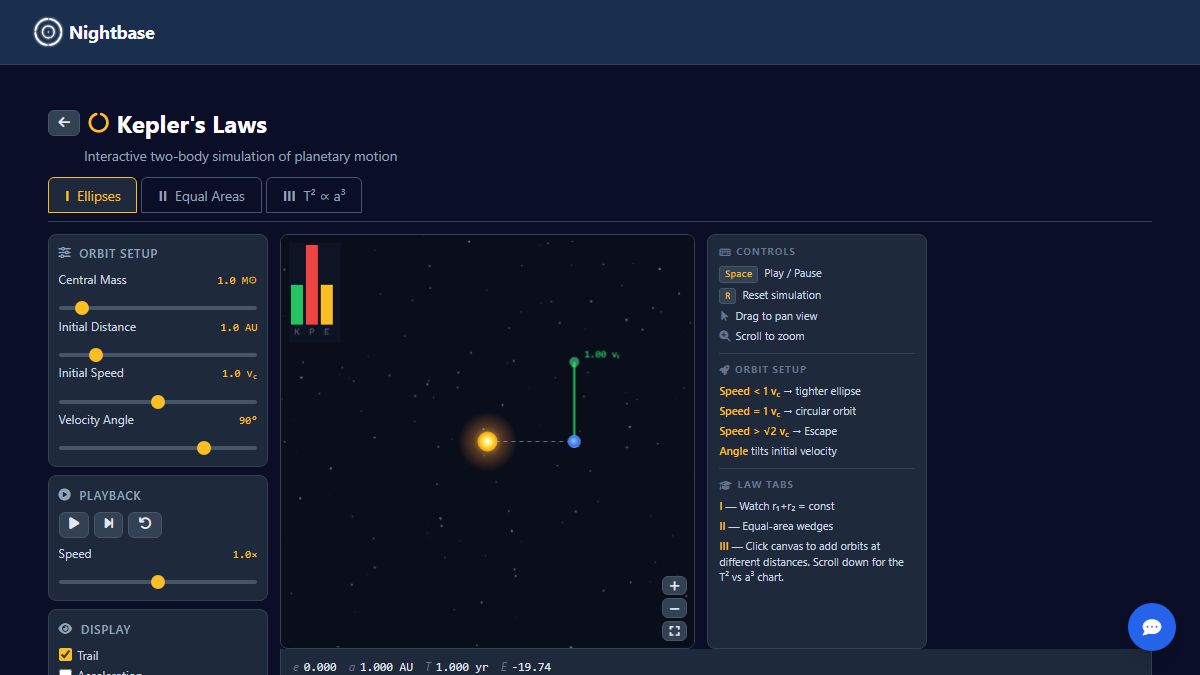 Open Kepler's Laws
Sign in to get this digest by email and customize it for your location.