Sky Digest
Export Sky Digest PDF
Include finder charts for selected objects:
Tonight at a Glance
Bright moon tonight — best deep-sky viewing after moonset (05:12)
Aurora Forecast — Very unlikely
Geomagnetic activity far below the Kp 7 needed at your latitude.
View full forecastPlanet Highlights
Comets
For Beginners (naked eye)
Binocular Targets
Small Scopes (3–6 inch)
Big Scopes (8–12 inch)
The Week Ahead
| Thu | Fri | Sat | Sun | Mon | Tue | Wed |
| 🌔 75% | 🌔 84% | 🌔 92% | 🌔 97% | 🌕 100% | 🌕 100% | 🌕 98% |
| — | — | — | — | — | — | — |
| Moon occults Kappa Gem | Full Moon |
NASA Astronomy Picture of the Day
Webb and Hubble: IC 5332
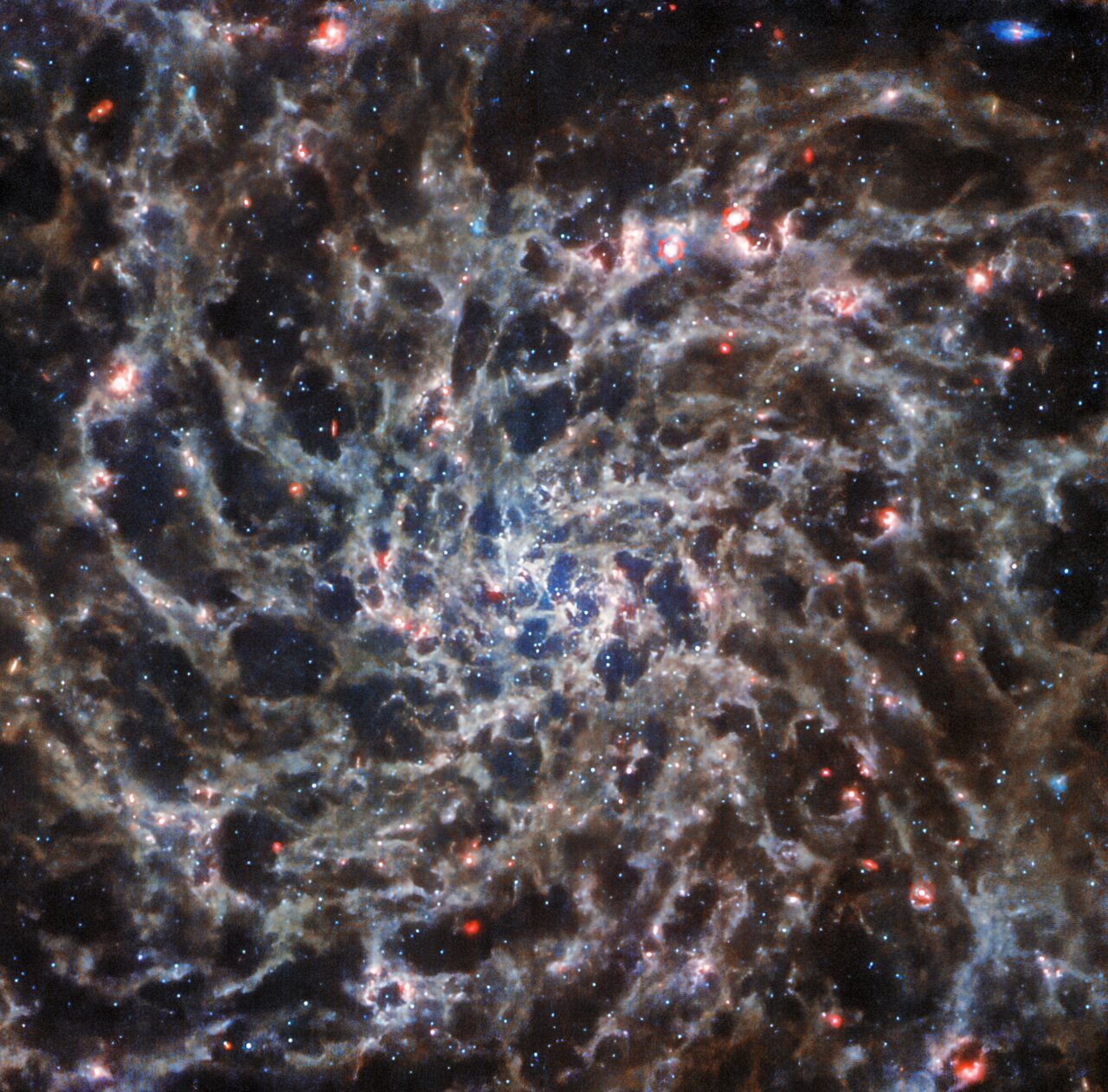
What does the universe look like through infrared goggles? Our eyes can only see visible light, but astronomers want to see more. Today’s APOD shows spiral galaxy IC 5332 as seen by two NASA telescopes: Webb in mid-infrared and Hubble in ultraviolet and visible light. To toggle between the two space-based views just slide your cursor over the image (or follow this link). The Hubble image highlights the spiral arms of the galaxy separated by dark regions, whereas the Webb image reveals a finer, more tangled structure. Interstellar dust scatters and absorbs light from the stars in the galaxy, causing the dark dust lanes in the Hubble image, and then emits heat in infrared light, so dust glows in this Webb image. The Mid-InfraRed Instrument on Webb needs to operate at a chilling temperature of -266ºC (or - 447ºF), otherwise it would detect infrared radiation from the telescope itself. Combining these observations, astronomers connect the “small scale” of gas and stars to the truly large scale of galactic structure and evolution.
APOD is a service of NASA and Michigan Tech. U.
View on NASA APODSpace News
NASA's X-59 experimental supersonic aircraft completed its second flight, beginning a series of dozens of test flights planned for 2026 to validate quiet supersonic flight technology.
NASA — 20 Mar 2026
Artemis II rocket rolled back to its launchpad at Kennedy Space Center, marking a key milestone in preparation for the crewed lunar test flight.
ESA — 20 Mar 2026
NASA conducted advanced simulations of airflow around rockets to optimize launch conditions for the Artemis II mission to the Moon.
NASA — 20 Mar 2026
More than a dozen NASA science missions observed the rare interstellar comet 3I/ATLAS, with data now available in NASA's public archives for future research.
NASA — 20 Mar 2026
Kepler's Laws Come Alive
Drag velocity vectors to reshape orbits, watch equal areas sweep in equal times, and discover why distant planets orbit slower — all three laws animated in real time.
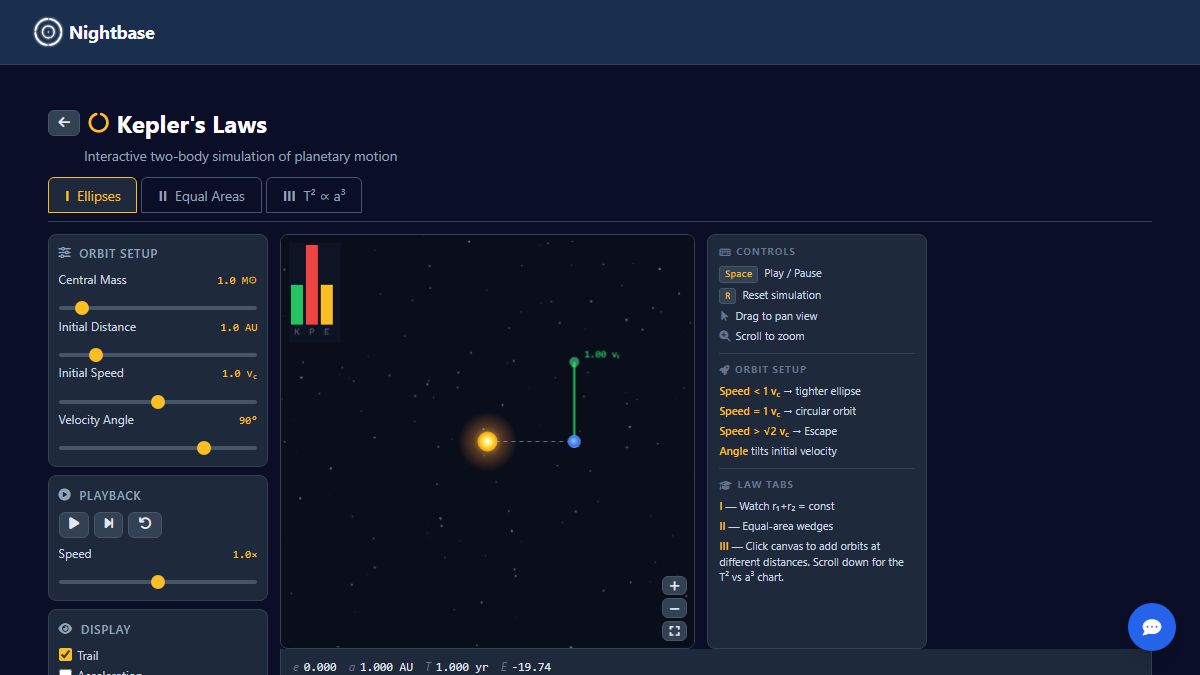 Open Kepler's Laws
Sign in to get this digest by email and customize it for your location.