Sky Digest
Export Sky Digest PDF
Include finder charts for selected objects:
Tonight at a Glance
Bright moon tonight — deep-sky viewing will be limited
Aurora Forecast — Very unlikely
Geomagnetic activity far below the Kp 7 needed at your latitude.
View full forecastPlanet Highlights
Comets
For Beginners (naked eye)
Binocular Targets
Small Scopes (3–6 inch)
Big Scopes (8–12 inch)
The Week Ahead
| Sun | Mon | Tue | Wed | Thu | Fri | Sat |
| 🌔 97% | 🌕 100% | 🌕 100% | 🌕 98% | 🌖 94% | 🌖 89% | 🌖 82% |
| — | — | — | — | — | — | — |
| Full Moon | Ursa Major Best Placed |
NASA Astronomy Picture of the Day
The Moon During a Total Lunar Eclipse
How does the Moon's appearance change during a total lunar eclipse? The featured time-lapse video was digitally processed to keep the Moon bright and centered during the 5-hour eclipse of 2018 January 31. At first the full moon is visible because only a full moon can undergo a lunar eclipse. Stars move by in the background because the Moon orbits the Earth during the eclipse. The circular shadow of the Earth is then seen moving across the Moon. The light blue hue of the shadow's edge is related to why Earth's sky is blue, while the deep red hue of the shadow's center is related to why the Sun appears red when near the horizon. Tomorrow night, people living in Eastern Asia, Australia, and much of North America may get to see a Total Blood Moon Lunar Eclipse. Here the term blood refers to the (likely) red color of a fully eclipsed Moon. Almost Hyperspace: Random APOD Generator
APOD is a service of NASA and Michigan Tech. U.
View on NASA APODSpace News
NASA used advanced simulations to optimize launch conditions for Artemis II, the first crewed lunar test flight, demonstrating critical preparations for the mission.
NASA — 20 Mar 2026
NASA's X-59 quiet supersonic aircraft completed its second test flight, advancing toward dozens of planned flights in 2026 to validate low-boom technology.
NASA — 20 Mar 2026
More than a dozen NASA missions observed the rare interstellar comet 3I/ATLAS before it leaves the solar system, with data now available in public archives for future research.
NASA — 20 Mar 2026
NASA's newest astronaut candidate class, the 'Platypi,' is training at Johnson Space Center for future missions to the ISS, Moon, and Mars.
NASA — 19 Mar 2026
Kepler's Laws Come Alive
Drag velocity vectors to reshape orbits, watch equal areas sweep in equal times, and discover why distant planets orbit slower — all three laws animated in real time.
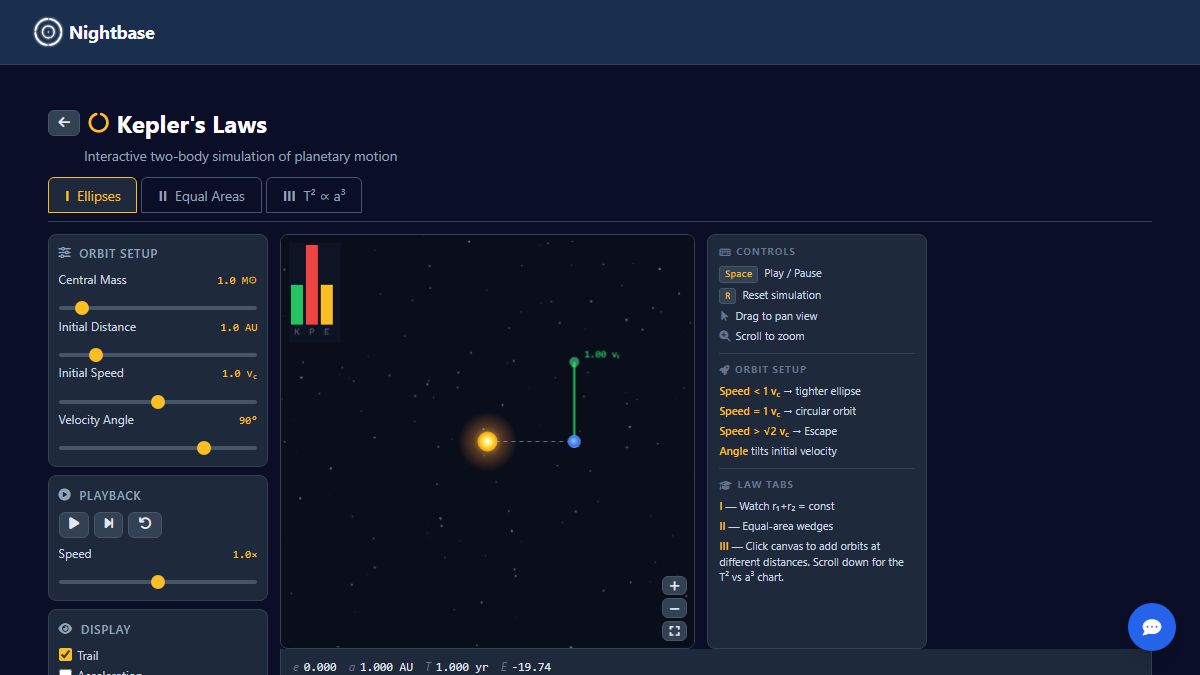 Open Kepler's Laws
Sign in to get this digest by email and customize it for your location.