Sky Digest
Export Sky Digest PDF
Include finder charts for selected objects:
Tonight at a Glance
Bright moon tonight — deep-sky viewing will be limited
Aurora Forecast — Unlikely
Need Kp 7+ (currently 6.3). Watch for geomagnetic storm upgrades.
View full forecastPlanet Highlights
For Beginners (naked eye)
Binocular Targets
Small Scopes (3–6 inch)
Big Scopes (8–12 inch)
The Week Ahead
| Mon | Tue | Wed | Thu | Fri | Sat | Sun |
| 🌕 100% | 🌕 100% | 🌕 98% | 🌖 94% | 🌖 89% | 🌖 82% | 🌖 74% |
| — | — | — | — | — | — | — |
| Full Moon | Ursa Major Best Placed |
NASA Astronomy Picture of the Day
The Dusty Surroundings of Orion and the Pleiades
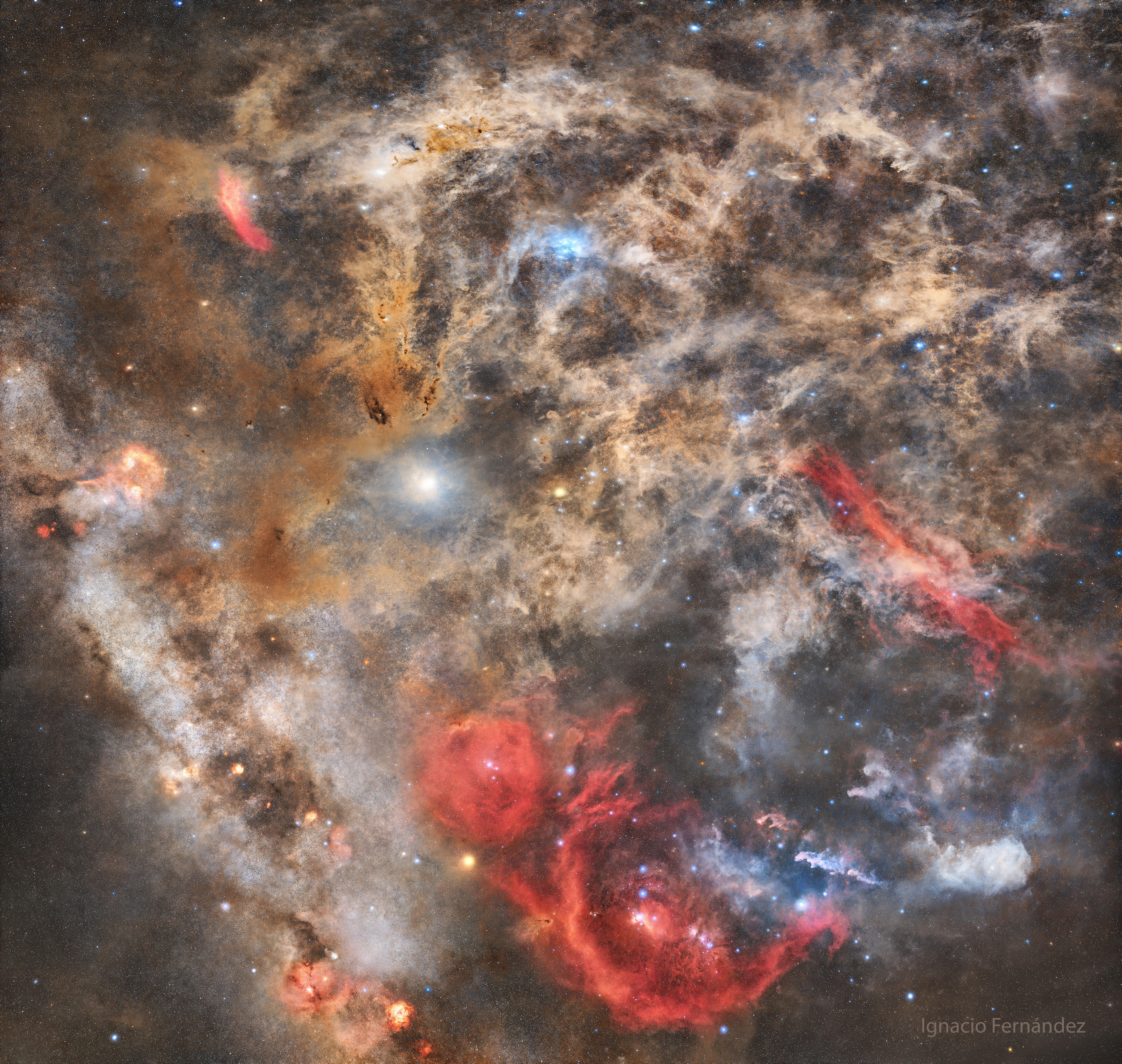
How well do you know the night sky? OK, but how well can you identify famous sky objects in a very deep image? Either way, here is a test: see if you can find some well-known night-sky icons in a deep image filled with filaments of normally faint dust and gas. This image contains the Pleiades star cluster, Barnard's Loop, Orion Nebula, Aldebaran, Betelgeuse, Witch Head Nebula, Eridanus Loop, and the California Nebula. To find their real locations, here is an annotated image version. The reason this task might be difficult is similar to the reason it is initially hard to identify familiar constellations in a very dark sky: the tapestry of our night sky has an extremely deep hidden complexity. The featured composite reveals some of this complexity in a 16 hours of sky exposure in dark skies over Granada, Spain. Tonight: Total Lunar Eclipse
Image credit: Ignacio Fernández — APOD is a service of NASA and Michigan Tech. U.
View on NASA APODSpace News
NASA used advanced simulations to optimize launch conditions for Artemis II, analyzing airflow effects on the rocket as it travels to space for this crucial crewed lunar test flight.
NASA — 20 Mar 2026
NASA's X-59 experimental supersonic aircraft completed its second flight, initiating a series of dozens of test flights planned for 2026 to demonstrate quiet supersonic flight technology.
NASA — 20 Mar 2026
More than a dozen NASA science missions observed the interstellar comet 3I/ATLAS before it leaves the solar system, with observations now available in NASA's public data archives for future discovery.
NASA — 20 Mar 2026
NASA's newest astronaut candidate class of ten explorers is currently training at Johnson Space Center for future missions to the ISS, Moon, and beyond.
NASA — 19 Mar 2026
Kepler's Laws Come Alive
Drag velocity vectors to reshape orbits, watch equal areas sweep in equal times, and discover why distant planets orbit slower — all three laws animated in real time.
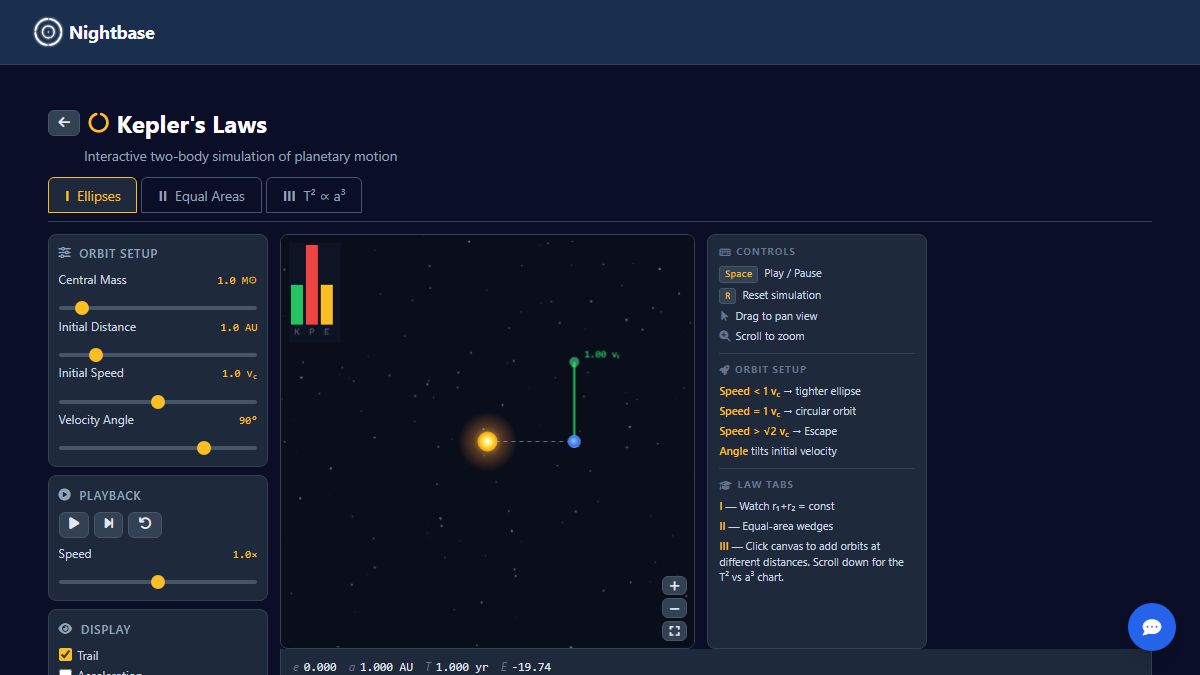 Open Kepler's Laws
Sign in to get this digest by email and customize it for your location.